Medical Spa MD: Physician community of skin clinics, laser centers, plastic surgeons, dermatologists and aesthetic doctors practicing nonsurgical cosmetic medicine.
Physicians, plastic surgeons, and dermatologists practicing nonsurgical cosmetic medicine in medical spas, laser clinics and aesthetic practices.
Take advantage of these insider secrets about buying (and selling) used cosmetic lases to make more informed buying decisions. Enter your name and best email below to make sure you don’t get burned.
Use this guide to narrow your search for the system that best suits your needs, allowing you to eliminate platforms and winnow the number of systems you’re looking at. Includes; Palomar, Syneron, Alma, Cutera, and Sciton.
Have you ever paid a commission for Botox and laser treatments? Although it’s very common ... it’s also very illegal.During the past several years, a very troubling trend has developed in the medical spa industry. Nurses, nurse practitioners, physician assistants and laser technicians are being paid by commission in order to incentivize them to bring new business into the spa. This is very lucrative for both the spa and the individual, but unfortunately, in most states, it is illegal.
However, by accepting commissions for Botox treatments, she was engaging in illegal fee-splitting. Not only could she face significant monetary sanctions if she continued to do so, but both she and her supervising physician risked immediate suspension or revocation of their licenses if the state learned she was taking commissions.Fee-splitting refers to dividing or sharing fees from medical services between a physician and a nonphysician. In most states, all fees generated for medical treatments must be paid directly to a physician or physician-owned corporation. No one other than the physician—including nurses, physician assistants or any nonphysician medical practitioners—may receive any share of a medical fee.
Although the prohibition against fee-splitting has been on the books in most states for years, the practice of paying commissions has become quite prevalent in the medical spa community. This is probably because, in medical spas, most medical directors do not want to spend time firing lasers or injecting since other services can be more lucrative. As a result, injections and laser treatments are delegated to other medical professionals, who, in turn, develop a large client base. An easy way to compensate those professionals is to pay commission.But the consequences for fee-splitting are severe. In most states, the state licensing board has the power to revoke, suspend or refuse to renew licenses in response to fee-splitting allegations. Accordingly, regardless of the monetary incentives, it is always advised to avoid paying or receiving commissions. A safe alternative to fee-splitting is to use a pre-set bonus structure—the nonphysician can still be rewarded for performance, but the bonus is not related to the number of treatments performed.
Recently, a client called me with an urgent concern. This client, a registered nurse in Chicago, worked in a medical spa as an injector and laser technician. She was well-compensated: In addition to an hourly salary, she was also given a commission—a percentage of net revenue—for every Botox and laser treatment she performed. And boy did this nurse perform—during the past 12 months, she personally had generated more than $350,000 in revenue for the spa.
Her concern arose from a conference she had recently attended where she learned that most states have laws prohibiting fee-splitting. She was informed that taking commissions on Botox and laser treatments might land her in hot water with the state nursing board. She explained that this didn’t make sense, given that she had been receiving commissions for years, and that the physicians who paid her surely wouldn’t risk their licenses by doing something illegal.
It is imperative for any medical spa professional to seek legal counsel immediately if being paid a commission for medical treatments. The laws of each state vary and are often difficult to find, but as is often the case, ignorance of the law is never an excuse.
The 2 main types of breast implants available for decades have been the saline filled an silicone gel filled breast implants. Each has its pros and cons.
Silicone gel implants have a more natural feel and look. Unlike silicone gel, implants containing only saline do not blend well with surrounding tissues at the edges of the implants. This is due to the chemical properties of salt water which is chemically charged as positive and negative charges that attract each other as opposed to silicone gel which does not carry a charge. Thus saline is more cohesive than silicone. What this means in clinical terms is that saline implant margins are more visible than silicone gel implant margins, especially when the soft tissue (breast gland and fat) between the outside world and the implant is thinner. Thus, in those patients with smaller breasts (less glandular tissue and/or fat) it is preferable to place saline implants under the chest muscle.
Saline implants may look very good when lying flat on a table. However, when upright the upper portion of the implant collapses (wrinkles or ripples) as the cohesive saline falls
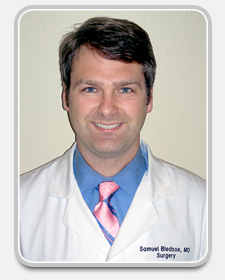
Guest post by Samuel Bledsoe MD
An interesting thing happened to me at work the other day. It was Friday afternoon, and I received a call from a primary care doctor. The phone call began with, “I’m really sorry about this, but I have a surgeon’s nightmare in my office.”
This is not a good way to begin a conversation.
He began to tell me about the patient. This particular woman had a Lap Band placed several years ago. For one reason or another, she decided that she would like this converted to a different procedure. She drove by my hospital to get to the airport, hopped on a plane and flew over hundreds of other well-qualified bariatric surgeons in order to reach a surgeon in Mexico where she had her Lap Band removed. She then returned 6 months later and had a sleeve gastrectomy. This is where things go bad.
Guest post by Craig Koniver MD
I know, I know, another social media platform is about all you need to read about these days. From Facebook to Twitter to Pinterest to Instagram to Foursquare, it always seems as if there is another "latest" and "greatest" social media platform to pay attention to. But, trust me when I say this, I think Google + is THE one to pay attention to. And here are some reasons why...
By Greg Bledsoe MD MPH
Over on Freelance MD, I've posted a couple of articles about taking responsibility for yourself and "building your own ship" , and we've also gone through a few common reasons why physicians aren't the best at career modification.
In this post, I'd like to spend a little time introducing you to the idea of "lifestyle design," something that has become a bit of a buzz-phrase in the business world but as far as I can tell hasn't penetrated the world of medicine just yet (for a lot of reasons).
I'll begin with a personal story...
When I jumped off the academic track in 2006, I wasn't exactly sure what I wanted to do as a career but I knew I wanted something unique. My idea was to design a career that was flexible, fun, adventurous, and meaningful, all the while paying my bills and being a responsible spouse and parent. Simple, huh?
I spent months thinking about how to do this as a physician. I searched websites and blogs. I spoke with mentors and colleagues. I read the literature, all to no avail. There seemed to be no conversation about a career like this in medicine. I mean, there were a few articles about volunteer opportunities or non-traditional careers, but nothing really like what I was trying to create.
By Craig Coniver, MD
Are you tweeting yet? Posting to your Facebook wall? How about connecting through LinkedIn? How big is your cirlce in Google+? With the onslaught of social media, there is mounting pressure to join each network, manage conections and monetize these various social media outlets. It seems as if social media has become the dominant measuring stick for how well you are doing as a business and how well you are connecting with others.
And while I think social media is something to be embraced, I do not think every outlet is for every person. Nor do I believe that social media serves as any type of barometer in your life (professional and personal). In fact, I think the more you are selective about where you garnish your social media energy and attention, the better you can use social media to your advantage.
Before I get to the specifics of the most popular social media outlets, I want you to come away from this article with one main point: social media presence does NOT equate to success. There is a lot of advice coming at us telling us to join all of the social media networks, trying to convince us that the only way to grow our business and connect with people is by creating these various outposts/hubs to connect with others.
The truth remains, however, that most of the time you can spend a lot of time and energy creating and maintaining these various social media outlets without actually realizing much results. And so while we embrace social media in medicine and beyond, we need to be cognizant as to the actual role of each social media outlet is providing for us. I think a better perspective is "what can I do for social media" not "what can social media do for me".
Let's review the major social media outlets. For each I will give you my personal experience and opinion:
A community of dermatologists, plastic surgeons, laser clinics, & skin clinics world wide.
Medical Spa MD is a community of physicians and clinicians practicing nonsurgical cosmetic medicine in laser clinics, medspas, dermatologist and plastic surgeon clinics worldwide.
Please read our Terms of Service, Advertising Terms and Privacy Policy.
Copyright © 2011. All rights reserved.
Protect your clinic and profits in 24 hours.
This Embezzlement & Employee Theft Scams training course gives you a practical roadmap to protect your clinic, your patients, your reputation, and your bank account.
Taking cash payments in the treatment room, stealing Botox and fillers to inject their own patients, ordering fraud, trading extra services for large tips, or stealing your client database to sell or use... This new course on beating embezzlement and employee theft schemes uncovers the hidden tactics behind how these scams work, and how to discover them before they kill your clinic.
Get This Free Training Academy Course