When Clients Demand a Refund: Free Webinar

Our friends over at Healthy Aging Magazine are hosting a free medical webinar that should be of great interest to our members.

What happens when a patient is not happy with service or the result and demands a refund? ADVANCE for Healthy Aging, a trade magazine for cosmetic medicine professionals, will be offering a medical webinar, called “Doctor, I want my money back.”

  • This free webinar takes place Wednesday, Jan. 19, 2011, 8:00-9:00 p.m. EST, with presenters Jeffrey Segal, MD, board certified neurosurgeon and CEO of Medical Justice; and Michael J. Sacopulos, partner with Sacopulos, Johnson & Sacupulos of Terre Haute, Ind. The Webinar will address how doctors can level the playing field; and when refunding makes sense and doesn’t. In addition, these presented will also discuss what to do with negative online reviews—that often come as a result of disgruntled patients.

Use the link below to register:

https://www1.gotomeeting.com/register/590756176

Is Productivity Evading Your Medical Spa?

Does your medical spa or office run like a hamster on a wheel?  Is your payroll increasing but your revenues are declining?

The definition of "Productive" according to Webster’s is:

1: having the quality or power of producing, especially in abundance

2: effective in bringing about

3: yielding or furnishing results, benefits or profits

To expand a bit on Webster, we can define "productivity" as using the energy of people to create better ideas, better products and better working conditions - all leading to abundance for the people involved.

To improve existing productivity means removing existing barriers and energy-wasters that drain valuable resources (like people, money, focus) away from the production of better ideas, products and work environment.

Increasing productivity in your medical spa, clinic or office means being able to get better results without more staff, more resources, more cost, or more energy. So this means learning how to do the work so that less energy is required to produce the same results, producing higher results using the same amount of energy. The result is abundance for the whole team, happier patients and less staff turnover.

The start of every workday can often be overwhelming. You are likely to come into an office with an overflowing email inbox, endless lists of messages on the voicemail, messages from coworkers, to-do lists from your last meeting, as well as the every day tasks that were not completed from previous day or week.  Lastly, you are likely to have a line of impatient people waiting to speak with you throughout the day.

Using a set of disciplined skills can help you get the “stuff that matters most” done first. 

1. Communication

One of the most important skills in any business is effective communication. When you are communicating with staff and clients, make sure that all your instructions and information is crystal clear. Simply repeating the same request in different words at the end of a conversation can mean the difference between getting the report you want and the one that your staff thought you wanted.  Always check for understanding.

With communication, clarity is the number one objective. You may have a degree in English, but the person you are communicating probably doesn’t.  Keep the language you use simple and you increase your chances of being understood.

2. Planning

With larger projects, plan the entire project at the beginning. Let’s say you are remodeling your office to add space for 2 more cosmetic dermatologists – a daunting task for sure.  Break it down into smaller steps and assign a date by which each step should be completed. Delegate any of the project that can be done by someone else, but keep it closely supervised as to who is doing what and when you need it completed by. Once you have planned how you will do the project, you will find it much easier to dive in and get started.  Ask for frequent updates from anyone working on the project.

3. Procrastination

For many people, this is the biggest time thief of all! The most vital thing you need to do is to acknowledge that you are guilty of procrastination, and then identify the tasks you tend to put off as long as possible. Once you know which things you are likely to procrastinate about, consider why it is you don’t want to do them. Perhaps they are too large, too boring, or just seem like a waste of your time. By identifying the reasoning behind your procrastination issues, you can find solutions, such as breaking larger projects down into smaller pieces (see planning above), scheduling the boring tasks for first thing in the morning so they are done, and delegating (see delegation below) any tasks that are so routine they feel like a waste of your time. Eliminate procrastination from your working day and see how much more you can accomplish in your day.

4. Prioritizing

Jumping around from one project to another, not feeling as if you have accomplished anything each day or constantly rushing to finish on deadlines is a sign that you need to reorganize how you approach your task scheduling and work prioritizing strategy.

Each morning go through your in box and prioritize its contents. Once you know what has to be done, how urgently it is needed, and how long it is likely to take to complete, add the tasks in order of importance to your work schedule for the day. 

At the end of each month take a look at the projects that are known for the month ahead and start to schedule when you might start working on these so that you start the month already thinking about what needs to be done.

5. Delegation

If you have a staff or team, delegate some of your routine tasks right away.  Every front desk receptionist has slow times; a perfect time for you to delegate.  This will leave you open to handle the more high-level tasks.  We can tend to gravitate to “what is easy or comfortable”, but it’s important to push as much down to your team as possible. It let’s them grow in their jobs and allow you the freedom and time to be creative, grow your client base and earn more money.

Making these changes won’t happen overnight, but whether you are running an office or a med spa – increasing productivity will typically lead to decreasing cost and a happier bottom line.

Using The Art Of Persuasion On Your Website

Is your medical spa's website causing potential patients to make the kind of decisions you want them to make?

Think about the last 10 decisions you have made.  How did you come to your decisions? 

You probably made a mental note of the pros and cons, factored in your intuition along with some sound logic and came up with an intelligent decision. You probably understand that most people aren’t as strong and smart as you and therefore are easy targets to sway. But, that never happens to you. You are just too smart.

You just made your first mistake. You experienced something called the “fundamental attribution error”.  This is the belief that other people’s behavior is solely based on their personality, rather than external factors. For example, “Mary is late because she doesn’t care if others have to wait for her” verses “Mary is late because she must have had car trouble”.

These types of biases are very common and play a big role in the way decisions are made. So of course web designers are using this information to influence the behavior of users.  Some designers intuitively know what techniques to use to achieve this, but they may not be able to tell you exactly “why” it works. However, there are some very skilled “decision architects” that understand the psychological behavior and intentionally design web sites with the goal of shaping a visitors decision process and guiding them into a specific action.

There are 7 main components in the decision architect’s toolbox:  Authority, Commitment, Scarcity, Salience, Reciprocation, Framing and Social Proof.

#1 Authority: 

This principle is about influencing behavior via credibility. This is why you will see a lot of name-dropping, used to give the reader confidence that this information is valuable and credible. The MD or DO afer your name is a prime example.

Readers are more likely to believe information if it is written by an “expert” in the field.  In turn, they are more likely to act (buy) as a result of this information.

Decision architects exploit this principle by listing rave reviews and testimonials on their site. Patient testimonials are a common example that a lot of medical spas use. E-commerce sites show highly visible icons assuring the user that the site is secure.  Forums are another way to use authority.  People have the opportunity to rate their peers and users might rely on those ratings as if they were from an expert.

#2 Commitment:

This principle is about taking a stand on an issue that is consistent with our own beliefs. When you take a stand on something that is visible to other people, you usually feel a drive to maintain that point of view to appear credible and consistent.

Designers use this principle by asking for a small, but visible, commitment from you. If they can get you to behave in a certain way, you’ll soon start believing it. An example of this is Facebook.  If a group page can get you to “like” their page and it appears on your newsfeed, you are basically recommending this to all your friends.  If you can get a patient to “like” your medical spa fan page, you have “publicly committed” to being your fan.

#3 Scarcity:

This principle takes me back to some of the manufactured product scarcity around Botox and filler injections. The newspapers or press (or even a local doc) runs the headline “Botox shortage” and there are immediately lines around every block of people wanting to be seen. (Of course there is no Botox shortage and never will be.)

People are more likely to want something if they think it is in short supply or more valuable than it actually is. For example, psychologists have reported that if you give people a cookie from a jar, they rate the cookie as more delicious if it comes from a jar with only 3 cookies list verses a jar with 10 cookies. A nice fact and part of the reason that Fifth Avenue shoe stores put their shoes on pedistals in almost empty stores.

Decision architects exploit this by showing scarcity of a product. This could include limited treatment times or any number of 'act now' specials in your clinic. Smart medical spas understand that perceived scarcity will generate demand.

Another example of this might be a Grand Opening sale. How many medical spas keep that sign up for months and months, hoping that new customers will take advantage of the “special” price?

#4 Salience:

People are more likely to pay attention to details in your user interface that are unique such as a colored “continue shopping” button.  For example, there are certain times during a purchase when consumers are more likely to investigate a special offer. Being able to understand this gives you an opportunity to sell more products or services by offering them at just the right time in the buying cycle.

#5 Reciprocation:

Do you like to return favors?  Most people do and it’s this psychology that is the basis for this principle.  If someone helps you paint your house or babysit your kids, you feel obligated to help them at a future date.

Decision architects know that if they offer you a small gift – a free newsletter, consultation, seminar, or a sample chapter from a book – you are very likely to do something for them in return, even if it's only positive word of mouth. At first they may not ask you to buy something. They may start by asking you to comment on their blog or link to a website.  They know that it usually take several contacts with a user to make them an actual “customer”. 

#6 Framing:

Savvy decision architects know that we like making choices. It makes up feel in control of our destiny.  So, if we are given a choice of 3 tiers of products, you can be assured that there is one of them that they are pointing you towards whether you realize it or not. Another example of framing is the medical spa doc who shows you the most expensive 'total makeover' package knowing you can’t afford it.  Then the next 'best bang for the buck treatments' seem like a real bargain in comparison!

#7 Social Proof:

Have you ever gone to lunch with a group of friends?  Have you ever watched as everyone orders and then base your decision on their choices? 

A great example of Social Proof is shopping on Amazon. When you buy a certain product, say a digital camera, Amazon will then post a note to you saying “other people who bought this camera bought this case and memory card”. Well, if other people bought them, you certainly should as well!

A medical spa example is a 'recommended treatment' for a patients age issue or skin type. A good decision architect will have the 'most patients like' add-on already checked. The client thinks, “I guess everyone buys this so I should too”. 

So back to my original question: How do your medical spas patients come to their decisions?  Maybe now you can see that their decisions can be 'helped along'! Smart medical spas help patients make the 'right' decision.

Making Things Happen in 2011

How many New Year’s resolutions do you actually keep past the month of January?

How many ideas do you dismiss because there isn’t enough time.  If you are like most of us, “getting more done” is on your list of things to improve in the New Year.  Here are great tips from some of the top idea executors out there to help you transform that idea in your head into a reality.

1. Walk before you run.  Great ideas usually start as big, blue- sky concepts in our head.  The downside to this is that you may not know how or where to start executing.  Break your big idea into small, actionable chunks that will move you past the “dreaming” stage.  Once you get some initial feedback on your “small” steps, you will feel more confident taking the bigger steps.

2. Find the courage to move.  What separates the entrepreneurs and creative professionals from the rest is an innate desire to move forward.  Yes, planning is crucial, but don’t fall into analysis paralysis.  As soon as you take that first step (applying for a patent, designing a prototype), your momentum will grow.  You must challenge yourself to take action sooner rather than later.   

3. Try, try and try again.  Even the best idea can suck the first time it’s prototyped.  Trial and error is a must in the creative process.  The important thing is to learn, refine, study and create a new-and-improved version. Rather than getting discouraged by your “failures,” just keep moving.  Then build a new prototype. Then do it again. And then one more time if needed until you get it right. 

4. Create a routine and stick to it. Part of being able to work on your project a little bit each day is carving out the time to do so. Routines can seem monotonous and uninspiring, but they actually form a strong foundation for creating true insight. 

5. Create simple objectives and review them frequently.  Working on complicated projects can make it difficult to remain focused on the goal.  Lots of new ideas enter the scene and the project’s scope can grow out of control.  This phenomenon, called “scope creep” can make it impossible to ever complete anything. The best way to avoid it is to write down a simple goals that summarize your objective at the start of each project. Read it regularly and ask yourself if you are still focused on the original goal.

6. Avoid “out of sight, out of mind”.  Whether you are writing a book, developing a new medical instrument or just learning a new skill, it is imperative that you maintain momentum.  It’s like exercise; the more you do it, the easier it becomes.  The same thing applies to your brain.  Just as when you run everyday, the exercise gets easier and easier, the same thing happens with your brain. As Jack Cheng argues in a great blog post, “Thirty Minutes A Day”: “the important thing isn’t how much you do; it’s how often you do it.”                                               

7. Say “no” more often. Be selfish with your energy. 

Creative energy is not infinite. Seasoned idea-makers know that they must guard their energy – and their focus – closely. Take author Jim Collins for example. His books Built to Last and Good to Great have sold millions of copies. His business acumen and insights are in demand. Yet, “even though Collins demands over $60,000 per speech, he gives fewer than 18 per year.” More than that and Collins wouldn’t have enough time to focus on the research and writing that yield those bestselling books. The ability to say “no” is an essential part of the productivity process.

The tips here should only be followed as long as they are actually working. If moving forward seems impossible, then take a walk, call a friend, visit a museum. Make sure you occasionally shake up your established routine. New perspective is gained and helps recharge us to keep moving forward.

What Are You Worth As A Physician

By Arlen Meyers MD

You're a physician but what are you worth as a business asset? Here are 3 Ways to determine your price.

One of the key decisions every seller has to  make , whether it's a house, a business or any other asset for sale, is to detemine its value and price. I'm married to a residential real estate broker, one of the dwindling few left standing, it seems, in a business that's been in a tailspin for the last 3 years. Consequently, I hear lots of stories about how much people want for their houses and how they make the decision. Typically, sellers overprice, figuring that the largest drop in housing prices in 30 years does not apply to them, that they are entitled to recover every cent they spent on their gourmet kitchen renovation, and they need to build in some wiggle room in the price anyway since they know they will have to negotiate some away later. Then, of course, there is dreaded realtor's commission to factor into the equation.

When it comes to selling a business, there are three basic ways to value it.

The first approach is known as the Asset Based Approach. This approach derives an indication of value based on the costs to replace the tangible assets in depreciated or replacement cost condition. Some businesses for sale are generating negligible cash, so the assets are the only thing that has value. True, intangible assets, like intellectual property, and future market growth might have value, but let's keep this simple for now.

The Market Approach
derives indications of value using ratios or factors derived from the earnings, sales and/or assets of past transactions of similar businesses. This approach is like getting comparables for house, asking what a similar house in a similar location has sold for in the recent past. In the case of businesses, the value is determined by comparing it to the selling prices of similar businesses.
 
The Income Approach derives indications of value by converting some level of earnings into a value using a capitalization rate, discount rate or multiple. There are several ways to calculate this net present value, but basically it has to do with using historical revenue numbers and applying a discount rate to determine the value of the revenue streams.

http://www.score.org/article_business_valuation.html

If you are considering branching out from your medical practice or leaving it all together, suppose you were to apply the same technique to valuing yourself?

Using the asset method, the monetary value of the chemicals and proteins in the human body is $4.50.

http://www.savingadvice.com/forums/everything-else/22337-how-much-your-body-worth.html

Using the comparables method, you are probably worth what most others who do what you do are worth. The average salary of a realtor, for example,  is about $45K and it is all commission based. But, don't tell that to all the ex-realtors trading resumes at Starbucks or Ms. Bigbucks still selling the occaisional multi-million McMansion.

Using the NPV method, you are worth the discounted net present value of the future cash flows you can generate compared to what you make doing what you are doing now.

Inevitably, despite the self-actualization talk, docs and  their families want to know how much they'd be worth if Mommy or Daddy did something different. Go figure.

About: Arlen Meyers MD MBA is the cofounder, and Chief Medical Officer of MedVoy, a medical tourism company. He is also a Professor of Otolaryngology, Dentistry and Engineering at the University of Colorado at Denver and CEO and President of the Society of Physician Entrepreneurs. He blogs at Freelance MD

Submit a guest post and be heard.

Your Medical Spa + Groupon

Does it make sense to promote your medical spa with Groupon?

Groupon is a “daily coupon” website. It’s basically an email list that charges advertisers to send out their “coupons” called Groupons.

Many small businesses I’d likely never hear about otherwise send me their coupons this way. I receive them mainly to see what’s up… because the city I receive them from is 2 hours away, I don’t expect to take advantage of them.

I've noticed that for the most part, these are not large mainstream businesses. They are small businesses – spas, bakeries, etc. that likely don’t have large advertising budgets and think that Groupon is a great way to drive traffic without spending marketing dollars.

At Groupon, they have an email list of over ten million people and if you contact Groupon to be included on their “deal-of-the-day”, you can get the word out about your medical spa to thousands of people you would otherwise never be able to reach.

There are usually huge discounts involved (50% or more) to incentivize buyers and the general idea is that by offering a big discount on your products or services, people will try out your offerings and keep coming back for more. On the surface, it sounds like a great way to market your business and I was really excited about the idea until I thought about it some more and did some analysis. While Groupon might work for a small subset of local businesses, here’s why I don’t think Groupon is a good fit for the majority of medical spas out there.

Using Groupon will cost your medical spa an arm and a Leg... and another arm.

You might have read some Groupon horror stories already, but the reality is that Groupon is extremely expensive for a business. If you look at their faq, they give off the impression that running a Groupon campaign is free. They collect the money online from prospective customers, send you a check and mail out the coupons automatically.

What is not explicitly spelled out is that they take 50% of your revenue as a fee for using their service. So given that most Groupon campaigns offer the end customer around 50% off, let’s run some numbers here. Say your product retails for $100. By giving a 50% discount to customers, you will only make $50. After Groupon’s 50% cut, you only get $25 for something you normally would charge $100 for. Depending on what your markup is, it better be more than 400% otherwise you could potentially lose money on every transaction!

What’s attractive about Groupon is that they run the campaign for you and simply send you a check. It’s not until later when you have to fulfill orders with these ridiculous discounts do you realize how much money you are potentially losing out on. Most medical spas that are using Groupon—and there are many of them—tend to try to limit their 'deals' to services like laser hair removal and IPL treatments rather than Botox or cosmetic surgery to limit their exposure to services with high fixed costs. But whatever you're offering, it's questionable that taking a huge loss on hundreds of services will prove beneficial to your clinic's bottom line in the long term.

While I'm not absolutley against using Groupon in any way, there are some issus that you want to be aware of around how using Groupon will actually hurt your medical spa or cosmetic clinic.

Groupons don’t make your medical spa memorable.

I’ve got some experience using Groupon a few times as a consumer and you know what? Every time I've purchased through Groupon, what stands out in my mind after my purchase was not the business itself but how great of a deal I got on the product or service. In fact, I remember talking to friends about what a killer deal I got through Groupon. Not once did I mention any details about the business that I was actually purchasing from. I was too excited about the bargain itself.

Using a Groupon takes the spotlight away from your business. After all, it was Groupon that provided your customer with the coupon and the unbeatable deal. It was Groupon that made your customers’ purchase exciting and fun. As a result, customers are far more likely to brag about Groupon and not your clinic.

Groupon deteriorates the perceived value of your medical spa.

Whenever a store offers an incredible deal or discount, there is this perception that the markup was already ridiculously high. If company X can offer a 50% discount and still make a good profit, then they must be jacking up their prices. Once a customer receives a large discount, it trains them to wait for later coupons and deteriorates the value of your products and services. This is especially true with medical spas since Groupon is saturated with them.

There is this dining card I sign up for almost every year called “The Passport” card which entitles the card holder to a free entree at select restaurants when another entree is purchased. The card lasts exactly one year until it expires and you have to pay to reactivate it. One year, we decided to let the card expire and you know what? We refused to dine at “Passport” sponsored restaurants during this period because it didn’t seem worth it without the card. We were so used to getting a free entree that we didn’t want to pay full price again.

While this principle applies to coupons in general, the price erosion caused by a Groupon are infinitely worse because the discounts are so steep.

You can bet that the majority of the new clients you attract through Groupon will be visiting your competition next month. You've just invited all of these new users to price shop you.

Groupon hurts your loyal clients.

Don’t you hate it when you are a loyal customer of a product or service only to find out that the company started issuing huge discounts for new customers only? This happens all the time with cell phone carriers and it really pisses me off. Using Groupon has a similar effect on your regulars and your loyal customer base.

By taking a loss using Groupon to obtain new clients and patients, you are essentially forcing your loyal clients to make up for your losses. And this is counter-intuitive to the way you should be doing business. Your regulars should be the one rewarded with discounts and perks.

There are 2 possible outcomes when a regular customer sees one of your Groupons and both are bad. In one case, your loyal customer could get pissed off and consider shopping with a competitor. But more likely, your regular customer could buy a S@$% load of Groupons and only pay a fraction of the price for what they normally would spend at your store. In effect, you would be losing out on future business with this customer because you would be taking a loss or breaking even on what could have been a 4X profit!

I've had experience with this first hand through another service. Some of our most loyal—and profitable—clients found out about some discounts and switched to them. All we could do was smile since there was no way that we wanted to make waves with our existing clients. We just quietly folded our program and smartened up.

Conclusion

Outside of the issues I’ve already covered, the main problem with Groupon is that the longer term effects are extremely hard to measure. It might be possible to measure repeat business somewhat but it’s almost impossible to measure the word of mouth effect.

To sum it up, I think of Groupon as a shortcut with major consequences. The attraction is that you’ll get a lot of customers upfront, but once everything is said and done, you’ve lost a lot of money and the long term benefits are questionable.

My general philosophy in business is to focus on the long term. Instead of trying to get a one time flood of customers, why not put forth your efforts on making your business stand out? Be the store that everyone wants to shop at because you are awesome and not because of a coupon. Be the medical spa that offers the best customer service. Be the clinic that gives customers the best experience. Giving a one time discount isn’t going to win over any followers and you risk damaging your medical spas real business.

What's Standing In The Way Of Your Medical Spa's Success?

If you're a physician with a medical spa that wants the freedom to control your career and lifestyle, it's going to demand action.

At the turn of the new year it's a time for resolutions that generally have actions associated with them.

Here are the most common excuses that physicians give for why they can't actually take control of their career and lifestyle and actually do what they want. (You'll also notice that it's the same list that everyone else has.)

It's quite a list and there are plenty of pegs for most physicians to hang their hats on and, indeed, most docs will never have real control or freedom. But, as the wise man once said, the world needs ditch-diggers too.

If you're risk-adverse and choose security over opportunity every time, here's your list courtesy of 99%:

1. I DON’T HAVE ENOUGH TIME.
Extra time, like money, rarely just materializes out of thin air. We have to work for it. If “finding creative time” is a struggle for you, consider getting proactive about carving it out, and doing the most important work first.

2. I’M AFRAID OF FAILURE.
If we really push ourselves, we will fail more than we’ll succeed. But that’s how we gain experience, how we learn, how we grow. The greater failure is to never risk failure at all. Choreographer Twyla Tharp: “If you do only what you know and do it very, very well, chances are that you won’t fail. You’ll just stagnate, and your work will get less and less interesting, and that’s failure by erosion.” 

3. I’M NOT INSPIRED.
Inspiration comes from action, not the other way around. Our friends at Red Lemon Club shared this insightful tidbit from leadership guru John C. Maxwell: “"The whole idea of motivation is a trap. Forget motivation. Just do it. Exercise, lose weight, test your blood sugar, or whatever. Do it without motivation. And then, guess what? After you start doing the thing, that’s when the motivation comes and makes it easy for you to keep on doing it."

4. I NEED TO FIND BALANCE IN MY WORK AND HOME LIFE. 
Living a full, balanced life is a wonderful goal. But does that mean doing less work and having more leisure time at home, or doing better work and feeling more fulfilled? Seasoned non-conformist and entrepreneur Chris Guillebeau makes the case for better work and bigger dreams, arguing that balanced people don’t change the world.

5. I CAN’T OVERCOME MY INERTIA.
Getting started can be hard. Once you’re sitting still, once you’re in your comfort zone, the easiest thing to do is just stay there. As serial entrepreneur Andy Swan has written, one of the most common mistakes when we’re just beginning a project is to “set lofty goals from a resting start.” With images of fame and success dancing in our heads, we set the bar too high, fail to make the grade, and quit because we’re discouraged. Instead, build momentum by starting with small, achievable goals, and work from there.

6. IT’S NOT ORIGINAL ENOUGH.
Originality is immaterial. Filmmaker Jim Jarmusch puts it like this: “Nothing is original. Steal from anywhere that resonates with inspiration or fuels your imagination… Select only things to steal from that speak directly to your soul. If you do this, your work (and theft) will be authentic. Authenticity is invaluable; originality is non-existent… Remember what Jean-Luc Godard said, ‘It’s not where you take things from – it’s where you take them to.’” 

7. I’M AFRAID OF THE COMPETITION.
If someone else is doing something similar that needn’t be a reason to give up. In fact, it’s a great reason to get more excited. As Seth Godin has said, competition validates your idea by creating a category. It also lights a fire under your ass. 

8. I GOT MY EXPECTATIONS TOO HIGH JUST THINKING ABOUT IT…
It’s easy to get high on the idea of executing your idea. You daydream about how great it will be, the recognition and acclaim that will inevitably follow its launch. You build it up so much that the reality of actually executing the idea starts to seem unappealing. Ze Frank calls these un-executed ideas “brain crack” – it’s a dangerous addiction. 

9. IT’S NOT THE RIGHT MOMENT TO DO IT.
Occasionally, this excuse has the merit of actually being valid. Twitter creator Jack Dorsey had the idea for the service back in 2000. Unfortunately, the technology that would help Twitter thrive wasn’t in place yet. But how did he recognize this? Dorsey did a small-scale implementation of the idea that flopped. Even though it failed then, the exercise crystallized the idea in his mind, and Dorsey was able to revive it later when the timing was right

10. I HAVE TO PLAN EVERYTHING FIRST.
At this year’s 99% Conference, author and entrepreneur Frans Johansson argued that humans are very bad at predicting which ideas are going to be a success. Thus, nearly every major breakthrough innovation has been preceded by a string of failed or misguided executions. The moral of the story? Spend more time doing, and less time planning.

11. THE PRODUCTION IS TAKING TOO LONG.
Nobody ever said creative execution was sexy. In fact, it’s grueling. Author Junot Diaz battled writers block for 5 years before finishing his Pulitzer Prize-winning novel. Inventor James Dyson built over 5,000 prototypes before he found the right design for his vacuum. And the list goes on. We must find joy in the process of execution, not just the end product.

12. MY IDEA ISN’T POLISHED ENOUGH YET.
Charles Darwin spent 20 years developing his theory of natural selection, and planned to eventually publish his research in a multi-volume tome. But in 1858, he received a letter from the naturalist Alfred Russel Wallace essentially summarizing the theory he’d been cultivating over decades. Darwin scrapped his plans for a tome and quickly published his now-famous abstract, On the Origin of Species. Without Wallace nipping at his heels, though, how long might Darwin have gone on perfecting his world-changing theory? Sometimes it’s best to launch a project before it’s “perfect.” 

13. I NEED TO DO MARKET RESEARCH.
If you think about real, game-changing inventions and discoveries – the electric lightbulb, the double helix of DNA, the airplane – almost none of them had the support of the masses in the early days. Being a visionary means being able to see what other people can’t even imagine. That’s why companies like Apple don’t do market research

14. I HAVE YOUNG CHILDREN.
This excuse reminded us of a great piece from writer Rebecca Cantrell, who struggled with the impact her newborn had on her writing. Though initially she lost her will to work as she focused on child-rearing, Cantrell found – in watching her son’s willingness to experiment and fail and never give up – that the experience actually inspired her and improved her writing practice

15. I’VE GOT TO PAY THE BILLS.
Here's the big one for most physicians. Going with the status quo, we tend to give high priority to things like wealth and stability. And once we have them, it’s extremely difficult to imagine life without them. (To wit: “The three most harmful addictions are heroin, carbohydrates, and a monthly salary.”) But should these things come at the expense of pursuing big, bold ideas? Paying the bills won’t necessarily earn you a legacy.

You started your medical spa with specific goals in mind but the enjoyment of control and freedom isn't something that's ever going to be handed to you. You'll have to earn it through action.

Gift Certificates That Work For Medical Spas

Year end gift certificates and postcards are where some medical spas are making 40% of their yearly sales.

Gift Certificates For Medical Spas

It's a well known fact that, at least for 'day spas', December is a time of plenty where gift certificates pile in daily and generate terrific end-of-year income. (One of my friends that ran a 50 employee day spa would generate an additional $250+ in revenue in the run up before Christmas.)

The challenge is often how you decide how you handle this pre-selling since you're now going to have to deliver all of those services over the next few months. (Jaunary is often spartan in income since all of your treatment rooms are filled delivering services that you've already recieved payment for.)

I'm wondering if anyone has thoughs on how to manage this effect?

One of the things that I've thought of offering but never really tried is an additional stipulation/option that gives someone an incentive—perhaps a slight discount—for postponing a redempton of the gift certificates. I was thinking of offering an additional 5-10% increase in the value of the gift certificate if it was redeemed after March or May.

How Are Employees Working In Your Medical Spa?

By Arlen Meyers MD

Who is working in your medical spa?

Employee engagement refers to the bond employees have with their organizations and the amount of connectivity they have with their organizations' missions. Current thought is that employee engagement is a greater indicator of productivity than employee satisfaction. When employees really care about the business, they're more likely to go the extra mile. Numerous studies show that employee engagement is correlated to a company's bottom-line success.

http://www.cunahrtdcouncil.org/news/422.html

In the late 90's the Gallop Organization developed the Q12, a tool for measuring employee engagement. Those who score high on the survey instrument are more engaged and their employers benefit with hgher profits and market shares.

Here are the questions.

  • Do you know what is expected of you at work?
  • Do you have the materials and equipment you need to do your work right?
  • At work, do you have the opportunity to do what you do best every day?
  • In the last seven days, have you received recognition or praise for doing good work?
  • Does your supervisor, or someone at work, seem to care about you as a person?
  • Is there someone at work who encourages your development?
  • At work, do your opinions seem to count?
  • Does the mission/purpose of your company make you feel your job is important?
  • Are your associates (fellow employees) committed to doing quality work?
  • Do you have a best friend at work?
  • In the last six months, has someone at work talked to you about your progress?
  • In the last year, have you had opportunities at work to learn and grow?
  • http://www.workforce.com/section/hr-management/article/12-questions-measure-employee-engagement.html

    After administering this test to thousands of employees, Gallop found that only 40% of employees are engaged. The rest , in the best case, show up and do their job, while in the worst case, 15% are disengaged and sabotage the organization or create problems. As you know, misery loves company.

     The questions concern having the tools and authority to do your job, getting honest feedback, feeling appreciated, and having a learning and growth plan.

    Whether you are the employer or the employee, the Q12 can help you pinpoint holes in how you are treated or how you treat your employees. The sooner you identify gaps and fix them the better. Disengagement is contagious and most antibiotics no longer work.

    Arlen Meyers MD MBA is the cofounder, and Chief Medical Officer of MedVoy, a medical tourism company. He is also a Professor of Otolaryngology, Dentistry and Engineering at the University of Colorado at Denver and CEO and President of the Society of Physician Entrepreneurs. He blogs at Freelance MD

    Submit a guest post and be heard.

    Freelance MD's First 30 Days

    If you've been around Medical Spa MD for the last month or so you may have noticed a few posts by guest authors from Freelance MD, our new sister-site.

    Freelance MD is for physicians who are interested in non-traditional or non-clinical medicine as well as information about physician career and lifestyle control. To couch it as being a hit is something of an understatement. Here's the post I just published on Freelance about it's first 30 days.

    Freelance MD was launched one month ago today. There have been a few changes.

    Greg and I launched Freelance MD after meeting at the Medical Fusion Conference in Las Vegas at the beginning of November. We'd already had a number of discussions about the need but I wanted to talk to physicians outside of my usual cosmetic medicine contacts and listen to what they wanted, and gauge their reaction to what we were thinking about. Well, whatever doubts I had about the need for this type of community were quickly assuaged. I could see that the opportunity to provide a very broad, horizontal platform that focused on providing physicians information, products and services was growing and we were in a unique position to address it.

    The conference ended on the 7th and on the 17th we launched Freelance MD in it's current iteration. Now, one month later, we've been astounded by it's growth and it's resonance with physicians. I've been involved with a number of online communities but the speed with which Freelance is growing is more than unusual, it's astounding. Here are a couple of notable milestones from our first thirty days;

    • We've grow to almost twenty authors that include experts on topics as wide ranging as physician entrepreneurs, non-clinical careers, wealth planning, investing, and writing. We've passed 100 posts from our own authors, had our first guest post. It's actually been difficult for Greg to get back to everyone as fast as we'd like—but we're trying.
    • We're growing fast. Take a look at the growth curves below. For a community site that's just one month old and hasn't launched with an existing network this is phenomenal. As a point of reference, when I started Medical Spa MD it took me more than a year (maybe two) to reach this number of unique monthly visitors. Fast growth often comes with volatility but this trajectory is better than we could have hoped for.
         

      Freelance MD traffic From November 17th — December 17th, 2010


      10,319 page views an more than 2,000 unique visitors in the last 30 days and 1,500+ unique visitors so far this month! ; )
    • We're sticky. Take another look at the image above and you'll see a wide gap  between unique visitors and page views. This shows that the average visitor views slightly more than 4 pages each time they visit. For anyone who knows something about user behavior online, this is a key indication of how 'sticky' a site is and how interested visitors are in the content. The fact that we're seeing 5 page views per visitor literally blows the doors off of most sites, especially since there are 20 blog posts that are visible on the first page. This indicator—even more than the growth curve—is something to get excited about since it denotes that readers are heavily engaged.
    • Readers are recommending us with 500 Facebook likes, more than 1,000 stumbles, and an unknown number of tweets. (You can do us a solid by helping out here and posting a recommendation to our favorite social networks.) If you look up in the right corner of the site you can see the number of times that we've been referred through popular social networks. (The Twitter number will change because it relates to the specific page you're on, not an aggregated total. That's why you'll see changing numbers under different posts.) We've also just added the new LinkedIn 'share' button. To be honest, I'm not sure exactly what to think about what's going on there since I've never seen numbers like that appear so fast before.
    • We've partners with some fantastic organizations. You'll notice that our Select Partners list is growing and we're also excited about that. With partners like Health 2.0, ExpedMed, and the Medical Fusion Conference, we're tapping in to a number of other communities and events that we can add value to.
    • We've expanded our community to include Freelance MD groups on LinkedIn, Facebook pages, Twitter feeds... You can connect with the community through any or all of these. (You'll get bonus karma for connecting with them all.)
    • We're building out promotions for some of our partner organizations. If you haven't visited the ExpedMed CME Polar Bear Adventure to investigate your adventurous side or thought about attending the Health 2.0 Spring Fling in San Diego, you should take a look.

    The numbers above are pretty impressive, but we're not going to be resting on our laurels any time soon. There's too much to do. We'll undoubtedly have some issues as we grow, but we're committed to pushing through these obstacles and making Freelance MD the single best community for action-oriented physicians on the web.

    In the very near future we'll be adding memberships, downloads, a non-clinical physicians jobs board and even more authors to the mix.


    Botox Self Injectors & Entitlements

    Women are still injecting themselves with fake Botox?

    The stupidity of some people continues to astound me. Here's a comment that I received from 'Regina'.

    I could rail on this for quite some time but I think that Regina does an excellent job of displaying her ignorance and self-entitlement for cosmetic treatments that she evidently can't afford.... Amazing.

    I can no longer afford Botox. I paid $670 for three areas and now I broke the bank,  I have to pay it back with very high interest (23%) .
    Do the doctors care about my financial problems?  NO!  In fact, I have never seen a more careless crowd of ignorant  doctors,  when they sell me Botox. Why?  Because they are profiting from Botox and then they date younger women with my money, while I cry myself to sleep without a dollar in my pocket. .
    I injected myself with Hyaluronic Acid from Brazil and I am looking just fine and people are impressed with my independence and courage.

    Now, I will go ahead and order Botox from China and inject myself. I hope Allergan goes broke and China will win over this greedy world of US doctors. Hopefully, China is going to swamp the market with Botox, inject-able fillers, clothe and  what no all ---and the banks have been bailed  with my money  for nothing,  fatcat bankers putting aside very high amounts of money only to fall very  very low.  Love is all  God's money and that  I have left and I love Botox from China.

    - Regina  kiwibird@bellsouth.net

    Regina here doesn't mention it but I'm wondering if she feels that insurance companies should pay for her Botox treatments?

    She's certainly a trusting soul since Botox from China is actually not 'Botox' at all. I can't imagine what the though process is for someone who will squirt who-knows-what into their own face.

    10 Tips For Your First Medical Spa Interview

    By Lisa Tener

    Recently a client of mine e-mailed me in a panic. She booked her first radio interview as a published author. “The interviewer wants 10 questions from me. What do I send him?”

    I helped her come up with compelling questions and we did a role play so she could practice.
    Here are some of the tips I shared:

    1. Think like your audience. Who will be listening to the interview? What do you think they most want to know? What will resonate most for them? Speak their language and speak to their biggest concerns, pains and desires.

    2. It’s not about the book. Focus on the information you have to offer to improve the lives of the people listening. Yes, you want them to buy your book (if you have one), but you’re on the air to make a difference. Book sales will stem from service and relevance.

    3. Avoid generalities. Tell short, entertaining stories to illustrate your points.

    4. Interviewers love sound bites. Create catchy phrases and pithy sound bites around the points you make.

    5. Be succinct. The most engaging interviews have an upbeat pace and the banter goes back and forth between host and guest. Hosts find it frustrating if you talk on and on, especially if you’re not on point.

    6. Write out your answers to your questions and have them in front of you.  Of course, practice until you get it down before your first interview. You should know your answers inside out. Still, you may get nervous. It can’t hurt to have a cheat sheet in front of you in case you space out. And it may make you feel more relaxed.

    7. Stand up. Your voice and demeanor will naturally be more commanding and confident when you stand. Your vibrant energy level will come across.

    8. Have fun. The more you enjoy yourself, the more your audience will, too. Don’t be afraid to use humor.

    9. Be spontaneous. Once you’ve prepared and practice, allow room for spontaneity to take over. Be grounded and centered for the call and connect with your host.

    10. Don’t mention your book too often. It’s the host’s job to talk about your book. Don’t overdo book mentions. On the other hand, if your host doesn’t mention the book at all, by all means,  mention it towards the end. Most hosts are quite gracious, however.

    Good luck with that first interview! It gets easier each time. Soon, you’ll be a pro.

    Lisa Tener serves on the faculty of the Harvard Medical School continuing education course on writing and publishing books. She appears regularly on radio and through teleseminars. She is a regular columnist for Aspire Magazine and serves on the magazine’s advisory board, as well as the advisory board of the International Association of Writers. She blogs at Freelance MD

    Submit a guest post and be heard.

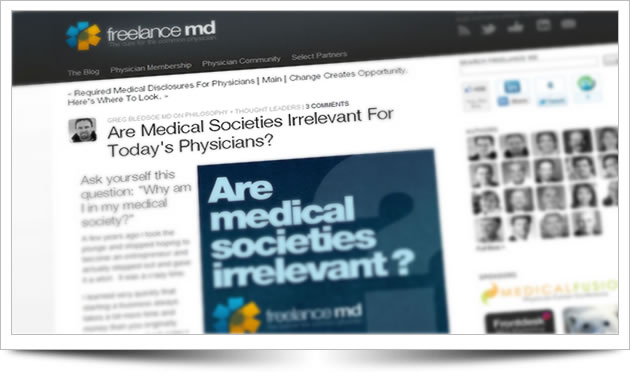
    Are Medical Societies Irrelevant For Physicians?

    By Greg Bledsoe MD

    Ask yourself this question: "Why am I in my medical society?"

    A few years ago I took the plunge and stopped hoping to become an entrepreneur and actually stepped out and gave it a whirl.  It was a crazy time. 

    I learned very quickly that starting a business always takes a lot more time and money than you originally envision, and in short order I was scrounging for capital to fuel my dream.

    It was during this time that I made a decision to let my medical society memberships lapse.  I had never considered it before, really, and as far as I was concerned, being a part of medical societies was simply part of being a physician-- I paid my dues and they supplied my, er, membership.

    When I was in academics, my department paid my society dues as part of my contract.  I never thought about the cost since I didn't view the funds as coming from me (there seems to be a moral here somewhere...), but when I entered the world of community, or non-academic, medicine, suddenly the costs associated with these memberships became very real.

    Five hundred dollars for this membership.  Three hundred a year for that one. It quickly added up, but I got a special tuition discount if I attended the annual meeting and I even got an occasional journal delivered to my mailbox with my name stamped on the front.  It all seemed very official and made me sort of feel like part of a special group, so I dutifully paid the dues and congratulated myself on my support of the furthering of the intellectual aims of XX society.  

    However, as anyone who's ever been in business can tell you, at some point tough decisions have to be made, and for me, the relinquishing of my membership in these societies was one of those tough ones.  I believed in these organizations.  I liked being associated with them.  I enjoyed seeing my name stamped on the front of the journals and I even flipped through an article or two when I could.  Walking away from something that made me feel so "involved" made me feel isolated, vulnerable.  If being a member of these organizations made me feel included, leaving them made me feel...alone.

    That was almost three years ago.

    Since then, the various ventures with which I'm involved have finally started to right themselves and for the first time in quite a while I have begun to have the ability to get involved once again in medical societies.  In the past few months I've begun to ponder joining this society or that one, trying to figure out which one would be a better fit and from whose membership I would learn the most skills-- and meet the most talented leaders.

    After marching down this path for a little bit, I finally stopped and asked myself a very simple question: why?

    Why was I considering membership in a medical society?

    It's true that when you begin a company your mind becomes much more keenly aware of the theoretical "return on investment" (ROI) than before.  I began asking myself the typical ROI questions I had asked myself at the beginning of any of my entrepreneurial ventures:  What would I gain from the investment of time and money in this organization?  Would my funds be better directed elsewhere?  Could I gain the same benefits without investing the relatively high annual dues?  How would I verify that my funds would be used appropriately and at what point would I be able to have an impact in the overall mission of this organization?

    My honest assessment after a sit down talk with myself and a review of the available information before me was the following: For the most part, medical societies do not offer a significant enough ROI to warrant the investment required to participate.

    I know this sounds like heresy for some, but let's review the facts...

    From what I can tell, the reasons given for a physician to be a member of any medical society today basically revolve around three points.  

    First, societies are said to offer camaraderie and networking opportunities for their members.  Second, societies supposedly help promote medical education and proper practice standards among their participants.  Third, medical societies, through the old "strength in numbers" adage, are in theory better able to represent their members politically and promote and pass legislation that furthers good medical practice.

    Let's review these arguments in broad daylight and see if they hold water.

    A generation ago, being a member of a medical society was really the only way a physician could connect with other physicians outside their basic social circle.  You joined the medical society of X in order to associate with its members, get invited to its galas, hear the latest research, and hopefully move up the ladder of influence of said organization as you progressed in notoriety and seniority.  This model was the same model used in the business world with the Elks Club, Rotary International, and the corporate culture at large.  Young, idealistic individuals, regardless of their skill set or motivation, waited in line patiently for their name to be called and an opportunity given to begin climbing the rungs of leadership within an organization, whether this organization was the Elks, IBM, or the X Medical Association.  One didn't even consider leaving if you had any career ambitions or longing for social connectedness.  The arrangement was what it was, and you just had to adjust.  

    This model worked for quite a while since it was easy for senior members to control the benefits of membership, and parcel these benefits out only to those junior members who walked the line. 

    In the corporate world, the personal computer revolution and especially the internet explosion, completely imploded this hierarchal regime.  No longer could senior corporate members exclusively hold the benefits of membership.  Enterprising upstarts could easily, from the comfort of home, begin a company on the web and not only leapfrog their old positions, in some cases they leapfrogged their entire industries.  The recent movie The Social Network , while criticized for not being 100% accurate, at least tells the gist of the story-- that a couple of Harvard undergrads turned the world on its ear from their dorm room.  

    The internet has become the great world flattener, and while Richard Florida is correct that innovation still occurs in geographic regions, the ability to take your idea to the world in an instant is a tremendous power that prior generations did not have.  Furthermore, with the internet and more specifically, the social networking ability on the internet, junior members in every organization can instantly, and freely, associate themselves with whomever they choose all around the world.  Gone are the days when being on the outs with your local or even national medical society is a professional death sentence.  Individuals now have the ability to join any number of interesting networking groups, or even start their own.

    Along this same line of thinking, the days when medical societies controlled medical education are long gone.  With the click of a keyboard, I can find medical education on almost any topic and I can access it at any time. I don't have to wait for my professional journal to arrive, and anything cutting edge will be posted on the web long before it hits my mailbox anyway. 

    When I pay my fees to earn CME credits, I now have the opportunity to choose what topics I hear, and whom I hear teach them.  No more sitting in a conference lecture listening to the droning of Dr. Oldenkrinkle simply because he's the chair of the education committee. I can learn from the best teachers at any time in the comfort of my home and earn my CME credits on my own terms.

    So with regards to the power of networking and the educational opportunities available, I would have to say that there are as many, or more, opportunities outside of medical societies today as there are within.  And when you consider that most of the membership societies available to the modern physician are free, why would you pay $300-$500 to be a member of a medical society for the networking or educational reasons?  It just doesn't make sense.

    The last reason-- pooling our strength to become a stronger political lobbying force for X issues or specialty-- is the one most often cited in the recent past by modern physicians as a reason to be involved in a medical society.  Matter of fact, this one reason was a big one for me.  I mean, any objective person can see that physicians need a strong lobbying voice in Washington, if for no other reason than simply to attempt to counterbalance the influences of the trial lawyers and their ilk.  

    However, I describe this as being cited in the "recent past" because I haven't heard it from any physician recently.

    No, if there was one glorious revelation that came into full view during the healthcare debate in this country, it was the cowardice of the self-serving leadership at the helms of most medical societies in this country.

    I don't think any physician will be fooled in the future with the "give us your money and we'll stand up for you" line that motivated us in the past.  What the healthcare debate clearly revealed was that when medical societies say they work for their constituents, they do truly mean this.  It's just that their constituents aren't the dues-paying members that constitute their ranks-- they're the entrenched bureaucrats in their leadership.

    Physicians watched in horror as medical society after medical society lined up and endorsed Obamacare, and then spoke to America as if their members were in agreement.  The American Medical Association was the worst offender, selling its soul to keep intact its lucrative, exclusive right to the CPT billing codes that fund its bureaucracy.  It was appalling in its transparency, and no physician who saw it will ever forget it.

    So what to do as a modern physician?

    The point here isn't to argue that no medical society is worth joining.  Many societies do good work in certain areas and there are physicians who derive a great deal of pleasure from membership in a society or two of interest.

    My point in this post is that being a member of a medical society is simply not the knee-jerk necessity it was a few years ago, and there's no credible reason to join any society unless you really feel that their mission meshes with yours and you want to be involved.

    More importantly, I believe that medical societies need to begin asking themselves what real value they give their members.  Today's young physician will not be coerced in the traditional way into membership, and if value isn't apparent, many will simply walk away.

    So will I eventually join a medical society?  

    I don't know.

    Maybe.  

    I'll need to discuss it with my friends on Facebook and get back to you.

    Greg Bledsoe MD MPH is a Board Certified Emergency Medicine physician and the founder and CEO of ExpedMed and the Medical Fusion Conference. He blogs at Freelance MD.

    Submit a guest post and be heard.

    Requred Disclosures For Physicians & Medical Spas

    By Arlen Meyers MD MBA

    When it comes to working with industry, keep your karma clean.

    Working with industry comes with strings. The Patient Protection and Affordable Care Act, signed into law on March 23, 2010,  includes a number of provisions including a requirement that all pharmaceutical and medical device manufacturers publicly post on a website all payments or transfers of value from the manufacturer to a health care professional or institute. Some companies, like Allergan, have taken it a step further and entered into a Corporate Integrity Agreement with the feds. (http://www.allergan.com)

    The present oversight environment demands that you disclose and make transparent your interactions with industry and any financial interests that result from that interaction. Here are some things to do to be sure you don't get caught with your stock options down.

    Keep score

    Be sure to keep an updated inventory of your consulting engagments, contracts and activities and  how you were compensated in cash, stock or some other financial instrument

    Disclose

    If you are an employee of an organization, like a univeristy of hospital chain, it is likely that you will get  a friendly (hopefully) reminder from your compliance officer to submit your conflict of interest statement. They will review it and get back to you if they see problems.

    Don't study or use what you own

    Big ticket conflicts make headlines. If you are being paid as a consultant to an orthopedic company and use lots of their products, beware. If you give lectures on depression to docs who like to eat expensive steaks and drink top shelf wines for free, and, you are the biggest prescriber of antidressants in your galaxy, that will raise a red flag.

    Disclose your activity to peers and others

    When you publish something or give a talk, disclose your interests. If you participate in medical legal activities, like expert witness participation, understand that your commercial interests will come under the magnifying glass of opposing counsel. Likewise, if you agree to work with one company, you will usually be asked to sign something saying that you will not work with another company where there might be a conflict.

    When working with industry, it's best be safe than sorry. Doctors hate to flunk tests. The worst one to flunk is the New York Times test.

    Arlen Meyers MD MBA is the cofounder, and Chief Medical Officer of MedVoy, a medical tourism company. He is also a Professor of Otolaryngology, Dentistry and Engineering at the University of Colorado at Denver and CEO and President of the Society of Physician Entrepreneurs. He blogs at Freelance MD

    Submit a guest post and be heard.

    Simple Tech Support For Your Medical Spa Staff

    If you're looking to get out of the tech support role this Christmas, Google has a site for you.

    Christmas is going to have more technology gadgets than ever, and they're all going to be connected and web enabled. If you've been handing the tech support for your parents since the VCR needed to be connected, you're days of wine and roses are here.

    Google staffers (Googlers) have drafted a site that teaches the most technology-challenged among us how to take a screenshot, set up an autoresponder for your email, send large files or make a phone call with your computer.

    This is a nifty resource that you can actually use to train your medspa staff. Nice.


    Kiva Loan Team For Medical Spa MD

    Medical Spa MD's Kiva lending group for micro-loans to Third World entrepreneurs.

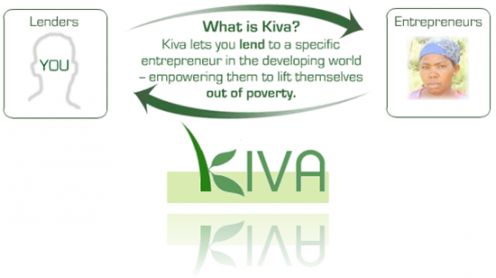
    Kiva, a non-profit website that allows you to lend as little as $25 to a specific low-income entrepreneur across the globe. You choose who to lend to—whether a baker in Afghanistan, a goat herder in Uganda, a farmer in Peru, a restaurateur in Cambodia, or a tailor in Iraq—and as they repay the loan, you get your money back. Here's the Kiva about page.

    I've been a member of for a while now. In fact, my daughtter and I started her micro-loan fund a few years ago. Since she started with $100, Maddy's lent to 33 different entrepreneurs and groups around the world and her fund is $500 or so. She re-invests the money with new entrepreneurs as the loans are repaid.

    We've created a lending team for Medical Spa MD

    Once you're a part of the team, you can choose to have a future loan on Kiva "count" towards our team's impact. The loan is still yours, you choose who you loan to and repayments still come to you—but you can also choose to have the loan show up in our team's collective portfolio.

    If you'd like to join our lending team we'd love to have you. We'd love it even more if you were to blog/post/tweet/invite your friends. For $25 you can help change someone's life.