New Classified Listings For Cosmetic Lasers & IPLs

We've just finished with our new classified listings area for selling your medical spa, used cosmetic laser or IPL, or even your business services.

We've been using 'forums' to try and offer a place for our Members to be able to sell their used equipment, but that's always been something of a hack. So, we've created a subdomain and put up a dedicated classified listings site - along with our medical spa jobs site - that goes hand-in-hand with our forums where you have access to cosmetic laser & IPL reviews as well as very specific 'how to' threads.

This new site works much better, allowing you to upload images of what you're selling, has integrated Google maps and some really nice contact features that forums just don't provide; like automatically expiring a listing so that you don't have to wonder if that Palomar Starlux you've been eyeing is still on the market.

Right now, you don't even need to register with this site, although that may change in the future.

I want to put a special shout out for a couple of our Select Partners — Frontdesk SEO — who put up the dosh to get this done and are helping to sponsor the site and build out the Business Vendor category so that business will now have truly inexpensive place to add thier services. This was specifically designed for business that sell directly to medical spas — like IPL head refurbising, used cosmetic laser retailers and even marketing companies — to have a place that they can affort do advertise... right where the buyers are. ; )

There are a couple of things to remember.

Used cosmetic laser resellers are welcome to list their entire inventory individually or list their business in the 'Business Services' category.

Note: If you’re listing your business as a provider that sells equipment, technology or services to cosmetic clinics, you’re required to post your listings in the Business Services Category. If you abuse the system you'll be banned.   ; (

Pricing

Some of the listings will cost you a little to post. All listings are for 45 days.

  • Individual Listings: $9
  • Featured Listings: +$9
  • Business Vendors: $45

How to create a listing that sells

One line descriptions don’t do well. If you want to make a sell, follow these rules:

  • Be descriptive! Make sure that you include  an accurate, lengthy description if you’d like to make a sell. Studies show that listings with at least 400 words sell more than 4X as well as brief descriptions.
  • Add images: Your buyers want to see what they’re buying. You can add up to 5 images. Use them in the listing and don’t just put a link out to your Flikr account.
  • Use your email as your contact info: Include your email address in your listing. If your listing sells, you won’t want to keep fielding endless phone calls. Use your phone number in your email responses.
  • List your items individually: People want to know exactly what you’re selling from the title. Don’t try to squeeze multiple, different types of products in the same listing.
  • Make your title descriptive: Include the product, location and price in the title if you can.

Remember: Only Members may post listings. If you’re not yet a member you can join Medical Spa MD here. It’s free, which is a terrific price.

Concierge Medicine, Social Justice & Sex at 100

By Steven Knope MD

Some of my medical colleagues who champion the cause of “social justice” bristle when they learn that I practice concierge medicine. 

They fervently believe that it is somehow more noble to practice Soviet-style medicine in America than it is to take professional responsibility for delivering excellent, individualized medical care to their patients.  One of the benefits of being sanctimonious about private doctors who practice in a capitalist model is that you can blame some of the crappy medicine you deliver on your benevolent, utopian system, which claims to be “fair” to everyone.  How convenient.  But what are the consequences of focusing on clinical algorithms, electronic medical records, and the forced “fairness” that comes down from the Politburo?

Today I saw a 99-year-old patient in my office who is on my indigent medical care program.  She pays me $5 per visit, just so that she’s got some skin in the game.  (Quiet…I don’t want my social justice critics to know that I actually see people who can’t afford to pay my concierge fees.)  This elderly woman has diabetes and has been in the ICU twice over the past year with urosepsis, on the sepsis protocol.  Last week she was taken to a local ER at a hospital where I do not practice.  She had a recurrent kidney infection, despite receiving rotating prophylactic antibiotics and intravesicular gentamycin given to her by an expert urologist.  I was never called by the ER physician, because I am merely the patient’s attending physician – a point that is irrelevant to most ER physicians, given that virtually every patient in the ER is now admitted to the “hospitalist team.” 

Instead of admitting this frail, 99-year-old diabetic for IV antibiotics and careful monitoring, the ER physician opted to treat her as an outpatient with generic Keflex.  This would not have been my approach, but I have to agree that it certainly was “cost effective.”  Fortunately, my patient survived this “UTI algorithm.”  The doctor also opted to treat her hyperkalemia with equal efficiency, giving her a single dose of oral Kayexalate, which she promptly vomited after arriving at home.  Luckily, she did not have a cardiac arrest from her hyperkalemia, especially in light of the fact that they did not bother to hold her ACE-inhibitor, which was contributing to her elevated potassium.

As my patient left the ER, the medical team dutifully handed her the ubiquitous, and always helpful, discharge instruction sheet.  This document no doubt met all hospital and governmental regulations for educating people about pyelonephritis and hyperkalemia.  Although my patient is legally blind and cannot read standard print, I’m sure she found this 4 page document very comforting.  More importantly, the purveyors of social justice can rest assured that they followed all of the guidelines set forth by the Politburo and did their duty to deliver the same level of care to everyone, regardless of income, ethnicity or social standing.   

Had my 99-year-old patient been able to read this information sheet, I’m sure she would have found it helpful to know that she should “refrain from having sexual intercourse until after all of her kidney infection symptoms had resolved.”  I don’t know about you, but there is nothing that irritates me more than seeing a non-compliant, centenarian who continues to have sex while being treated for an active pyelonephritis.  The only way to prevent these elderly nymphomaniacs from reseeding their genitourinary tracts is to put it in writing!

What we are now seeing is just the beginning of medicine by administrative committee.  If you think I am misusing the term “Politburo”, just wait until you see what happens under the Department of Health and Human Services in the name of ObamaCare.

About: Dr. Steven Knope runs a concierge medical clinic and blogs at http://FreelanceMD.com

Physicians & Assets

By Gregory H. Bledsoe MD

With all the concern over the economy and the changes in health care, I thought it would be a good idea to write just a quick post about financial assets.

Most physicians do not understand the concept of financial assets and wonder why they feel like they are working harder and faster for less and less reward.  

Now, I want to be clear, I am not a financial expert or a wealth manager.  However, I have found a few principles that have really helped me personally, so I though I would pass them along to the readers of Freelance MD.

First, it needs to be said loudly and clearly that when a physician first graduates from his or her residency program, they have not "made it" in the financial sense.  Yes, graduating from residency is a great achievement and does signify the completion of a long, difficult training period.  It also usually is accompanied by a significant increase in salary and the ability to live better and spend more.

However, in the financial sense, a newly minted physician is in a horrible financial place.

Most physicians finish residency with significant debt, debt that is made worse due to the young physician's new salary, a salary that places the physician in a tax bracket that precludes the interest on student loans from being tax deductible.  

Next, most physicians have little financial training so they immediately "reward" themselves for all the years of focus and discipline with a "few" nice things.  I clearly remember many resident friends of mine who bought expensive luxury cars and nice homes immediately after graduation.  Since few residents have significant savings, these new physicians simply added to their significant student loans even more debt in the form of car loans and large mortgages.

The problem with all this is that the new physician is suddenly saddled with enormous overhead.  His or her lifestyle looks nice, but at the end of each month very little money goes to savings or retirement or investing in other financial assets that could help increase their overall net worth.  Even those physicians who are aggressive about paying down debt and funding retirement often do not rise as high as they could financially because they make the mistake of pouring their disposable income into items that they believe are assets but actually are liabilities.

Robert Kiyosaki, author of Rich Dad Poor Dad, has produced a couple of very short informational videos (around 2 minutes each) that summarize the issue of assets.  The true definition of an asset is something that makes you money.  While this seems obvious, it is often misunderstood.  For instance, many physicians consider their homes and their cars "assets."  Strictly speaking, these items are not assets since for the most part they take money out of your pocket.  

Here's a short video of Robert defining true assets, and how to differentiate them from your liabilities:

Make sense?

For an item to be a true asset it needs to produce cash for you.  

Physicians work very hard and make a good salary, but most take their disposable income and instead of using it to buy assets, they pour it into items that actually increase the outflow of money from their pockets.  If the physician hits a snag in his/her career-- illness, salary decrease, burnout-- they suddenly realize how fragile their financial world really is.  Without true assets putting money each month back into their pockets, these physicians realize they are simply highly-paid hourly workers who are forced to exchange time for money indefinitely if they are to survive.  This realization is a very depressing concept, and one that I believe significantly contributes to the frustration of many physicians today.

To break out of this cycle, a physician absolutely must understand the principle of investing in true assets with their disposable income so that they begin to slowly wean themselves off of the dependence of their physician salaries.  In the end, a wise physician will have lived frugally, paid down debt, placed money in retirement, and instead of buying "toys" with their disposable income, instead slowly built up a collection of assets that put money back into their pocket and made their physician salary superfluous.  Ideally, a physician will eventually reach a point where their living expenses are covered by the income from their assets and their salary as a physician becomes simply the "icing on the cake" so to speak.  Perfectly executed, this freedom from the time-money continuum allows a physician to see their careers as something they choose to do for whatever reason-- desire, interest, altruism, curiosity, etc...-- not something they are forced to do to continue surviving.  It truly is a life-empowering shift in perspective.

So what are some examples of assets?

Here again, Robert Kiyosaki succinctly describes the three broad categories of assets in the following video:

I hope this all makes sense and you're beginning to get a vision about how you can begin breaking free from the time-money grind through the purchasing and development of true financial assets.  

About: Dr. Greg Bledsoe is a physician entrepreneur that has founded ExpedMed.org and the Medical Fusion Conference. He blogs at FreelanceMD.com

Understanding The HITECH Act: HIPAA On Steroids

By Jeffrey Segal MD JD and Michael J. Sacopulos JD

Understanding the law before you send your patients any e-mail.

Snail mail is becoming less popular as the calendar pages turn. E-mail and social media networks have changed how we communicate. Before clicking the send button in an e-mail template, healthcare professionals should better understand that HIPAA violations have also entered a new era. More cases are prosecuted with assessment of both statutory civil fines and criminal penalties.

A little background: Even though HIPAA passed in 1996, little prosecution followed when patient privacy was violated. Since the law took effect in 2003, nearly 45,000 complaints were filed with the Health and Human Services (HHS) Office for Civil Rights. Of these complaints, only 775 cases were referred to the Department of Justice or the Centers for Medicare and Medicaid Services for investigation. None resulted in direct civil monetary penalties.

Then, in 2009 the HITECH Act (“HIPAA on steroids”) was enacted. This act intended to increase HIPAA confidentiality protections of Electronic Protected Heath Information(ePHI), instill tough civil and criminal penalties for violations, mandate notification of breaches of HIPAA protected heath information, and extend the definition of covered entities to include business associates. A tall order indeed.

For example under the tougher HITECH Act, in April 2010 a former employee of a hospital was sentenced to four months in prison for accessing the medical records of his coworkers and various celebrities. He had no “valid” reason for accessing these records.

According to the Health and Human Services (HHS), penalties have increased. Prior to the HITECH Act, the HHS Secretary could not impose a penalty of more than $100 for each violation or $25,000 for all identical violations of the same provision. Section 13410(d) of the HITECH Act strengthened the civil money penalty scheme by establishing tiered ranges of increasing penalty amounts, with a maximum penalty of $1.5 million for all violations of an identical provision.

Just how "high tech" are physicians when it comes to communicating with patients?

A survey by the health information firm Manhattan Research in 2009 found that 42 percent of physicians had some online communication with patients.

The American Academy of Family Physicians reported in a 2009 survey that just 6 percent of responding members had performed a Web-based consultation - that number was more than double the 2.6 percent who had done so in 2008.

But is all of this electronic communication legal?

The HITECH Act requires that all communications involving ePHI be encrypted.  HHS recently adopted National Institute of Standards and Technology guidelines for encryption.  This means that if a physician wants to consult, refer, or prescribe for a patient by e-mail, the e-mail had better be encrypted.  Of course most patients do not have software to decrypt.  So what alternatives do healthcare providers have? And, more importantly, how can this be made easy and pragmatic. Email was designed to simplify, not complicate.

Healthcare providers may seek their patient's consent to communicating via unencrypted e-mail.  While HHS does not provide a standard form for securing patient consent, basic "informed consent" strategies should apply.  First, get the patient's consent in writing.  The patient should not be given just a binary choice – but a menu of choices.  For example, a patient may wish to electronically receive information on appointment dates but not test results.  The consent document – as is standard with most routine HIPAA forms -should also note that the patient may withdraw his or her consent at a later time. This can be part of an expanded HIPAA form the patient signs when first seeing you in the office.

Here are some more recommendations when communicating with patients electronically:

1) A physician may be held responsible for a delay when responding to a patient's e-mail. Solution: A physician that wishes to accept e-mail from patients should use an auto response feature that informs the patient that a) the physician typically responds to e-mail within XXX number of hours/days; b) if the patient requires immediate attention, the patient should telephone the physician's office or contact an emergency healthcare provider.  

2) If a patient initiates an e-mail with a physician, Rachel Seeger of HHS Office for Civil Rights says that it is assumed that the patient consents to unencrypted communication.  "If this situation occurs, the healthcare provider can assume (unless the patient has explicitly stated otherwise) that e-mail communications are acceptable to the individual”.

3) If a physician does end up sending a patient an e-mail, double check the recipients’ e-mail address before clicking the send button. This is to prevent the e-mail from being sent to the wrong person, therefore sharing private information to an unintended party. Good advice also in the non-healthcare world.

4) Add any e-mail a patient sends (and any response) to the patient's chart.

5) In the HITECH Act code 170.210 section B states that the date, time, patient identification and user identification must be recorded when electronic health information is created, modified, deleted, or printed; and an indication of which actions occurred must also be recorded. This means if you send an email to a patient with protected health information – and delete it – you will need a record of what was deleted and when. This is not dissimilar to crossing out a line in a paper medical record- updating the record – with a date of the update.

6) Since communicating with patients via e-mail is becoming stricter, more physician offices and hospitals are using portals as a means of communication. This allows the patient to sign in with a secure username and password to view their records and communicate with their physicians. The security rule allows for Electronic Protected Heath Information (e-PHI) to be sent over an electronics open network, as long as it is adequately protected.  Of course, this is more complicated than using Outlook or gmail.

The HITECH Act has ushered in a new era of technology requirements and standards that must be met by physicians.  Given HHS's recent enforcement efforts, physicians should use caution when electronically communicating with patients.  By working within the boundaries of the six points above, physicians should comply with the HITECH Act. 

Jeffrey Segal MD JD and Michael J. Sacopulos JD are with Medical Justice, a Medical Spa MD Select Partner that protects physicians from frivilous lawsuits.

Submit a guest post and be heard.

2011 Medical Fusion Conferenece Faculty & Agenda

Medical Fusion ConferenceBy Greg Bledsoe MD

At every Medical Fusion Conference we attempt to cover the most pertinent topics for clinical physicians who are attempting to branch out from their clinical careers.  

For 2011, we've once again assembled a stellar faculty comprised of leaders in many diverse niches from around the country, and have included many hot topics that physicians should be exposed to in this ever-changing healthcare environment.

Our 2011 faculty list was recently published on Freelance MD, but we've added a few more names so I've decided to list our entire 2011 Medical Fusion Conference faculty once again.  Many of these faculty members are authors on Freelance MD so you can read about their backgrounds and perspectives. I'm also listing our agenda below so you can get an idea of what's going to be discussed at this year's event.

The 2011 Medical Fusion Conference is November 11-13, 2011 and space is limited.  If you're interested in attending you can register online or call 866-924-7969 .

Our 2011 Medical Fusion Conference faculty:

Our conference topics this year are wide-ranging and cover many niches within and around clinical medicine.  Our 2011 agenda is the following:

Friday, November 11th

8:00  Leaving the Tribe, Silbaugh
9:00  Physician Career Transition, Wendel
10:00 Break
10:30  Prescriptions for Financial Success, Mazumdar
11:30  Living and Working Abroad, Bledsoe
12:30  Lunch
2:00  Concierge Medicine, Knope
3:00  Cosmetic Medicine Profits Blueprint, Barson
4:00  Real Estate Investing, Taff
5:00  Should You Get Your MBA?, Cohn
6:00  Accelerator I

Saturday, November 12th

8:00  Writing & Publishing I, Silver
9:00  Writing & Publishing II, Silver
10:00  Break
10:30  Internet Entrepreneurship I, Woo-Ming
11:30  Internet Entrepreneurship II,  Woo-Ming
12:30  Lunch
2:30  Product Development, Silver
3:30  How to be a Rockstar Physician, Barson
4:30  Independent Consulting, Cohn
5:30  Accelerator II

Sunday, November 13th

8:00  Believe Me: The Importance of Building an Unforgettable Brand, Gulati
9:00  Careers for Physicians in Managed Care and Health Insurance, Peskin
10:00  Break
10:30  Introduction to Disability Review, Neuren
11:30  Online Marketing for Physicians: The Essentials, Quatre


I wanted to make sure I highlighted our two Accelerator sessions at the end of each day.  Our Accelerators are some of our most popular times spent at the Medical Fusion Conference since each faculty and mentor has a table, and participants are allowed to wander from faculty member to faculty member and ask any and all questions of the speakers.  No other event allows you this much face-time with nationally known leaders.  Our participants raved about our Accelerator sessions in 2010 and we know that our 2011 participants will also enjoy this time. 

As you can see from our faculty list and our agenda, Medical Fusion participants will be given exposure to a wide array of interesting topics and significant time with our stellar faculty. There's no event like the Medical Fusion Conference and there's only one Medical Fusion Conference in 2011: November 11-13, at the Aria Resort & Casino in Las Vegas. It's the  most exciting and invigorating medical conference in the country.

Dumbing It Down?

By Julie Silver MD

It's not uncommon that someone will make a comment to me about how we (physicians) need to "dumb it down" when it comes to publishing information for consumers. 

In fact, this is exactly the wrong approach when you are trying to reach people with important health information.  Instead, what we need to strive for is a smart translation of medical science. 

While it's true that people who are not in healthcare likely won't understand a highly technical medical research study (just as doctors probably wouldn't understand a complicated document in another industry), what isn't true is that our patients, readers and consumers need to have information "dumbed down."

A smart translation means that you are approaching your reader with respect for his or her intelligence and knowledge.  Dumbing anything down is just plain disrespectful.  Attitude comes across the written page and seeps into the "take home messge."  A respectful attitude means that readers are more likely to consider the information presented.  Perhaps to heed the advice and even to share it with others. 

Bottom line: everything that physicians write and publish should be done with the goal of offering a terrific translation for a given audience.  I think about this a lot.  When I don't get it right, it isn't because I dumbed my communication down.  I just didn't quite nail the translation.  Great translations aren't easy, but they are incredibly effective.  Offering important health information along with respect is what we should all aim for all of the time.

About: Julie K. Silver, MD is an assistant professor at Harvard Medical School in the Department of Physical Medicine and Rehabilitation and is the Chief Editor of Books at Harvard Health Publications, the consumer health branch of Harvard Medical School. She is the director of the annual Harvard CME course titled "Publishing Books, Memoirs and Other Creative Nonfiction". She blogs at Freelance MD.

Submit a Guest Post and be heard.

Your Medical Spa Pricing, Cognitive Dissonance, & How To Charge More

Your profits are in your prices. Where are the psychological triggers you can use to raise your prices and charge more?

You'd like to be able to charge a premium for your services and rake in the big bucks, right? Then why are so many physicians and clinics utilizing the slow death spiral of constantly trying to undercut the competition and using discounting coupon services like Groupon. Why are some physicians able to charge 50% more for Botox and others are trying to give it away and scrambling for any new patient. Where's the disconnect?

Guess what. It's psychological.

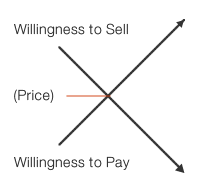
Look, there are only two things that determine ANY price.  Put these lines on a graph.

  1. How much you're willing to sell something for.
  2. How much someone's willing to pay for it.

That's it. Just those two things, and the second of those is based on psychological triggers more than anything else. (Of course, those two lines cross at some point or you're pricing yourself out of the market and in big trouble.)

As a physician running a cosmetic medical practice or medical spa, when you’re essentially selling time, how do decide where you can set — and then raise — your rates?

Guess what? People actually want to pay a lot.

I learned this as a young painter in New York. My paintings sold between $25,000 and $60,000. Why? It's pretty simple. I wouldn't sell them for less and I could easily get buyers who would pay that amount. I could find lots of buyers that would purchase my work as fast as I could produce it. I had both the skills and business savvy to understand that the quality and uniqueness of my work created the demand and drove up my prices. I didn't just set my prices high. I started by creating a unique niche that I completely dominated; beautiful, realistic women in oil with old world craft. I would never have been able to charge $60,000 for paintings that no one wants and anyone could produce.

Even more, I set myself up as able to demand those prices. Believe me, no one want's to pay $50,000 for a painting. They only pay that amount for a story, and the story is around something that's unique and scarce.

People want to pay a lot for cosmetic treatments.

If you don't know it already, you're in the vanity business. People will pay outrageous prices for vanity. Think of the prices that high end vanity commands; $600 for a felt purse by Kate Spade, $1,150 pumps from Christian Louboutin, the $84,000 Audi A8, the Omega Seamaster watch, any Apple product... The cost is actually integral to the enjoyment.

People want to pay a lot for your cosmetic treatments IF you position yourself correctly AND your treatments are both unique and scarce.

No one wants to pay more for the same coach seat on an airline, but there's obvious satisfaction when someone describes the purchase of an expensive luxury item, even if the price is never mentioned.

If you cater to the lowest common denominator, you'll have to price your services that way too. Specialize in a lucrative niche and your services become not only unique, but scarce as well. Uniqueness and scarcity work hand-in-hand to drive up demand and allow you to raise your rates.

So uniqueness and scarcity are primary ingredients to any offering that want's to charge a premium. We'll deal with both uniqueness and scarcity in other posts. What I want to talk about here is the psychology of pricing and how it relates to your own pricing and your customer loyalty.

Once you have something that's both unique and scarce, you can move on to increasing your prices.

Where's your current pricing?

I’ve met many, many physicians who under price their services.The primary reason that's give is that they have to have low prices to remain competitive in an every more productized marketplace, where every corner has a medical spa trying anything to attract new clients.

This can be true — especially around mass consumer treatments like Botox and laser hair removal — but whatever the reason, charging too little for your services is self-sabotage for two primary reasons:

  1. When you don’t charge enough you end up resenting your clinic. You do too much work for too little money. It’s not worth it. (Try to tell me this isn't the primary reason that so many physicians are trying to leave clinical medicine.)
  2. A low price tells patients that you’re not worth it. It may be all smoke and mirrors in the beginning, but if you want to be perceived as the best, you’d better price your services accordingly. Low prices are THE primary indicator of low quality.

I've seen any number of small clinics where the marketing and pricing plans, if there was one, wasn't well articulated or just rattling around in the physicians head. As a result, these clinics, in an effort to build their own business, underbid services on low quality clients. As a result, they ended up with lots and lots of low fee procedures and special offers. Instead of focusing on high quality premium treatments, these staffs are pushed to get things done as fast as possible to keep the treatments profitable despite the low fees. This poor quality of training, service and oversight leads to mistakes. Clients nitpick and try to get additional discounts or haggle about pricing. Accounts receivable grows. Lawsuits happen. It's no surprise when clients start leaving for the next low bidder to open up shop.

Remember, people value things by price. Just one of the reasons why I’m sitting in Starbucks right now drinking a $4 coffee.  (And no, I don’t think $1 coffee is their best move.)

One of the primary components in positioning yourself is how you price your services.

Price Influences Your Perception Of Quality

As price goes up, so does your perception of quality AND pleasure (satisfaction).

I don't know this for sure but I would bet that 'premium' medical providers are sued less frequently and have higher satisfaction rates than lower priced physicians. It could well be that being the low cost provider puts you at greater risk for lawsuits for a number of reasons. (If you have any relevant information to this, please leave it in the comments.)

A well known study out of the California Institute of Technology and Stanford University details how price influences peoples perception of quality in wines.

Antonio Rangel, an associate professor of economics at Caltech, and his colleagues found that changes in the stated price of a sampled wine influenced not only how good volunteers thought it tasted, but the activity of a brain region that is involved in our experience of pleasure. In other words, "prices, by themselves, affect activity in an area of the brain that is thought to encode the experienced pleasantness of an experience," Rangel says.

Rangel and his colleagues had 20 volunteers taste five wine samples which, they were told, were identified by their different retail prices: $5, $10, $35, $45, and $90 per bottle. While the subjects tasted and evaluated the wines, their brains were scanned using functional magnetic resonance imaging, or fMRI.

The subjects consistently reported that they liked the taste of the $90 bottle better than the $5 one, and the $45 bottle better than the $35 one. Scans of their brains supported their subjective reports; a region of the brain called the medial orbitofrontal cortex, or mOFC, showed higher activity when the subjects drank the wines they said were more pleasurable.

But the experiment was rigged. While the subjects had been told that they would taste five different wines, they had actually sampled only three. Wines 1 and 2 were used twice, but labeled with two different prices. One wine 2 was presented as a $90 bottle (its actual retail price) and also as a cheaper $10 wine. When the subjects were told the wine cost $90 a bottle, they loved it; at $10, not so much.

In a follow-up experiment, the subjects again tasted all five wines but without any prices; this time, they rated the cheapest wine as their most preferred.

Previous marketing studies have shown that it's possible to change people's perception of how good an experience is by changing their beliefs about the experience. For example,  moviegoers report liking a movie more when they hear how good it is beforehand. Studies show that the neural encoding of the quality of an experience is actually modulated by variables such as price, which people believe is correlated with experienced pleasantness.

The results make sense. Your brain encodes pleasure because it is useful for learning which activities to repeat and which ones to avoid, and good decision making requires good measures of the quality of an experience. But your brain is also a noisy environment, and "thus, as a way of improving its measurements, it makes sense to add up other sources of information about the experience. In particular, if you are very sure cognitively that an experience is good (perhaps because of previous experiences), it makes sense to incorporate that into your current measurements of pleasure." Most people believe, quite correctly, that price and the quality of a wine are correlated, so it is therefore natural for the brain to factor price into an evaluation of a wine's taste.

How 'Cognitive Dissonance' Affects Pricing

Cognitive dissonance is that uncomfortable feeling you get when you're holding conflicting ideas simultaneously. The theory of cognitive dissonance proposes that people have a strong motivational drive to reduce dissonance since it causes internal conflict. They do this by changing their attitudes, beliefs, and actions. Dissonance is also reduced by justifying, blaming, and denying. It is one of the most influential and extensively studied theories in social psychology.

I'm not trying to force a psychology degree on you but  it is useful to have understanding some basic underpinnings of behavior and how they affect pricing, such as why critics don't like your favorite wine, and how wineries get away with charging $500 for a bottle.

Have you ever noticed fans almost never complain about lousy music concerts or albums, yet critics frequently give them poor reviews? What's going on? Are critics just inherently nasty?

Maybe, but the fact is that there's a psychological principal at work that's also in effect every single time you exchange something of value (money) for a product or service.

Here's an example of cognitive dissonance at work.

In a landmark study by Leon Festinger and James Carlsmith, seventy-one male students in the introductory psychology course at Stanford University were asked to spend two hours doing a very boring task, sticking wooden pegs in holes.

Participants were divided into three groups. Some were paid $20 (a lot of money back in 1959). Some were paid $1. And some were told they were volunteers and paid nothing. All were told what their payment (or non-payment) would be before they began.

After two hours of what was surely hellish tedium, participants were asked to rate the 'enjoyment' of the task.

So what do you think? Which of the groups ($20, $1, nothing) thought that sticking pegs in holes for two hours was the most fun?

Here's the answer: The group that was paid $1 found the task most pleasurable. The group paid $20 found it the most boring.

Why? Cognitive dissonance at work.

Here's the way that cognitive dissonance is at work in the real world:

  1. If you are induced to do or say something which is contrary to your personal opinion, there is a tendency for you to change your opinion to bring it into correspondence with what you have done or said.
  2. The greater the pressure used to elicit the overt behavior (beyond the minimum needed to elicit it) the weaker the tendency to change the opinion.

Let's discuss the first point. In the peg study the task was, objectively, tedious and boring, but people who were paid $20 could easily explain to themselves why they did it: they wanted $20. They rated the task as the most boring. People who were volunteers and got nothing could tell themselves they did it to advance science. They found it less boring than the $20 group, but still somewhat boring.

But here's where cognitive dissonance comes in. The people who were paid only $1 couldn't reconcile with themselves why they spent two hours putting round pegs in round holes. Their brain held two dissonant thoughts: "This task is dull" and "I'm wasting my time for a $1." The second statement was 'fixed' and couldn't be changed, so the brain unconsciously modified its belief about the first to decrease the conflict. People decided they were having fun; otherwise they would be fools for doing it at all.

But don't forget the second point; The greater the pressure used to elicit the overt behavior (beyond the minimum needed to elicit it) the weaker the tendency to change the opinion.

This is why the 'soft sell' can be so effective. Using less 'pressure' to elicit the behavior actually results in the strongest tendency for a person to modify their opinion.

Let's apply this lesson to how pricing affects the enjoyment of a product or service.

When you pay for anything; food, Botox, liposuction, or wine — your brain knows the price, and you're pretty sure that you're not stupid. So, if you pay $200 to see a live band and they're all singing off-key, your brain can change its evaluation of the performance to "charmingly gritty and spontaneous" or "incredible live performance". Your subconscious is pushing you to find the experience pleasurable.

But the critic sitting in back didn't pay for his tickets. He's just there to do a job, and his brain knows that. If the concert is bad and he says so, that doesn't make him a fool for going, he's just more objective.

Think about it: How often have glossed over a obvious shortcoming in order to avoid tainting your enjoyment of something you've paid a lot for? I know I do it all the time.

Here's what W. Blake Gray says about cognitive dissonance and wine.

I get a lot of free wine, and I pay for wine frequently also. Even though I'm aware of cognitive dissonance, I still think I'm more likely to give the benefit of the doubt to a so-so wine I order by the glass in a restaurant over a wine I taste in a professional setting. I'm paying for it, I'm no fool, it can't be that bad.

There are several implications here:

  1. Why do fans of an expensive wine like it more than the critics? Simple: they're paying for it
  2. The more money the wine costs, the more powerful the effect of cognitive dissonance. You can freely diss Two Buck Chuck, but that overripe $60 Syrah? It must have some good points. Many Napa Valley vintners understand the implication of this: Charge more, and while the wine might be difficult to sell, people who do buy it will like it more. Hows that for increasing your customer satisfaction?
  3. Why does Robert Parker give higher scores to wines than other critics? To his credit, he is well-known for paying for a lot more wines than any other critic. He chooses what to pay for, he doesn't taste blind, and I submit that even for a man whose palate is as consistent as anyone in the business, cognitive dissonance is at work.
  4. Why does wine taste better in the tasting room? There are other factors at work as well, but consider this potential dissonance: "I drove out of my way to get here and chose this winery over its neighbors. Plus I paid a $10 tasting fee." Cognitive dissonance is a good motivator for every tasting room to charge a modest fee. (Sorry, consumers.)
  5. Why don't professional critics rush to embrace funky, expressive wines, especially those in niche categories? We don't have to; we don't have the cognitive dissonance of "I paid $12.99 for this no-added-sulfite 'organic wine' and it smells like feet." Mmm, feet.
  6. How do the Bordeaux first growths get away with those outrageous release prices -- over $500 a bottle for some? In Hong Kong, people are thinking in Cantonese, "I paid $900 for this wine. And I am no fool. This is so worth it." Cognitive dissonance knows no language barrier.

Cognitive Dissonance & Irrational Customer Loyalty

Of course pricing isn't the only factor we're discussing. Let's talk some cognitive dissonance and how it leads to irrational customer loyalty, just what we're looking for.

In a study looking at why cognitive dissonance with dentists and their patients, Duke University behavioral economist Dan Ariely revealed the probability of two dentists separately finding the same cavity in an X-ray as being about 50%. And often, what dentists think is a cavity, turns out to be nothing. All the more odd, then, that as patients, we’re incredibly loyal to our dentists - more faithful, in fact, than to other medical practitioners.

Why? It's cognitive dissonance here as well. In order to rationalize all of the unpleasant poking, scraping and drilling that dentists subject us to, we convince ourselves that our particular dentist knows best:

"Dentistry is basically the unpleasant experience. They poke in your mouth. It's uncomfortable. It's painful. It's unpleasant. You have to keep your mouth open. And I think all of this pain actually causes cognitive dissonance - and cause higher loyalty to your dentist. Because who wants to go through this pain and say, 'I'm not sure if I did it for the right reason? I'm not sure this is the right guy.'"

(Kinda reminds me of Stockholm Syndrome in which people who are kidnapped actually begin to identify with their captors.)

But cognitive dissonance accounts for more than our loyalty to dentists. It also generating increased revenue for dentists and adding to their profits.

And it increases over time.

Imagine that at some point in your dental treatment, you have a choice between two treatments that have exactly the same possible outcome, but one of them is more expensive to you and better financially for the dentist. Which one would you choose, and how would the duration of the relationship with your dentist be affecting that?

It turns out that the more time people have been seeing the same dentist, the more likely the decision is going to go in favor of the dentist. People are going to go for the treatment that is more expensive but has the same outcome. More out of pocket for them, more money for the doctor. So in this case, loyalty actually creates more benefit for the dentists with no better potential outcome for the patient.

Now, while it may sound like I'm advocating standing on a patients toes while injecting Botox... not so.

There may be some effect of cognitive dissonance at work when you're performing a Melasma or other treatment where there's some pain and downtime, but what we really want to focus on here is how pricing your treatments higher, can actually increase both your patient satisfaction and revenue at the same time.

Does A Premium Price Drive Actual As Well As Perceived Value?

I would say yes in many instances.

Take a look at our medical spa training manuals and you'll see that they're more than a big hardcover at Barnes & Noble, much more. But we deliver on those prices since the quality of the content is so far above what you can get elsewhere. This isn't generic information, it's specialized, and it's valuable.

The medical spa staff training manuals are priced where they need to be to make the creation and distribution profitable enough that it's worth creating AND creates an incentive for buyers to actually use the information. Some of the most successful medical spas and cosmetic clinics around are using these training manuals. Do you think that someone who's at all serious about their business thinks anything at all about dropping $300 on a product that can optimize their operations and train their staff? Are you kidding?

Sure, I could give all that stuff away. Perhaps there are those that think that I should. This isn't for them. We give away 99% of everything for free already, but real products that give you the most benefit aren't valued if they're free.

It's not about information. It's about motivation. Paying a premium for them actually gives you more value... and pleasure.

Clarity

Look, you know more about your own situation than I do. I'm not trying to convince you to raise your prices if you can't support it, but hopefully you've got something to think about. There's a lot of obvious, anecdotal and researched evidence that shows that higher prices will make you more money and make your patients happier... but pricing is the second step. Creating a service menu and reputation that is unique and scarce is step one.

Pricing is one of the things that all physicians and medical spas struggle with. It is one of the handful of items that actually dictate how much money your clinic will make and where your profits are.

One last point: You've been reading this post for something like 3 minutes now. Isn't this the most interesting blog you've ever read? Please tell your physician friends. They're no fools either.

The Medical Spa Blueprint: This post deals with some of the topics we'll cover in The Medical Spa Blueprint, a guide to opening and operating a highly successful and profitable cosmetic medical clinic. To be notified when the Medical Spa Blueprint is available, just join Medical Spa MD. It's free, which is a terrific price.

If you have some thoughts on this stuff, please leave a comment. We want to hear from you and if we use it in the Blueprint, we'll credit you. ; )

References

Marketing actions can modulate neural representations of experienced pleasantness published January 14 2008 in the early online edition of the Proceedings of the National Academy of Sciences.

Cognitive Cinsequences Of Forced Compliance Leon Festinger & James M. Carlsmith First published in Journal of Abnormal and Social Psychology

William H. Cummings, M. Venkatesan (1975), Cognative Dissonance and Consumer Behavior: A Review Of The Evidence in Advances in Consumer Research Volume 02, eds. Mary Jane Schlinger: Association for Consumer Research, Pages: 21-32.

The Gray Market Report, Why Expensive Wines Taste Better: Psychology 101 W. Blake Gray

Cognative dissonance on Wikipedia

Treating Non-English Speaking Medical Spa Patients

By Jeffrey Segal MD JD and Mike Sacopulos, JD

According to the 2000 U.S. Census 18% of people living in the U.S. spoke a language other than English in their home.

Jump ahead 11 years and that number continues to grow. We are asked to press one for English and have the option of reading everything from a manual to a menu in Spanish. 

Of the more than 18% who don’t speak English as their first language, most, if not all, will see a physician here in the U.S. at some point. The physician they choose may not speak their native tongue.

 Title VI of the Civil Rights Act prohibits discrimination based on race, color, or national origin. The Act goes even further in protecting against discrimination of those with limited English proficiency -also known as “LEP”.

 Health care providers receiving Federal financial funds are mandated by law to take adequate steps ensuring those who can’t speak English are provided with the necessary tools to clearly communicate with their physician. Physicians who are unsure whether they receive financial assistance from the government should think twice. Physicians who receive reimbursement from Medicaid or Medicare are recipients of Federal financial assistance, and, thus must comply with Title VI requirements for language assistance.

The challenge goes beyond compliance with government rules.  Failure to comply can also result in civil liability claims.  The type of language assistance that must be provided to LEP patients depends on a variety of factors including:

  •        The size of the medical practice
  •        The size of the LEP population
  •        The nature of the service
  •        The total resources available to the medical practice
  •        The frequency with which particular languages are encountered 

If the Office Civil Rights (“OCR”) gets a complaint about a noncompliant physician’s office, they will inform the practice in writing of its findings and identify the steps that must be taken to become compliant. If the practice chooses to ignore the OCR’s helpful hints,  the OCR is empowered to terminate any Federal funding (after an administrative hearing).

A practice’s responsibility

  • Contact the Department of Justice (“DOJ”) to get the information they provide to health care providers on compliance with the American with Disabilities Act
  • Decide what foreign language assistance is most needed in the area
  • Find out what LEP services are already available in your area examples: hospital, community center, schools and the library.
  • Develop a written policy for your practice to ensure effective communication with the LEP population. The policy must be in compliance with federal laws and regulations. The plan should also include a list of qualified individuals who have the medical terminology to satisfy your requirements. A physician’s position in a lawsuit will be enhanced if they have relied on the interpretation of a qualified individual.
  • Educate the staff on LEP requirements and practice policies.
  • Schedule extra time with an LEP patient to ensure translation was as complete and accurate as possible

How should physician offices handle telephone calls to and from LEP patients? 

  •  Determine how your staff is handling calls from LEP patients and develop procedures to help them respond to patient communication needs.
  •  If possible, telephone calls from LEP patients should be answered by bilingual office staff or onsite interpreters. 
  •  If possible alternatives include enabling staff members to activate three-way calling with a telephonic interpreter or to transfer calls to someone at the office who speaks the relevant language. 
  • Answering machine messages should be provided in more than one language (with prompts) if there are a significant number of LEP patients in the practice who speak one or more non-English languages.
  •  In the case of a high volume of diverse LEP patients, telephones can be programmed to rollover directly to a phone line with telephonic interpretation services. 
  •  If using an answering service, consider contracting with one whose language capacity mirrors that of your practice.

While coming into compliance may seem like a daunting task, it pales in comparison to what will happen if your case is tried in a court of law.  Language does not seem to be a barrier when non-English speaking individuals hires an attorney – to go after you.  A thoughtful compliance plan can save much grief for both physician and patient.

About: Jeffrey Segal, MD, JD, is founder and CEO of Medical Justice Services, A Medical Spa MD Select Partner.  Mike Sacopulos, JD, is general counsel for the organization.

Submit a guest post and be heard.

Another 'Silicone' Ass Injection Death

Underground cosmetic procedures have become a growing cause of concern for health regulators.

This kind of thing is just as bad as the do it yourself Botox self injections.

From CNN

Claudia Aderotimi, 20, died early Tuesday, shortly after receiving buttocks enhancements in a hotel room near Philadelphia International Airport, according to police. The procedure allegedly cost $1,800.

Police say singer Black Madam -- whom they have identified as Padge Victoria Windslowe, 41 -- is believed to be the person who injected Aderotimi with a substance that was supposed to be silicone.

Aderotimi and three other women had traveled from England to undergo the cosmetic procedure in Philadelphia, police said.

Last month, New York officials arrested a woman for allegedly illegally injecting liquid silicone as part an underground business she ran out of her home, according to the Manhattan U.S. attorney's office.

She allegedly charged more than $1,000 for a round of shots and faces up to three years in prison if convicted.

Last year in New Jersey, state health officials launched an investigation into infections related to cosmetic injections after six women were hospitalized for complications.

The women developed symptoms after injections for buttocks enhancement and received surgical and antibiotic treatment, according to the state health agency. All the injections apparently were administered by unlicensed medical providers.

Investigators have had a difficult time tracking these procedures because they are performed by unlicensed providers.

"It's hard to tell how many people are utilizing that [type] of service," said Dr. Tina Tan, a New Jersey state epidemiologist.

Tan has heard reports of caulk and other products being used in the injections, as well as injection substances being purchased outside of medical supply stores, she said.

Not surprisingly, injecting these materials can result in serious health complications and death, she warned.

Understand Your Patient's Home Run In The Consultation Room

Before you leave the consultation room ask your patient this question: What's a 'home run' for you?

Consultations are where the money gets made in a medical spa but understanding and managing expectations with your cosmetic patients will keep you out of trouble, and your patients coming back. One of the very best ways to understand where your patient's head and expectations are is to ask, 'What's going to be a home run for you?'.

You're probably already trying to set expectations and get to know what your patient's after - you're in a consultation room after all - but I'm talking about some thing other than asking about 'What are you looking for?' or 'What are you trying to change?' which are the most common types of questions.

There's a lot you can do to increase your revenue in the consultation room. Don't miss the opportunity to set up your patient for the big win.

When you ask, 'What would knock the ball out of the park for you?', you're tapping in to some triggers that give you a much better feel for where the patient is, and creates a complete buy-in if you're able to align those 'big win' thoughts with manageable expectations. This is a part of the consultation that a lot of physicians miss by just asking general expectation questions like 'What are we trying to accomplish?' or 'What are you looking for?'. These kinds of milquetoast questions don't have any teeth.

The worst kind of ham-fisted consultation - and I've seen this - is just to hand a mirror to a patient and tell them to tell you what they don't like about their face. (A perfect example of a doc that never understood the psychology of buying and though of himself as a mechanic. Lame.)

Look, no one is coming in to your clinic with 'age management' as their goal. That's a totally goofy doc-talk deal. Patients are looking to drop 20 years. Once you've gone through the consultation you'll have a pretty good feel for if you're going to be in the running for making this patient happy or not. If you're not going to make the person thrilled, give careful consideration to treating the patient at all. But if you're pretty comfortable with the treatment and feel that you can deliver, ask the patient what they would consider to be a grand slam home run and then discuss it. Don't try to talk them down too far. They'll be pretty reasonable (or you'll see that you can't make them happy) if you give them some rope here.

Drive patient happiness.

Everyone likes to have happy patients. They don't sue you and if you're lucky, they'll tell a friend or two. But how often do you think of 'patient satisfaction' as a byproduct rather than the actual aim.

Setting up your consultation with this kind of 'big win' potential gives the patient a target to aim for and a peg to hang their hat on if you come close. If you deliver, the patient feels that it wasn't just an average treatment and that you really are the cosmetic guru you're website says you are, and if you fall short you're still in the ball park and all is not lost.

Managing your patients expectations should really be around finding the buy-in point of where this 'grand slam' outcome is, NOT the base hit of finding an adequate result. (I know there's a lot of baseball analogies in here.)

Don't create more patients. Create more zealots.

Meeting expectations creates another satisfied customer. Boring, and not the way to build your business. But if you can use the consultation to define what a 'big win' is, manage expectations around that end point and then deliver on those, you're creating a zealot, and zealots build your business for you.

Yes, you already have a few zealots. Everyone else does too.

What you're looking to do here is bump up the percentage of zealots that you produce, because they'll work tirelessly to drive new patient traffic.

This tiny change in the way you think about your consultations can deliver disproportionate results.

What do you think?

As A Physician, You Need to Understand Your Online Reputation

By Jeffrey Segal, MD, JD & Michael J. Sacopulos, JD

The observation that social media is experiencing explosive growth is hardly novel. Moreover, social media is significantly influencing the medical profession. 

Free Webinar: "How To Control & OWN Your Professional Reputation Online!"

CNN Money.com reported that Facebook passed the milestone of half a billion signed on users half a year into 2010.  The professional and legal ramifications from the rapid growth of social media touch almost every aspect of physicians practicing today.  One of the most challenging of these ramifications is a physician’s online reputation.

Pew Internet and American Life Project recently released numbers that document just how important the source of information regarding medicine and physicians the internet has become.  Sixty-one percent (61%) of American adults look on-line for health information. Forty-nine percent (49%) of Internet users report researching a specific disease or medical problem on the Internet.  Forty-seven percent (47%) report seeking information about their physician or other healthcare professionals from on-line sources. 

Finally, five percent (5%) of “E-Patients” have posted a review online of a doctor. It is these very reviews from a small subset which form the basis of a physician’s reputation on-line.

Most physicians equate a tainted online reputation with a direct loss of business.  The analysis is simple; the worse the online reputation, the fewer the patients.  There are certainly many examples to support this reasoning. 

Dr. Linda Morrison, a physician practicing in Indiana, experienced first hand the harm that arises from an online reputational attack.  In July of 2000, Dr. Morrison noticed that an anonymous individual was posting defamatory statements about her via the internet.  Dr. Morrison received e-mails from this individual under a pseudonym “Surfycity45” that, among other things, made threats against her medical license.  The attacks continued into the fall of 2000.  Dr. Morrison ultimately learned that “Surfycity45” had been circulating defamatory comments about her while simultaneously encouraging others to do the same.  “Surfycity45” worked hard to organize a cyber mob with Dr. Morrison as its target.  

Dr. Morrison, via counsel, attempted to enjoin Defendant American Online, Inc. from the continued posting of the defamatory statements about her by the anonymous subscriber.  For a variety of legal reasons, the United States Northern District Court of Indiana ruled against the injunction.  Although Dr. Morrison alleged that “Surfycity45” statements were false, defamatory, and had resulted in damage to her professional reputation as a physician, she was unable to have these remarks removed from the Internet in a timely fashion.The damage was done.  

The implications of a physician's online reputation now extends beyond patients.  At least twenty seven (27) states have a recognized cause of action for negligently credentialing a physician.  Given this liability, credentialing committees will likely perform detailed background checks using all available search tools, including social network sites.

It is not just patients and credentialing committees which are scrutinizing physicians’ online reputations.  In any  medical malpractice action, physicians should assume that the plaintiff’s attorney will checking the doctor’s online reputation.  Geoffrey Vance, a thirty eight (38) year old partner at McDermott, Will and Emry, makes use of social networking sites to gather facts about the opposing side for trials.  “I make it a practice to use as many sources as I can to come up with and to find information about the other side” Vance said.  “We used to run Lexus Nexus; we still do that.  We always look at cases, and now we use the internet – Google, and social networking sites.”

Mr. Vance is not alone.  Paul Kiesel, a lawyer in Los Angeles County, admits to using social media not only to investigate the opposing side, but also to help select jurors.  “Last month I had fifty (50) jurors, and as the Court Clerk read out the names, I had two (2) people in the courtroom and the third person back at the office, with all three (3) of them doing research.”

Lawyers are not the only actors in a courtroom who are using social media at trial.  Courts across the country are grappling with the serious problem of “Internet-tainted” jurors.  In case after case, judges and lawyers have discovered that jurors are doing independent research via cell phone during trials.  Last year in Arkansas, a state court judge allowed a 12.6 million dollar verdict to stand even though a juror sent eight (8) messages via Twitter from his cell phone.

Physicians’ online reputations are being examined with increasing frequency at crucial moments in their professional career.  It is no longer  prudent for a physician to fail to monitor his or her online reputation.  “Physicians should carefully monitor their online reputation.  I have seen examples of ex-spouses, past employees, and competitors all posing as disgruntled patients in an online effort to damage a physician’s reputation.  This is a real threat that is not going away,” says Rivera.

Whether physicians work through organizations such as Medical Justice or Search Engine Optimization companies or go it alone, they need to guard their online reputations.  In the words of Benjamin Franklin “It takes many good deeds to build a good reputation, and only one bad one to lose it.”

About: Jeffrey Segal, MD, JD, a neurosurgeon, is the founder and CEO of Medical Justice Services

Submit a guest post and be heard.

New Medical Spa MD Products Coming Soon!

There are some new Medical Spa MD products under development for our Members.

I've been exchanging emails with a number of member physicians running medical spas and it has me thinking.

I'll first say that I generally don't like consulting with individual medical spas and don't generally do it. Yes, I've opened seven medspas and, yes, I have helped physicians and trained docs, but I decided long ago that the 'medical spa consultant' is most often a hack, has a terrible business model, and doesn't have any fun. That's not for me.

Many of the emails are general in nature; How can I improve my medspa's website, use patient testimonials, finance my clinic, etc... but there are a few bullet points that stand head and shoulders above the rest in terms of where a physician running a medical spa's concerns lie;

  • What technology should I avoid or buy?
  • How can I get the best training in new treatments?
  • How can I improve my business operations?
  • How can I drive new patients and increase my business?

There are a few other secondary contenders but these are the questions most often asked.

We've devoted a tremendous amount of time and effort on providing resources around some of these. You can read through thousands of insider comments in the IPL and cosmetic laser forums to see what other physicians and medical spas think of the technology they're using, or why they didn't buy something. There's also a tremendous number of posts and comments about business operations, marketing, advertising and more than a few about medical training, but I've come to believe that there are also some holes in our offering and some places to improve.

While you can use all of the information on this site to make better decisions, there are benefits to having everything put together in a logical format or product that you can use. While we've been fantastically effective in organizing our members and using our combined group buying power to get Select Partners that offer our Members discounted Botox pricing, malpractice protection, outsourced internet marketing, or postcard marketing there's a lot of insider information that's not so easily packaged up and offered broadly.

However, the feedback that I received from our Medical Spa Training Manuals has me thinking that we should be doing more to offer quality 'how to' products that physicians can actually use to address both their internal operations, and drive more patients and revenue.

The challenge has always been that it's just to much work to take the very best of this information, develop a comprehensive, quality product from it and then train an individual do on how to use it. It's just not an efficient model to deliver individually, without some sort of broader distribution to keep the cost at a manageable level for our Members.

But our growth has now put us in a position that we can scale. ; ) So, about a week ago we decided that we were going to organize and produce a number of new information products to address specific needs for our Members. (If you're not already a Member, join Medical Spa MD here.)

These products are not going to be general information, they're going to be specific 'how to' products that give you simple, plug and play directions that you can implement within days.

Medical spa products that we're working on right now:

  • The most comprehensive medical spa operations manual ever developed that details specific treatments and procedures, from how to answer the phone, to how to handle cash, to up-selling. This one product took me literally 16 months to write (when you see it you'll know why) and I used it in every one of my clinics every day. This isnt' some crappy 'template' that you'll get from a 'consultant' who couldn't make any money with thier own medspa and now wants to tell you how to run yours. This one product will change your medical spa into a real business that gives your staff the tools they need to perform at peak efficiency.
  • The Medical Spa Blueprint. A complete blueprint that speaks to physicians running medical spas or cosmetic clinics. The Medical Spa Blueprint will be a free strategic and tactial overview of the key points you'll be addressing in your clinic.
  • How to drive an extra $120,000 in revenue in one month. Yep. You read that correctly. I'm going to offer a product that's the single most effective revenue producing system I'm aware of. I've used it in every medical spa or cosmetic practice I've been a part of to drive revenue and it's NEVER failed to deliver spectacular results. I've used it to increase monthly revenue at a single clinic by up to $120k without canibalizing existing business. It is BY FAR the single best thing you can do to increase sales. The best thing about this system is that you can use it over and over to actually increase your profit margin with full-price treatments that don't erode your business.
  • Outsourcing for your medical spa. I started outsourcing a number of business functions years ago and have been running businesses with full-time outsourced team for the last five years. Most people give up outsourcing because they spend just as much time managing their team as they did when they were doing everything themselves. But if you do it correctly, outsourcing can free you to work on your business rather than just work inside it.
  • New site for Medical Spa Classifieds so that you can buy and sell your cosmetic lasers and IPLs.
  • New site for Medical Spa Jobs.

These products are going to take some time but as soon as we launch we'll make some general notifications. As always there will be no pressure to buy. If we're offering a product that's not for you, then it's not for you. We'll also be offering Members some introductory offers and additional free downloads that well be available in our Members Only area.

If you've never purchased anything from us (you're not alone), consider looking though the offerings of our Select Partners and making a test purchase. See what your experience is like and compare it with going it alone. We're confident that you'll not only have a better experience that you're having with your existing solutions, you'll be getting a better price.

Disability Insurance For Physicians & Medical Spas

In a previous post I discussed the single most important feature of disability insurance for physicians—the definition of disability.

But there are multiple other features of disability insurance you need to think about before you buy additional insurance or if you are buying a policy for the first time.

Before I discuss those features, why exactly do you need disability insurance to begin with? Here are some sobering  statistics to think about:

  1. Almost 20% of working age people have a disability—half of these are severe
  2. There is a 1 in 8 chance of becoming disabled before age 65
  3. Only about 25% of working people with a severe disability are employed
  4. It is much more likely (nearly ten times more likely) that you will become disabled than die during your working years

Let’s take a look at the key features you need to think about your disability insurance policy:

Benefit Amount.  Next to the occupational definition of disability this is the next most important feature of your policy. Your benefit amount is related to your specific occupation. So higher risk specialists such as emergency medicine physicians will qualify for a lower benefit amount than lower risk physicians such as internists.

The benefit amount also depends on the income you make since the insurance company won’t pay out more benefits than your current income. Typically you won’t be able to buy insurance greater than about 60-70% of your gross income.

But one common mistake I see most financial advisors and physicians make is that your benefit amount should be correlated as close as possible to your current monthly expenses. If you don’t know what you’re spending today, then how do you know what amount of disability insurance to get? So sit down and figure out what you’re spending before you buy a policy. I know physicians who spend $20,000 per month or more and have disability policy benefits of less than $10,000 per month. Will you be able to get by on disability benefits that are significantly lower than what you’re spending right now?

Elimination Period. This is similar to a deductible in the sense that disability benefits typically don’t kick in until several months after you are totally disabled. In effect you are paying for your disability out of pocket until benefits kick in. The most common elimination periods are 90 days and 180 days. So if you become disabled today and you have a 90 day elimination you won’t receive your first check until the 4th month of being disabled (7th month for 180 day elimination period). So this again gets back to the issue of what you’re spending. How long can you get by with your current savings before you need income? If you can’t get by very long, your disability policy should have a short elimination period but if you have adequate savings, choose a longer elimination period to save on the premium.

Next time I’ll discuss other features that you need to consider in a disability insurance policy.

About: Setu Mazumdar MD is an affiliate of the National Association of Personal Financial Advisors (NAPFA) and a member of the Financial Planning Association (FPA), the National Association of Tax Professionals (NATP, and the American College of Emergency Physicians (ACEP). He's the managing partner at Lotus Wealth Solutions and blogs regularly at Freelance MD.

Submit a guest post and be heard.

Opportunity In Surgitels & Medical Travel?

By Arlen D. Meyers MD

Building a chain of Surgitels

Jackie G, a 23 y/o investment banker and avid tennis player, has arrived at the Meyers Palo Alto Surgitel following her arthroscopic shoulder surgery in a facility across the street from the hotel. Jackie lives in Denver, but came to Palo Alto because of the reputation of her surgeon, Dr. Meyers, who charged a lot less than her Denver based orthopedist. MedVoy has recommended she spend the first postoperative night at  the Meyers Surgitel Suite because of its reputation for catering to patients needing accommodations following discharge from a medical facility or needing a place to stay while getting outpatient treatment. Jackie is accompanied by her girl-friend, Sara, who will be watching over her.

Fortunately, everything went smoothly with Jackie’s operation and she was discharged from the Palo Alto Surgicenter at about 3Pm that afternoon. A hotel van takes Jackie and Sara from the Surgicenter to the Meyers Surgitel. They arrive via a private entrance with a wheelchair ramp and are met by a hotel greeter who wheels Jackie in her wheelchair to her room. Jackie and Sara have been preregistered. The room is on the ground floor with spectacular, soothing views , just right for a patient who needs rest and relaxation. The room looks like no room she has stayed in before…part hospital, part hotel. All the surfaces are antibacterial and the bedroom and bathroom have guard rails, walk-in tub and antibacterial soap to clean her wounds. The sink in the bathroom has fixtures that allow her to turn on the water with her elbows, an advantage for someone who arm is in a sling. Her friend, Sara, is staying next door and can enter through a common door. There is a small kitchen so Sara can make Jackie a bowl of oatmeal for breakfast.  The room service menu accommodates her special post op needs as does part of the menu in the hotel restaurant. An inconspicuous storage locker has medical supplies and wound dressings for medical professionals who might come to the room to visit her before she leaves for home. Her postoperative pain medicine has been delivered to her room, thanks to an arrangement made with a local pharmacy chain. She attaches her cooling shoulder apparatus.  A computer monitor allows her to communicate with her doctor and the doctor’s staff as well as her children back home. It also asks her to review a video of postop instructions before she leaves and confirms that she has done so.

During the night, Jackie is awakened with pain in her shoulder. She calls the medical concierge who has the contact information for the orthopedist taking call for Dr. Meyers. Within minutes, she gets a call and is reassured that this is a normal event following her surgery. Soothed by the presence of her Shetland sheepdog, Charlotte, sleeping next to her, she has an uneventful night.

After breakfast on the deck of her room, Jackie and Sara check out online, the bellhop takes their bags and they leave through a private exit to a waiting vehicle that will take both Sara and Jackie to her surgeon for a postop check (if she can’t come to her room) and then to a relaxing three day recuperation at a local spa arranged by MedVoy as part of her medical travel experience. They even allow pets. Much to her surprise, a few months after returning home, Jackie receives a check from her health insurance company as a reward for helping them keep down medical costs. Jackie bought a new tennis racket.

About: Arlen D. Meyers is a founder of Medvoy and blogs regularly at Freelance MD

Submit a guest post and be heard.

Health 2.0 Spring Fling: San Diego

Health 2.0 has brand new updates for the Spring Fling Conference in San Diego on March 21-22, 2010.

Even though the spring conference is quickly approaching, at Health 2.0 we are always keeping our eyes out for something new and exciting to bring to our audience. We have recently added documentaries, panels, presentations, and speakers to the agenda. You can’t afford to miss this conference. You can register here.

Health 2.0 San Diego 2011

The Health 2.0 Spring Fling Conference will focus on three themes where Health 2.0 can make a difference: making health care cheaper; the evolution of research; and prevention, wellness, exercise and food. Surrounding these three themes we have an exciting line-up of demonstrations, panel discussions, documentaries, and speakers that will both intrigue and inspire our audience.

Here are some additions to the San Diego agenda:

We have a great morning session scheduled called The Future of Research! The emergence of user-generated content, and the rise of patient involvement in Health 2.0 is radically changing research in both discovery and clinical practice. This panel may have the most impressive line-up of people changing the research process ever assembled. It includes:

  • Susan Love, the pioneering cancer surgeon behind the Army of Women clinical trial recruiting program.
  • George Lundberg, the former JAMA & Medscape Editor who’s now at Cancer Commons
    shaking up medical research publishing.
  • Gilles Frydman, of ACOR, the Founder of one of the oldest and most research savvy patient communities.
  • Josh Sommer, the young patient activist who’s building the Chordoma Foundation to accelerate specific medical research.
  • Paul Wallace, Kaiser Permanente’s lead on patient engagement and board member at the Society for Participatory Medicine.
  • Deborah Estrin, Professor of Computer Science at UCLA who’s leading very different ethnographic hands-on research studies in the inner city.

Health 2.0 always shows the most cutting edge technology demonstrations. A few of the demos you’ll see in the panel on Prevention, Wellness, Exercise and Food include; Keas (Linsey Volckmann), Shopwell (Brian Witlin) and Fooducate (Hemi Weingarten).

Also just added to the list, Will Roesenzwieg, Physic Ventures, investor in food & wellness start-ups, Abbe Don, health maven at legendary design company IDEO, and Arnie Milstein, famed medical director of the Pacific Business Group on Health, and now leading the new Clinical Excellence Research Center at Stanford.

We’ll also be highlighting winners of the Health 2.0 Developer Challenge.

Health 2.0 Developer ChallengeSan Francisco Bay Area Code-a-thon is January 29th at Google! This Code-a-thon is focused on making information easily accessible to individuals. All teams will have the chance to get their hands on newly opened API’s and both public and private healthcare data-sets. We’ll have technical talks from Roni Zeiger, Google, Sastry Nanduri, HealthTap, and Alex Tam, frog design. We are also happy to announce that the Lucile Packard Foundation has issued a challenge to benefit children with special health care needs.

Future Code-a-thons:

The Washington DC Code-a-thon will be on February 12th at Georgetown University’s Department of Health Systems Integration.

The Boston Code-a-thon will be on February 19th at the Microsoft New England Research & Development Center.

These events occur over the course of one day, bringing together developers, designers and raw data sets to build exciting new applications and tools for improving health care. Attendees quickly form teams and dive into the task of creatively designing new tools. Winning teams will get the chance to present their application in front of a distinguished group of judges at the Health 2.0 Spring Fling Confernce in San Diego, March 21-22, 2011. Registration is FREE!


The 2011 Adventure CME Medical Conference Schedule: Carpe Diem

By Greg Bledsoe MD

It's 2011 and we've got lots of fantastic CME physician conferences scheduled.

Over the next few months we'll be offering numerous opportunities for our Freelance MD members to connect with one another at live events around the country, and earn a little CME as well.

With everything that's happening I thought I would write a quick post detailing our upcoming events for the next 18 months so everyone is able to get them on their calendars. Every year, just before a major event, I get a steady stream of emails from individuals saying "if I only would have known."  For whatever reason they didn't find out until too late about one of our events and they're left waiting until the following year to join us.  Don't let that be you!  For any of our events you can contact us here at Freelance MD or call our registration center at 866-924-7929 to reserve your place.  

Here are the upcoming events that the more adventuresome physicians will be talking about...


Expedition Medicine National Conference: September 16-18, 2011

This September 16th-18th will be the five-year anniversary of our Expedition Medicine National Conference.  We hold this event every year in Washington, DC and always receive rave reviews.  Here are a few of the comments from past participants of our Expedition Medicine National Conference:

“Very well done – well organized! Great venue! Speakers are excellent. I would recommend this course and plan to attend again!" -Craig Hollinger MD, California

“This was a wonderful conference!  For the first time, I’ve met so many doctors who also like wilderness and adventure!  The speakers were amazing!” -Margaret Budzianowska-Kwiatkowski MD, British Columbia

"This conference is truly one of the best I have attended in 50+ years of actively practicing medicine. All of your speakers were outstanding. The material was very interesting and useful to my activities.” -Joseph English MD, Pennsylvania

Participants at this event will receive 20 hours of Category I CME taught by renowned experts from around the world and all will also receive our Expedition & Wilderness Medicine textbook ($150 value) free.  The event will be at the Omni Shoreham Hotel in Washington, DC.


ExpedMed CME Polar Bear Adventure: October 20-25, 2011

In October, ExpedMed will be teaming up with Frontiers North Adventures to take a handful of hardy souls to visit the polar bears of Churchill, Canada.  During the months of September and October, Churchill is the best place in the world to see polar bears in the wild.  We'll be staying at the famed Tundra Buggy Lodge and earning 25 hours of Category I CME (20 hours online prior to the trip and 5 hours of live instruction during the trip). 

This trip is going to be one of those rare experiences that create lifelong memories, and yes, spouses and non-medical people are welcome.

For more information on this trip, feel free to call our registration number (866-924-7929), visit the Frontiers North website, or read our information page on the trip here at Freelance MD


Medical Fusion Conference: November 11-13, 2011

I've mentioned it before but it's worth repeating, our 2011 Medical Fusion Conference will be November 11th-13th at the amazing Aria Resort on the Strip in Las Vegas.  We'll be announcing our 2011 faculty very soon, but suffice it to say that this year will be an incredible opportunity for you to learn more about how you can use your medical training in unique ways.  Topics for 2011 include internet entrepreneurship, monetizing your blog, cosmetic medicine practice, becoming an independent consultant, writing and publishing, concierge medicine, and much more.  Stay tuned to Freelance MD for more announcements regarding this event, and book early since space is limited.


ExpedMed CME Kilimanjaro Climb: March 24-April 6, 2012

For those of you who want to strike something off your "bucket list" and earn CME along the way, you really need to check out our ExpedMed CME Kilimanjaro climb.

ExpedMed has partnered with Tusker Trail to provide an excellent opportunity for participants to learn Expedition and Wilderness Medicine while climbing one of the world's most famous peaks.  Tusker is one of the premiere safari and climbing outfits in the world, and were our chosen team to support ExpedMed's 2009 Kilimanjaro summit.  

Check out this trip early as space is very limited, and be watching Freelance MD for more information on this incredible opportunity to have a little educational adventure in 2012.

So there you have it.  Four excellent ways for you to connect with others and learn skills that will further your career.  If you have any questions, feel free to let us know and of course, if you're interested in attending any of these events, please book early as they always fill up very quickly.

About: Greg Bledsoe blogs regularly at Freelance MD