Increased Botox Longevity With A Zinc Supplement

Botox & Zinc? Does Zinc make Botox last longer?


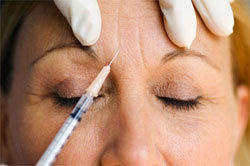
An American Academy of Cosmetic Surgery news brief has reported that a Houston oculoplastic surgeon, Dr. Charles Soparkar, has come up with a way to make Botox (and presumably all botulinum toxin neuromodulators) more effective and last longer. In a modified double blind, randomized, placebo-controlled, crossover pilot study and a subsequently completed formal study, the duration of effect was increased by 30% in over 90% of the patients studied. The study included both cosmetic and medical indications (blepharospasm, hemifacial spasm).

The theory goes like this: Botulinim toxin is very dependent upon zinc for effectiveness. Unfortunately, 50% of the US population is zinc deficient. Apparently, dietary zinc can be poorly absorbed due to binding elements found in many foods called phytates. Dr. Soparkar’s group posited that adding zinc to the diet of patients having a weak response or short duration of effect to botulinum toxin may be beneficial. Additionally, a phytate munching phytase enzyme was added to increase zinc bioavailability.

The result is a prescription medication called Zytaze. Each capsule contains 25mg of highly bioavailable zinc citrate and 1500 mg of Phytase. Patients take 2 caps daily for four days prior to AND on the day of injection. The drug is supplied in a 10 cap pack and cost $60 - $80. The result has been less frequent and decreased amounts of toxin needed and potential patient savings. (However, does the cost of the drug nullify these advantages?) This is great news for patients and a potential niche offering in the commoditized botulinum marketplace. Maybe not so great for practices depending on a high turnover of renewable products and services. 

Who else has experience with Zytaze?  

Dr. Rafael Estevez, Plastic Surgeon In The Dominican Republic.

Medical tourisim is growing rapicly. In this interview, Dr. Rafael Estevez talks about the current state of cosmetic medicine in Dominican Republic.

Dr. Rafael E. Estevez Dominican Republic Plastic SurgeonName: Rafael Ernesto E. Estevez, M.D.
Location: Santo Domingo, Dominican Republic
Website: doctorestevez.com

Can you tell us what is it like practicing cosmetic surgery in Dominican Republic in comparison with what you see in other countries?

The practice of plastic surgery in the Dominican Republic has risen as time passes by, and so have its standards of care. We now have state of the art facilities, where you can practice plastic surgery in a safe manner.

Read More

I Want To Be A Fibroblast!

medical spa md fibroblastWhat criteria is most important when choosing a treatment or technology to stimulate fibroblasts for skin rejuvenation?

Being a dermatologist focused on aesthetic treatment options for improving skin's condition  it's quality and overall appearance I clinically and scientifically overlook tons of different approaches.

Basically, and I think we can agree on this, many treatments try to target the fibroblast. Its about the stimulation of this branched tissue cell who's function is to maintain the structural integrity of connective tissues by continously secreting precursors of the extracellular matrix such as ground substance, a variety of fibers notably the reticular and elastic ones and cytokines.

The goal in many skin rejuvenation treatments is to activate and stimulate the fibroblasts... and there are countless strategies to do this: You might choose chemical peels, energy based devices such as non-fractionated or fractionated resurfacing lasers, intense pulsed light (IPL), infrared light or radiofrequency. One might think of dermal filler substances such as hyaluronic acid or – better – calciumhydroxylapatite (there are even publications on a stimulating effect botulinum toxin type a...). Further one might consider microneedling, dermabrasion, etc..

Or think about "newer" technologies such as platelet rich plasma, carboxytherapy, nitrogen plasma energy, kinetic HA (kinetic Hyaluronic Acid). And last but not least cosmeceuticals (this list is not exhaustive!!).

Which strategy to choose? It's actually very difficult to find way through this jungle!

I would like to encourage and activate the discussion here and ask for your opinion: What are the most important criteria for you when you do your choice? Is it about mangeability, about downtime, about scientific proof, about safety, about treatment protocols (such as e.g. multiple treatments), about clinical experience of other physicians, about availability, about the learning curve, about the deligability, about the costs?

What's your decision maker here?

Pioneer Of Non-Surgical Rhinoplasty, Dr. Alexander Rivkin In LA

Dr. Alexander Rivkin is an international authority on non-surgical cosmetic treatments who provides non-invasive and non-ablative treatments in Southern California.

Name: Alexander Rivkin, MD
Clinic: Westside Aesthetics
Location: Los Angeles, CA 
Website: Westside Aesthetics

That's Interesting: After several years of being an Allergan Clinical Educator, Dr. Rivkin was recently honored with Diamond level status: recognition that he is among the top 1% of Botox providers in the nation

He is a prominent member of the national teaching faculties for Allergan, Contura, Johnson and Johnson, Medicis and Bioform. He is also a member of the physician advisory board for Contura and serves on the boards of a number of charities including the Lynne Cohen Foundation for Breast and Ovarian Cancer Research.

I first met Dr. Rivkin somewhere around 2002 when I was attending a "medical spa conference" and Westside Aesthetics was on the tour. At the time, Westside Aesthetics was located above a salon but now Westside Medical Spa is tucked away on Gayley Avenue near UCLA. 

Dr. Rivkin is renowned for non-surgical alternatives to commonly performed cosmetic procedures. He was the first physician in the country to offer the Non-Surgical Nose Job, his signature method for non-invasive correction of cosmetic nasal irregularities.

Read More

Submit Embezzlement & Employee Theft Stories From Your Medical Practice Or Clinic

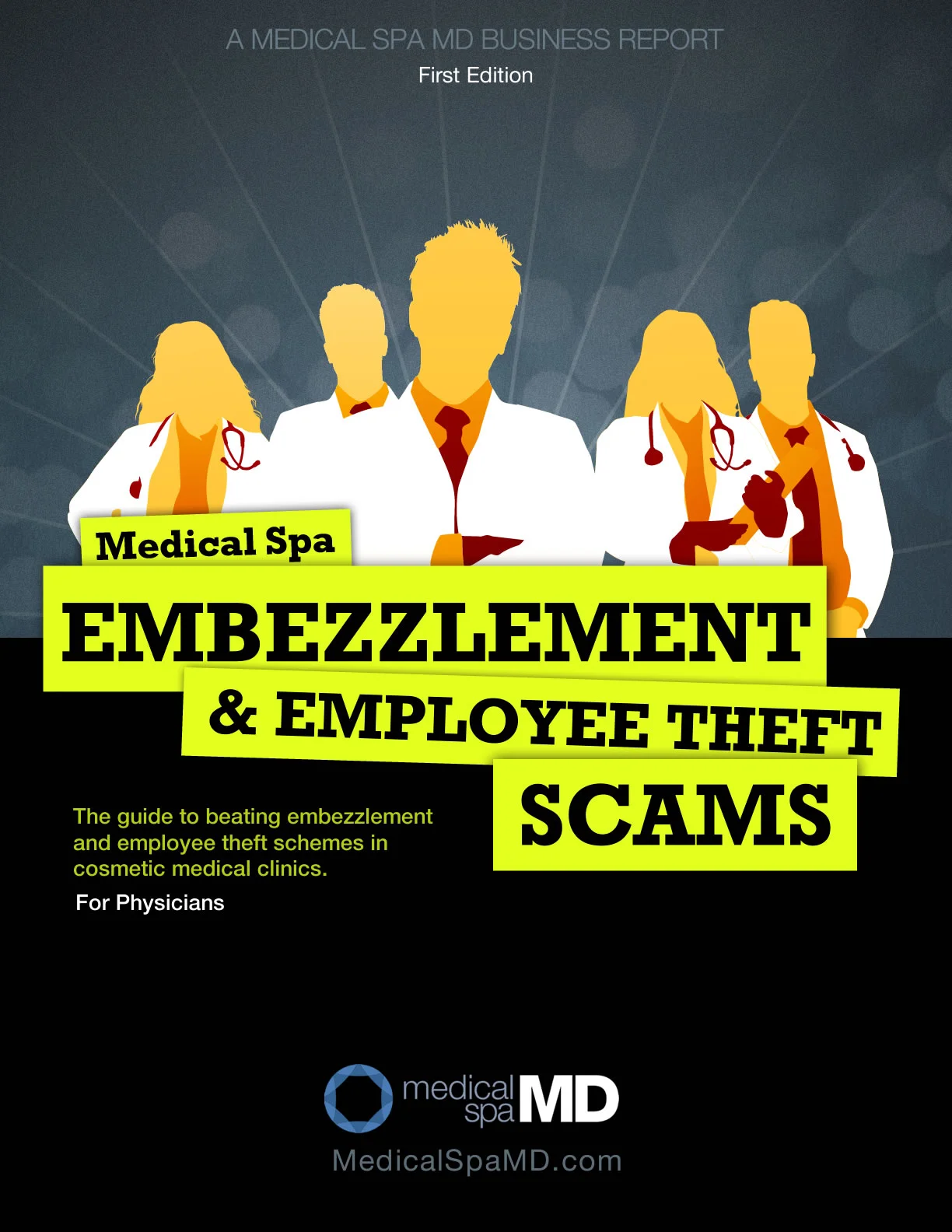
medspa embezzlementUnfortunately, employee embezzlement and theft in cosmetic medical clinics is commonplace. We're going to help you with that.

We've posted about theft and embezzlement before. Read: Embezzlement & Employee Theft: It can, and probably will, happen to you.

We're building a new loss prevention report that will cover this area and provide you with just about every trick in the book including:

  • How common embezzlement schemes are set up and how these criminals cover their tracks.
  • How thieves steal Botox and injectables to supply their side business.
  • Credit card and payment scams at the front desk.
  • Treatment room cash payments.
  • Inventory and product theft in the back room.
  • Everything else...

To do this we're reaching out to you, our Members and readers, and asking for your help. If you have inside knowledge of a situation that involved embezzlement or theft, that you let us know by submitting your story and giving us all the gory details. (No identifiable information is required so you can tell the story anonymously if you wish.)

We're compiling these submissions as well as drawing on our own experiences and contacting embezzlement and loss prevention experts to produce a comprehensive blueprint for protecting your clinic and your business that will give you insight into how these scams work, and how you can prevent them.

If you have any thoughts on this topic or what we should include, please leave them in the comments below.

Getting Your FDA 510(k) Medical Device Approved: How Long Does It Take?

How long does it take to get FDA approval for your medical device? About 90 days according to Palomar's CFO Paul Weiner.

Since we posted about Fairwarning's article on the RevecoMED LipoTron (or Lipo-Ex) there has been a lot of fiery back-and-forth in the comments and we've been getting more than the usual number of emails, including emails asking us questons about FDA approvals of medical devices in the US.

Read Fairwarning: The LipoTron 3000 (Lipo-Ex) FDA UnApproved $85k Massager

Now I have no real experience with any of the individuals or companies involved but one of the comments from the Fairwarning article caught my attention. It was this:

The company’s (RevecoMED's) initial application “wasn’t in-depth enough,” Rosen said, and the FDA repeatedly sought additional data. Finally, according to Rosen, “We said, ‘You know what, it’s not worth it.”

"It's not worth it"?

I would have thought that any business producing and selling cosmetic medical devices in the US would view FDA approval as being absolutely mandatory.

Perhaps the LipoTron guys know something I don't.

Read More

Top 10 Countries For Cosmetic Procedures

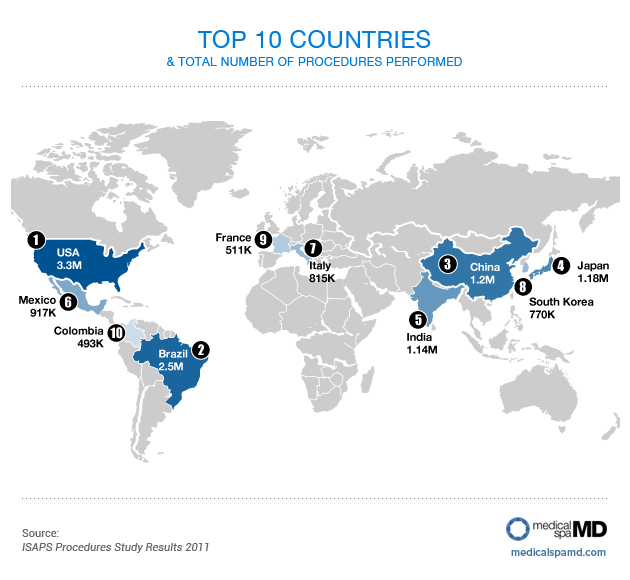
According to the International Society of Aesthetic Plastic Surgery, here are the top 10 countries ranked by number of cosmetic procedures.

Top 10 Countries For Cosmetic Procedures - Medical Spa MDSome interesting facts according to the report:

  • Japan moved from #6 in 2009 to #4 in 2011.
  • France moved from #14 to #9 in the same period.
  • The US dominates with just under 18% of procedures worldwide.
  • Asia performs the most treatments by continent with 28.8% of plastic surgeons and 31.7% of total procedures. North America is second with 24.3% of the worlds plastic surgeons and 24.6% of the total procedures.

Dr. Roy Kim - Plastic Surgeon In San Francisco

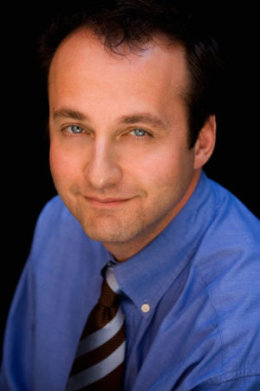
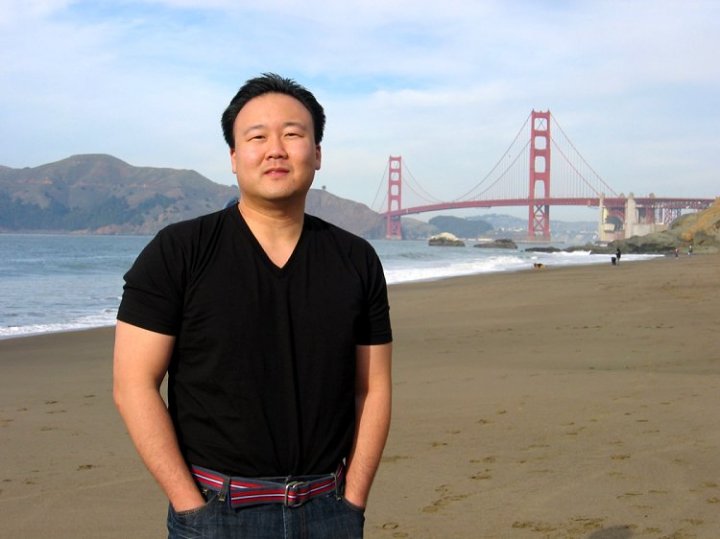
Dr. Roy Kim San Francisco,Board Certified Plastic Surgeon

Dr. Roy Kim shares his thoughs on social media, marketing, technologies and treatments including the Iguide neck lift system.

Name: Roy Kim, MD
Location: San Francisco, CA
Website: drkim.com

That's interesting: Dr. Kim has gone to Guatemala several times, and he has operated on patients from Rwanda as well. 

Dr. Kim is also an investigator in several elite clinical trials regarding facial fillers, the Iguide system, and cohesive or “gummy bear” implants and is a member of Operation Access, a way for local San Franciscans to get free health care.

You've got a blog on your site, you're on Facebook, Google +, LinkedIn and Twitter. You seem to be comfortable with social media and reaching out to patients online. How much of your marketing efforts are now online and are they working?

Most of my marketing efforts are concentrated on

Read More

"Hello Doctor. I Wouldn't Hesitate To Sue You."

medical malpracticeGuest post by Dr. Mandy Huggins

How many times during your day does the specter of a malpractice law suite rear its ugly head?

“I wouldn’t hesitate to sue you.”

"I’m sorry, what?"

That is what I heard from the mother of one of my patients. At the time, I was only 2-3 months into practice, and I was evaluating a high school athlete who had recurrent stingers and a possible episode of transient quadriparesis . I wasn’t on the sidelines for these injuries, so I had to go on the reports given to me by the athlete and the school’s athletic trainer. However, with that information, I did not want to clear this player to return to football until I could be certain he didn’t have cervical stenosis or any other abnormality that might put him at risk for permanent damage if he suffered another neck injury. I told the athlete and his mother that I needed to get an MRI of his cervical spine in order to determine this. The athlete was understandably upset with my decision, but his mother supported my decision to proceed with caution. She explained to me that if her son played again, sustained another injury, and something “bad” happened, she would be more than happy to take legal action against me.

Fantastic.

Read More

The Other Side Of Medical Tourism - A Surgeons Nightmare

The Other Side Of Medical Tourism - A Surgeons Nightmare

Medical TourismGuest post by Samuel Bledsoe MD

There is an element of a gamble inherent in the medical tourism industry as it currently exists.

An interesting thing happened to me at work the other day.  It was Friday afternoon, and I received a call from a primary care doctor. The phone call began with, “I’m really sorry about this, but I have a surgeon’s nightmare in my office.”

This is not a good way to begin a conversation.

He began to tell me about the patient. This particular woman had a Lap Band placed several years ago. For one reason or another, she decided that she would like this converted to a different procedure. She drove by my hospital to get to the airport, hopped on a plane and flew over hundreds of other well-qualified bariatric surgeons in order to reach a surgeon in Mexico where she had her Lap Band removed. She then returned 6 months later and had a sleeve gastrectomy. This is where things go bad.

Read More

Dr. Carey Nease, Southern Surgical Arts In Chattanooga, TN

Dr. Carey Nease Board Certified Tennessee Cosmetic SurgeonDr. Carey Nease's goal is to impact the lives of his patients in a way that they are transformed, but not different. 

Name: Carey Nease, MD
Clinic: Southern Surgical Arts
Location: Chattanooga, TN
Website: southernsurgicalarts.com

That's interesting: Dr. Nease is a Fellowship Director of the American Academy of Cosmetic Surgery and trains surgeons from around the country the latest techniques in cosmetic surgery. The fellowship is a one-year training program open to current ABMS-certified general surgeons, plastic surgeons and head and neck surgeons. He is also a board-examiner and trustee of the American Board of Cosmetic Surgery and trains other surgeons around the United States in SmartLipo and Affirm fractionated CO2 laser resurfacing.

Read More

Is Technology Changing The Doctor-Patient Relationship (for the Worse)?

The first point of contact for a patient to ask post-surgical questions should be the surgeon who performed said surgery. The trend seems to be in exactly the opposite direction.

I've noticed a concerning trend. I participate in websites like RealSelf.com that connect plastic surgery patients and cosmetic surgeons. These sites are allowing patients to have near immediate access to expert plastic surgeons from across the nation and plastic surgeons to interact with potential patients.

In the past few months an increasing number of patients in the early post-operative period (some with dressings still in place!) have posed questions to “online surgeons” seemingly before seeking follow-up with the plastic surgeon who just performed the procedure. It is concerning that a patient would seek advice from a surgeon they do not have a doctor-patient relationship with and who is unfamiliar with the specifics of the surgery that they've recently undergone. Patients have even gone so far as to inquire about where to seek second opinions and whether revision surgery will be necessary all within the first post-operative week.

The early post-operative timing of this phenomenon is most concerning. This is the period in which we need to reassure our patients that bruising and swelling will resolve, dressings and sutures will be removed and that they truly will look great once they’ve healed. This period can cause patients significant distress and many require a lot of hand holding at this point.

We’re obviously failing some of our patients if they're reaching out online during this period instead of calling our offices and dropping in to be evaluated. I agree that second opinions are highly valuable and would not hesitate to arrange such for a concerned patient. However, a patient-initiated second opinion from an unfamiliar, online surgeon who has an incomplete picture of the patient's history is problematic at any time point let alone while the compression dressing is still in place!

What could possibly be responsible for this trend? As cosmetic surgeons are we so difficult to reach that our patients need to seek online advice from others? As we become more amenable to interacting with potential patients online are we failing to care for those who have already made a trip to our operating room? Is it simply easier for our patients to log onto a website rather than call the doctor's office? What can we do to direct those online inquires back to our own practices rather than into the digital ether?

As a Facial Plastic Surgery practice, my entire team is in the business of building relationships. If a patient has a professional, responsible and ethical plastic surgeon, the first point of contact to ask post-surgical questions should be the surgeon who performed said surgery. This trend seems about as far astray of that goal as one could imagine.

Has anybody else noticed this trend online? Have you experienced this with one of your own patients? What you have done to prevent this from happening in your practice? Please contribute your thoughts.

Posting Comments On Medical Spa MD: Do's & Don'ts

We get the occasional email asking why someone's comment was deleted. Here are some answers.

Deleted comments are most often the result of someone committing one of the henious crimes on the list of "dont's" below, but there can be other fouls result in a comment being edited or deleted. (We usualy try to leave a comment notifying readers that a comment has been edited for violating our terms.

Here are some do's and don'ts that we use to help manage the comments on the site.

Read More

Fairwarning: The LipoTron 3000 FDA UnApproved $85k Massager

Lipotron Medical Spa MD

According to a new story on Fairwarning.org, RevecoMED claims that their LipoTron device is really being marketed and sold as an $85,000 massager.

I just got off the phone with Myron Levin or Fairwarning.org who contacted me about Advanced Aesthetic Concepts attempts to have comments and reviews about the Lipotron 3000 and their business removed from Medical Spa MD claiming that some negative comments were costing them sales. It was an intersting discussion and Myron filled me in on some of the background that went into the story which has some interesting twists including anonymous calls to the FDA and secretive meetings with criminal investigators.

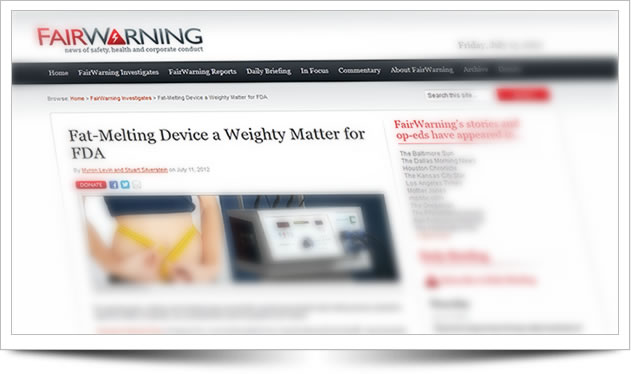
Read the entire article here: Fat-Melting Device a Weighty Matter for FDA on Fairwarning.org

From the Fairwarning.org article: 

According to interviews and records, Reveco first sought a green light from the FDA in 2007. It chose the FDA’s market clearance procedure, which is less demanding than the formal approval process.

To get a new device cleared this way, the manufacturer must show it is similar in safety and effectiveness to products that are already on the market.

However, Reveco’s bid failed. The company’s initial application “wasn’t in-depth enough,” Rosen said, and the FDA repeatedly sought additional data. Finally, according to Rosen, “We said, ‘You know what, it’s not worth it.”

According to interviews and a document reviewed by FairWarning, the FDA then told Reveco that the device could not be marketed.

LipoTron sales continued, however. Rosen wouldn’t disclose how many of the devices have been sold, but the number is believed to be in the low hundreds.

In 2011, Reveco took another tack with the FDA. It classified the LipoTron as a massager used for relief of minor pain. That would make it, in FDA parlance, a Class 1 device — a category that includes such simple, low-risk items as elastic bandages and examination gloves.

The advantage for Reveco is that massagers can be sold without a green light from the FDA. They automatically are exempt from FDA review and can be put on the market once a notice is filed.

Yet doctors and med spas have been promoting the device on the Internet not for massages but for removing fat.

Rosen said that was not Reveco’s responsibility, stating that the company can’t dictate what doctors do or “police everything out on the Internet.”

Asked who would pay $85,000 for a massager, Rosen replied: “Anybody that wants to buy it.”

Wow. It would take some really big cajones to claim that you're selling an $80k+ device named LipoTron to cosmetic clinics from a company named RevecoMED but you're only marketing it as "a massager for minor pain" and that it's the doctors who are running around uncontrolled promoting it for fat-melting. I'm actually somewhat impressed. I guess the real lesson is that if you can't get your device approved by the FDA as a medical device the first time, reclassify it as a band-aid and declare yourself in full compliance. That seems simple enough. 

Of course it also seems fairly clear from the article that if you have one of these devices and you're promoting it as FDA approved or as a treatment for anything other than a 'massager' you might not be in lock-step with the FDA, a fact that might be exacerbated by the fact that this story has been picked up by major media outlets like MSN.com.

I'm curious; Does anyone have one of these Lipotron devices that they're using as a massager for minor pain? You might want to see if it works on yourself because I'm guessing you have a headache about now.

Stem Cells & The Vampire Facelift

If you attend medical conferences, or read the trade journals, you’ve no doubt heard about stem cells and their incredible potential in the healthcare industry. These cells have the ability to repair or replace damaged cells, reduce inflammation, and possibly even have a role in disease prevention and cure.

Lately, these cells have been the target of much interest in the cosmetic field. Platelet-rich plasma (PRP) is the portion of the blood that remains after centrifugation has separated out the red cells. This fraction is unusually rich in growth factors and stem cells, that have the ability to repair damaged skin, and act as a long-lasting filler to volumize the face. The PRP is activated using calcium, and then is immediately injected into the donor’s face.

At Canyon Lake MedSpa, we have been using the patented “Vampire Facelift” technique (Regen Labs) in conjunction with standard HA or CHA fillers. We inject the filler using standard technique and then layer the PRP on top. Although still very new to this technique, we believe we are seeing the early effects including improved skin tone and color. Research has documented significant prolongation of filler effect, but we have not been doing this procedure long enough to attest to that yet.

Since we are only minimally manipulating the blood (centrifuging and decanting off the PRP) in a completely closed system, and re-injecting it into the same patient, there is virtually no risk.

In our next article we will discuss, in greater detail, tips on collecting and injecting PRP, how to educate patients and the outcome of our patients’ results.

There has been tremendous interest in the very-well marketed “Vampire Face Lift” and we have experienced an increase in our Med Spa new-patient visits as a result of this interest.