Dr. 90210: Robert Rey MD's saves plane from geriatric flight attendant pusher.

dr90210.jpgThis is just too funny. Dr. Rober Ray, the Brazilian plastic surgeon from Dr. 90210, finally got a chance to utilize his training and show why he has all his scrubs without sleeves.

From CBS news: An elderly man on an American Airlines flight was restrained by passengers, including television's "Dr. 90210," after he got out of his seat and shoved a flight attendant late Monday, officials said. 

Dr. Robert Rey, a plastic surgeon who practices martial arts, told The Associated Press he got out of his seat and intervened when he heard the man make a "big noise" as he pushed a female flight attendant toward the cockpit.

"When you get a black belt, at that stage your brain just clicks into action," the doctor said. "I restrained this gentleman in a very aggressive way without hurting him." 

Of course the story continues with this:

Flight crew members described the man as "very frail".

Fighting Obesity: Weight Loss Wars & E-Health Compete

weightlosswars.gifWith Americas ballooning waistline (mine included), obesity is a prime concern for everyone. Technology to the rescue.

E-Health Compete & Weight Loss Wars provide a kind of 'we're all in this together' feel for groups trying to shed a few pounds.

Weight Loss Wars

 Fun for the whole family:

In a few simple steps WeightLossWars allows you to create weight loss or exercise competitions among your friends and family. You can compete belly to belly, or team against team. It is your competition, you build it how you want, and compete against who you want, for the prizes you want.

E Health Compete

Save your business money on health care:

These full scale programs are results driven and include a detailed report on the outcomes of the campaign. That way you can keep your finger on the pulse of your investment in eHealthCompete.

Surface Medical: Opening in Nashville.

277.31.jpgSurface is bringing a new tune to Nashville.

 
Nashville will be the headquarters and jumping off location for a new Surface company who's developing new medical cosmetic centers in the South East.

Surface SE, a new company formed expressly for this purpose, has built out the Beta site in an upscale suburb of Nashville. My partner at Surface, Dr. Aaron Barson, has been busy training the physicians for this new location.

This marks a change in the wind for the deliver of cosmetic medical services.

Why? Because Surface SE is bringing to bear the operations and scale of major business to the market.

There have been a number of franchises and startups that have tried in a limited way to do this before. There are a number of reasons that they've failed; undercapitalization, poor operational skill, and misunderstanding the market. We think that Surface SE has none of these shortcomings.

Surface South East

This new clinic is the first of a new breed of retail medical businesses. (It's the technology stupid.) that are able to compete as real businesses rather than individual physicians. 

Individual physicians will find themselves unable to compete on the same level. I don't mean this to be condescending. It's a fact.

Imagine this: You're a physician with a successful medical practice with loyal patients and great reputation. Your appointment book is overflowing with a host of patient eager for your services. But now a new clinic opens up down the street. It's offering treatments you've never heard and can't get. It's open 20 hours a week more than you. It performs to the highest medical standards and has customer service out the ying yang. It has an advertising budget that's 20 times more than you've ever spent. It has corporate programs, associate programs, affiliates with large businesses. In short, it runs as a professional corporation with it's sights set squarely on you. You find yourself in the position of the small town store whom everyone loves. But when Wal-Mart opens up in the same town it just doesn't matter.

Unlike the current batch of medical spa franchises (What I think of medspa franchises) these new clinics are built entirely around physicians. And not fly-by-night physicians who are there just a a figurehead, physicians who specialize exclusively in this area. Every patient, from upper lip hair removal to whatever, is see by a physician.

What will individual & group physicians do? 

Hey, we're not there yet. For the near future, the market will continue on in the same way with a few subtle changes. There will always be ways to be successful and compete, but it will necessitate changing. The consolidation of the market that will take place over then next 5 years will present opportunity as well as potential problems. Physicians who are able to adapt to the new paradigm will be able to grow, but the key will be to find a niche. 

Black Market Botox....A Better Buy?

Botox: $50 for 100mu?

Thought that would grab your attention.  I've heard you can find Botox on the internet for that price.  I wouldn't recommend it.

Occasionally a patient will ask me to explain why those people in Florida "died from Botox."  They are referring to a story that was widely publicized in early 2005 about some people in Florida who were sent to the hospital after receiving phony Botox injections and becoming paralyzed.  There was another story around the same time of a woman in California who died from Botox injections done by a hair stylist.  Hair stylist?  Yes, you read that right.  The very important distinction is that they didn't actually ever have Botox injected into them.  They were duped and actually had raw-grade Botulinum toxin type A used on them. 

Right about now you might be thinking, well that would certainly never happen to me.  My vials all say Botox and have the purple, red, orange colors on the box.  Matter of fact, I'm guessing that the guy in Florida thought his product was safe since he used it on himself.  I actually know a physician who had ordered, but never used, this killer Botox that he ordered from the same source. He thought he'd found a better source to get the real thing at a cheaper price.

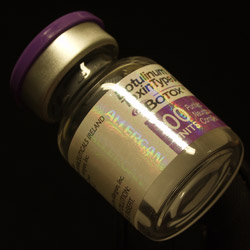
Botox is a trademarked name for a substance that is made by Allergan. Anything else is phony and potentially very dangerous and most certainly not worth the savings that might be had.  This bootleg industry has become so prolific that I wanted to be sure everyone knew what to look for and what to avoid.  Fake Botox is frequently made in China or Korea. Authentic Botox is made and distributed world wide by Allergan and has a hologram indicating it's credibility.

To view the hologram on a vial of Botox:

1) Examine the vial under a desk lamp or fluorescent light source

2) Rotate the vial back and forth between your fingers; look for horizontal lines of rainbow color on the label

3) Confirm that the name "ALLERGAN" appears within the rainbow lines.

I'm guessing that this black market industry will soon learn how to counterfeit the hologram as well.

Medical Spa MD: Top 10 Blog Posts

Medical Spa Top 10 

Top Community Forums:


The 10 most read posts on Medical Spa MD.


Medical Spa MD Series: Inside a Sona medical spa franchise.

Medical Spa MD: Most commented on posts

Top Searches on Medspa MD: Posts & Comments

To search for any posts, article or comments on Medical Spa MD, input your query into the search box at the top of the navigation menu. Here are some of the top searches on Medspa MD.

Top Ten Medspa Lists:

Start Your Medical Spa Here:

Medical Spa Franchises & Consultants

Physician Turf Wars in Cosmetic Medicine:

Medical Spa Legal Issues:

Non-surgical Medical Technologies:

Inside A Medical Spa Franchise Series:

Filler Injections: The old and the new.

From a Wall Street Journal Article: Face Time: The new injectables.

restylane_treatment.jpgOn the Market Now

 Botox: A neurotoxin drug that is by far the most common injectable, with more than three million procedures reported last year. Botox temporarily paralyzes muscles with a series of tiny shots, smoothing frown lines between the eyebrows and crow's feet around the eyes. It is the only neurotoxin approved for cosmetic use in the U.S. Lasts three to four months. Average physician fee: $363. From Allergan Inc., Irvine, Calif.
 
 Restylane: The second-most-common injectable, with about 700,000 procedures in the U.S. last year, Restylane is a filler that plumps up creases under the skin and is mostly used on the lower face. It is made from hyaluronic acid, a natural sugar that binds to water, creating temporary volume. Lasts six months or longer. Average price for all hyaluronic acids: $557. From Medicis Pharmaceutical Corp. (A thicker version, Perlane, is awaiting FDA approval. Medicis is also developing other versions to complement its brand, including Lipp, Fine Lines and SubQ.)
 
 Juvéderm: A new hyaluronic acid in limited release that is going up against Restylane. Doctors like its ease of injection, but competition will focus on relative cost and duration. The cost to physicians is slightly more than Restylane, but retail pricing won't be clear until after Allergan officially launches Juvéderm in January. Allergan's older Hylaform and Captique products don't last as long as Juvéderm or Restylane.
 
 CosmoDerm: A collagen product that, unlike its 18-year-old predecessors, Zyderm and Zyplast, doesn't require an allergy skin test several weeks before treatment. Zyderm and Zyplast are harvested from cows, whereas CosmoDerm and its sister product CosmoPlast are made in a laboratory from human collagen, a natural component of the skin. CosmoPlast is used in deeper lines and furrows. Treatments are also popular in the lip border and fine lines above the mouth. Average fee for all collagen products: $390. Allergan.
 
 Radiesse: Made from tiny calcium particles that create a scaffold for the body's own collagen to grow. Approved for craniofacial surgery. In August, an FDA panel recommended approval for smile-line wrinkles, but the agency hasn't ruled yet. Some dermatologists who use it off-label for cosmetic applications caution that particles can migrate and cause nodules, especially in the lips. Some tests show it lasts perhaps a year or longer. Average fee: $914. From BioForm Medical Inc., San Mateo, Calif.
 
 Sculptra: A synthetic polymer that stimulates new collagen production. Approved in 2004 for treating facial fat loss in HIV patients, but used off-label by some cosmetic dermatologists. It is reported to last a year or more. There have been some reported incidences of delayed small bumps under the skin. Average physician fee: $876. From Dermik Laboratories, a unit of France's Sanofi Aventis.
 
 ArteFill: A permanent implant approved last month for treating smile lines. Early versions of the product, sold in Europe and Canada, caused reactions called granulomas in some patients. Many doctors won't use it, but advocates say it's especially good for acne scars. Results are reported to be very dependent on the medical practitioner's technique. Price hasn't been announced. Artes Medical Inc., San Diego.
 
 Silicone: A permanent, liquid injectable that is making a comeback. Many doctors stopped using it a decade ago, especially after silicone breast implants were taken off the market. It remains controversial, but some dermatologists are using a purified product sold by Alcon Inc. for eye surgery. Like ArteFill, it's an option for permanent filling of facial scars.
 

Coming Soon

 Evolence: A collagen product developed by the Israeli company, Colbar LifeSciences, that was recently purchased by pharmaceutical titan Johnson & Johnson. Evolence is reported to be in late-stage human tests in the U.S. Dermatologists are buzzing about its potential to last a year or more and supplant other collagens on the market.
 
 Puragen Plus: A hyaluronic acid filler, expected to last about six months, about the same duration as Restylane and Juvéderm. Mentor Corp. launched Puragen in Europe last year. Puragen Plus includes an anesthetic, lidocaine, that the company says make the injections less painful than those of other fillers. Mentor hopes to launch in the U.S. late next year.
 
 Laresse: A biomaterial used in spine surgery that has been developed as a filler, expected to last about six months. Launched in the U.K. this summer. Entering U.S. human tests soon, possibly on the market in 2008. FzioMed Inc., San Luis Obispo, Calif.
 
 Aquamid: A permanent filler made from a biomaterial used in contact lenses and other medical devices. Sold for cosmetic use throughout Europe. FDA human tests expected to begin in the U.S. soon. Contura International A/S, Denmark.
 
 Reloxin: A Botox-like drug undergoing human tests in the U.S. Expected launch in 2008. Physicians hope it will break Botox's monopoly and bring down prices. Sold in Europe under the brand name Dysport. At the Palm Desert meeting, preliminary data were presented by a U.K. physician indicating it might not last as long as Botox. Medicis has U.S. rights.
 
 Puretox: Another potential Botox rival. Technology licensed by Mentor from the University of Wisconsin. A researcher there decades ago helped develop the purification process for botulinum toxin that later became Botox.

Clear Skin: The one universal beauty truth.

dove-real-beauty.jpg


The Ponderance blog shows the excellent Dove Real Beauty video (via YouTube), in which a rather unassuming woman is transformed into a billboard model: Ponderance: Real Beauty Vs Photoshop (or: An Important Video for Young People).

The Photoshop Lab presents a quick tutorial on how to instantly add years to someone's face, using Salma Hayek as an example: Aging People.


Retail Medicine: Don't nickle & dime your patients.

dime.jpgLittle added fees = pissed off patients.

If you're adding small fees to your service to cover your costs, you're pissing off your patients. If you didn't guess, pissed patients don't speak kindly of you. Actually, I'm a proponent of the flat fee. I hate the little charges.

From Ronda Abrams 

When I went into business, I sat down with a lawyer to review my legal and tax responsibilities. When we finished, he gave me some wise advice.

"Rhonda," he said, "don't nickel-and-dime your clients. Clients willingly pay thousands of dollars in hourly fees without complaint, but if I bill them $2 in long-distance calls, they'll get upset. It's small items that alienate clients."

We all react negatively to what we see as petty little fees that should be part of what we've paid for. A patient might be willing to spend $3000 for liposuction but she doesn't want to be charged for the laundry service or the support hose. The tiny fees at the end mark you as a cheapskate. It's better to charge an extra $100 for the service and give the hose away for free.

Make the most of the fact that you're not charging for these extra services. After all, you're a physician angel and friend to all your patients, right? Have your front desk go through the bill detailing the little suff as "Complimentary" or "Fee Waived." That lets the patient know you could charge them but haven't, increasing customer loyalty. Make the last interaction the most pleasant; go ahead and give the wheelchair ride for free.

American Academy of Dermatology: Skin cancer & tanning beds.

ITisOUT120x240.jpgFrom the AAD: Skin Cancer Public Service Advertisements


The ADD has a campaign targeting teens to try to prevent them from using tanning beds. A Swedish study presents strong evidence that indoor tanning increases the risk of melanoma, especially when indoor tanning begins at an early age.

From the American Academy of Dermatology:
On an average day, more than one million Americans tan in tanning salons. Of the customers, 70 percent are Caucasian girls and women, aged 16 to 49 years. These numbers continue to rise each year, despite research which demonstrates the risks of indoor tanning, including premature aging such as age spots and wrinkles, and even worse, the danger of skin cancer. To help educate the public, particularly teenagers, the Academy’s 2006 – 2007 skin cancer public service advertisement (PSA) campaign speaks to teens in a language they can understand, instant messaging (IM).  Approximately 53 million American computer users – most of them teens – use IMs. Many exchange IMs more frequently than e-mail. It has a language all its own, and the Academy has developed this campaign specifically for teens who use it.

Fact Sheets

Indoor Tanning Fact Sheet 
Skin Cancer Fact Sheet (2006)
Melanoma Fact Sheet (2006)

Articles from The Journal of the American Academy of Dermatology

The indoor UV tanning industry: A review of skin cancer risk, claims, and regulation 
Do adolescent tanners exhibit dependency?
Sunlight, tanning booths and vitamin D

Articles from other scientific, peer-reviewed journals

Pediatrics

Use of sunscreen, sunburning rates, and tanning bed use among more than 10,000 US children and adolescents

Pamphlets

The Darker Side of Tanning
Ultraviolet Index 
Skin Cancer
Basal Cell Carcinoma
Squamous Cell Carcinoma
Melanoma

More information on skin cancer

SkinCancerNet

The Biology of B-Movie Monsters

21701757_shrinkingman.jpgThe Biology of B-Movie Monsters 

Among the most interesting posts I've ever read.

Michael C. LaBarbera, professor in Organismal Biology & Anatomy & Geophysical Sciences at the College of the University of Chicago, has written an unbelievably interesting piece about the science behind horror movies like King Kong, The Incredible Shrinking Women, Them, and Fantastic Voyage. An incredibly interesting read.

In The Incredible Shrinking Man (1957), the hero is exposed to radioactive toxic waste and finds himself growing smaller and smaller. He is lost to family and friends while fending off the household cat and must make his own way in a world grown monstrously large. He forages food from crumbs and drinks from puddles of condensation. In one famous scene, he defends himself against a house spider by using an abandoned sewing needle, which he has to struggle to lift.

Stop the projector! Time for a little analysis...

...As for the contest with the spider, the battle is indeed biased, but not the way the movie would have you believe. Certainly the spider has a wicked set of poison fangs and some advantage because it wears its skeleton on the outside, where it can function as armor. But our hero, because of his increased metabolic rate, will be bouncing around like a mouse on amphetamines. He wouldn't struggle to lift the sewing needle--he'd wield it like a rapier because his relative strength has increased about 70 fold. The forces that a muscle can produce are proportional to its cross-sectional area (length squared), while body mass is proportional to volume (length cubed). The ratio of an animal's ability to generate force to its body mass scales approximately as 1/length; smaller animals are proportionally stronger. This geometric truth explains why an ant can famously life 50 times its body weight, while we can barely get the groceries up the stairs; were we the size of ants, we could lift 50 times our body weight, too. As for the Shrinking Man, pity the poor spider.

Botox? Restylane? Fraxel? How big business is getting into your wallet.

theft.gifTime article: Buying your face


Botox is no longer the only game in town. With competitors ready to pounce on an expiring patent, Allergan is bringing the guns to bear.

Allergan: Botox & Juvederm

Allergan, a specialty pharmaceutical outfit with sales of $2.9 billion, will put the same marketing muscle behind Juvéderm that made Botox a household name. There are some potential wrinkles in that plan, though. Botox, a facial-muscle relaxant that was used by some 3.5 million people last year, had the market to itself; Juvéderm has a competitor before it's even out of the box: Restylane, the current best-selling hyaluronic-acid filler, made by Medicis, a $344 million dermatological company based in Scottsdale, Ariz. And Medicis' Perlane, a more robust version of Restylane, is expected to get the FDA's thumbs-up any day now. Down the road, there's a possibly even bigger blow, Reloxin, a Botox-like alternative.

Also in Medicis' corner: plans for a Medicis-sponsored reality-TV show, The Hottest Mom in America.

(Please not another plastic surgery reality show.) But the Fraxel Crew is not to be outdone. Following the Thermage business model of high cost disposables, Reliants got a plan to get into consumables too.

Reliant: Doctors have money. We want some. 

Reliant Technologies, a privately held company in Mountain View, Calif., known for its popular resurfacing laser, Fraxel. Its newest model, Fraxel SR1500, which lets dermatologists treat deeper layers of skin, sells for $110,000. Orders have been pouring in, but the revenue stream doesn't stop there. The handheld device requires a special tip that needs to be replaced after four to six treatments. Cost per tip: $400. "It is a great business model," says Reliant vice president of global sales Keith J. Sullivan, with a grin.

I'll bet if Keith J. Sullivan was speaking to a medical journal and not a business publication there would have been less smirking. Anyone really think that the tip costs Reliant more than $10?

Physician Oversight & Scope Of Practice: What's legal in a medical spa?

int-05.jpgPhysician oversight & scope of practice in medspas.


We receive an ever growing number of questions about physician oversight, scope of practice, and other legal issues surrounding medical spas. What oversight is required? What can I do? What can't I do? Here's our opinion (ie. not a legal one.)

The quick growth of medical spas has led to something of a Wild West mentality. Many spa owners and even some physicians are trying to jump into this market. Unfortunately, this has landed a number of medical spas in hot water. Very hot. Medical spa professionals and many physicians don't understand the legal ramifications of what they're doing. What's legal? What's not?

Here's a sample: "Hello, I am an esthetician currently working in a day spa. My boss has decided to buy and train another esthetician and myself on the Thermage system. Since we are a medical spa, there is no practicing physician on the premises. My question to you is; how legal will our Thermage treatments be without an overseeing physician? By performing these treatments, will my license be on the line?"

Short Answer: Performing Thermage under the above circumstances is practicing medicine without a license.

Longer Answer: There are a couple of problems the question alludes to. First, the 'boss' appears to be someone other than a physician. Non-physicians can not purchase medical devices restricted by the FDA to physicians only. Second, if patients would be treated medically without an examination or being seen by a physician that is absolutely illegal. Third, 'no physician on the premises' is a big red flag. Doctors can not extend their licence to Thermage any more than they can extend it to surgery. It doesn't matter that a physician is directing that the treatment be performed or that your boss thinks it's safe. Fourth, Yes, your licence is at risk. Anyone performing medical treatments without adequate oversight is going to be between a rock and a hard place if anything happens. Thermage (and every other medical treatment) have potentially harmful side effects. Don't think for a moment that you, the doctor, or the business are protected by a physicians medical malpractice if a treatment is performed illegally. (Always check with an experienced lawyer.)

Physician Oversight

Physicians are responsible for every treatment performed under their medical license. If it's a medical treatment, the physician is responsible and liable for the performance of that treatment. The state medical board has jurisdiction as to scope of practice and physicians can't extend the scope of their medical license.

Aestheticians and medical spa technicians performing 'medical treatments' are doing so under the license of a doctor. If the doctor can't extend his license to that particular treatment, it's not covered by his licence and is being performed illegally. Anyone, including the physician, involved with treating patients without legal medical supervision is asking for trouble.

Post your question as a comment on this post and we'll add the answers here.

Question: I really appreciated this article. But I'm wondering, what are the issues involving an registered nurse or nurse practicioner, both of which are entering the esthetics industry? Does a spa offering Botox with a np need a doctor on site? What if that np is working in a state in which np's can operate as an individual business? What options does a spa have with nurses as opposed to a doctor or esthetician?   Spalady

Answer: Nurse Practitioners (NP's) and Physicians Assistants (PA's) in some states have the ability to operate outside of the direct supervision of physicians.

Both must have an arrangement with a physician to supervise them and enter into an agreement with their supervising physician that gives access to the doc. PA's are limited in that they can not open up a business by themselves and have to report more directly. (Which is one reason PA's are more attractive to physicians since they can't just open up in competition with you.)

Registered Nurses (RN's) do not have the ability to operate outside of the direct supervision of a physician in the same way as NP's.

It breaks down as this: NP's and PA's may have the ability to provide medical oversight if a physician is not physically on site, RN's do not. You should always, always, always, have your lawyer check with the state since they're the ones who will decide.

Good advice from a lawyer I know is this: write to the state detailing exactly what you are doing. Do not try to sugar coat it at all. Ask for a written reply from the state saying that they have no problem with you. Keep this as documentation if something goes amiss. That way you have a state regulatory body saying that you were performing within the scope of practice. Excellent advice.

Read the comments since there is some elaboration on scope of practice.  

Boutique & Concierge Medicine: Doctors on retainer.

logo.jpgMarketwatch: Boutique & Concierge Medicine

Boutique Medicine: Patients pay a flat annual fee to a primary-care doctor who caters to a smaller group of patients.

There has been a lot of media attention on the supposed rush into concierge medicine by unhappy docs. I haven't seen much of a rush. There are a few doctors I know that have discussed or investigated this as a possibility but I can't think of any that I know personally that have tried this.

From the article: Dr. William Plested, president of the American Medical Association and a thoracic and cardiovascular surgeon in Santa Monica, Calif., said doctors making the transition to a retainer practice are obligated to ensure the patients who don't join find a reasonable alternative. "The idea is certainly not to leave a patient in the lurch. The idea is to improve the type of service you're providing -- improve it for yourself and for your patients."

He and Caplan agree that boutique medicine is likely to stay a niche practice.

"It's a tiny drop in a huge ocean," Plested said. "The economic reality and demographic reality is there aren't that many areas that will support this type of practice."
Still, retainer practices point to an uncomfortable truth, Caplan said. "It undermines one of our favorite myths, which is same quality of health care for all. That's never been true, but this rubs our nose in it as a society."
Any one have experience with or thoughts on this? 

Anti-Aging: Lower temp. = longer lifespan

sstbar.gifFrom NewScientist.com: Cool down live longer.

Researchers have found that lowering the body temperature of mice by just 0.5°C extends their lifespan by around 15%. In the future, people might be able to take a drug to achieve a similar effect on body temperature and enjoy a longer life, they say.

The only previously proven method of significantly increasing the lifespan of an animal has been through a restricted calorie diet.

...in the future people might be able to take a drug that specifically targets the preoptic “thermostat” area in their brains to trick the body into cooling down slightly. Coming up with such a drug “will be very challenging”, but he hopes it would allow people to live longer without cutting back on the calories.