Botox For 8 Year Old Girl?

Botox Mom is shooting up her 8 year old.

You'll have to watch an advertisement, but Anderson Cooper's take on Botox Mom illegally shooting up her 8 year old daughter is worth watching.

Of course Botox Mom isn't the only one finding and using Botox themselves as we've discussed before in these posts:

The 'Botox' vial shown in the clip clearly doesn't have a hologram and I can't believe it's real. I'm guessing that it's some fake from China.

It shouldn't be too hard to find out where she, and these other 'pageant moms' are getting this.

New Skin Clinic & Laser Center Products

There are a number of new product launches for physicians, skin clinics and laser centers coming.

The first three or four of these will be launched over the next two weeks or so and include a webinar on how to protect and control your online reputation, a Botox training membership site that teaches physicians how to add cosmetic Botox and fillers to their existing clinical practice, some videos on social marketing and building relationships, a course in creating additional revenue for surgeons, and quite a few others. These are being launched in conjunction with other physicians and businesses to have information and expertise that are of value to our community.

You can find all of the current medspa products and services here.

We are also working on integrating a number of new technologies into our systems and providing greater conductivity for our membersand will be rolling out some new systems in the (hopefully) near future.

One of the principles that we founded this site (and Freelance MD) on is the idea that there are many physicians who have information that is of value but that is siloed and unavailable outside of the confines of a medical conference or seminar.

One of our goals is to take that information, specialized knowledge and skill set and to make it much more widely available to physicians who want and need it. We're doing this by building information products and membership sites that allow very specialized information a broad reach and benefit both the author and the consumer.

We will be announcing a number of these products in the next few weeks... and besides just building in the announcements of these new products, I'll be diving into great deal of detail about how we produce this content and how physicians can benefit from it. My hope is that you'll take a look and give this new system a chance.

PS: As a side note, if you're a physician or medical service provider that has some specialized knowledge that  would benefit from a wider physician audience please contact us and let's discuss if there is a way that we get that online.

Medical Goblety Gook Speak

There are a lot of physicians that tend to speak in medical gobbledygook to their patients. I can't see that that's ever a good idea.

The physicians that do the best in the consultation room are those that speak to every patient as though they are explaining a procedure to their family member. There is either no or very little medical jargon, there's some empathy displayed, and the attempt is to make the communication as clear as possible.

If there's one thing that turns most patients off it is a physician to talk down to them. Especially in a cosmetic medical setting where every procedure is elective the way that you communicate with your patients and clients is either making you more money or less.

One of the best physicians that I ever saw in the consultation room was Dr. Ida Bergstrom, she spoke every patient as though they were a great friend. Dr. Bergstrom had a knack for making every patient feel heard and valued. It's simple enough to do if you approach every patient as though you were speaking to a good friend.

It is what you take control of the conversation or consultation and steer it in a specific way. it's a holdover from clinical practice but it has limited benefits in a retail cosmetic medical setting.

The results of this one simple change can add $10,000 or $20,000 a month to your bottom line and make dealing with unwanted resulting unhappy patients much easier.

Embezzlement In Skin Clinics & Laser Centers

Did the $300 a patient handed to your receptionist to cover a photofacial go into the cash drawer... or the staffer's pocket?

American Medical News (1/17, Elliott) reported that medical office embezzlement "is common at medical practices, and experts say the risk is especially high at the beginning of the year."

This is because "patients are paying an ever-larger share of their medical expenses, and, with most deductibles resetting on the first of the year, a significant amount of cash may pass through staffers' hands."

Download the free, members-only report: Medical Spa Embezzlement & Employee Theft Scams

According to a survey released in November by the Medical Group Management Association, "nearly 45% of practice managers reported cash stolen before or after it was recorded on the books." For that reason, "prevention strategies are particularly important to minimize the risk because a business's insurance may not cover the entire loss, which can be significant."

As every physician running a clinic knows, embezzlement by staff is a problem... I'm going to put together some information on preventing embezzlement and finding embezzlers that will show you how to make sure this is not happening in your clinic and how to make sure that it never does.

Submit your own story about medical clinic embezzlement or theft here

Dr. John La Puma: NY Times Bestselling Author & TV Host

Dr John LaPuma

Over on the Medical Spa MD Podcast, Dr. John La Puma of Chef MD discusses being a physician entrepreneur, TV host, and NY Times bestselling author.

In episode 9 , we touch on the use (and missuse) of social media, how to use your existing skill set and match those with your interests to exert more influence over your career and lifestyle.

Dr. La Puma is incredibly knowledgeable and freely shares all sorts of tasty advice (somewhat intentional pun there) about how he started Chef MD , became a NY Times bestselling author and television host, and grew his passion for food and health into a fulfilling medical career. He also gives some great tips on marketing, how to be a great interviewee (which he is) and we even touch on medical ethics. A great episode and not to be missed.

Medical Spa MD Podcast: Dr. Thomas Young & Smartlipo

Dr. Thomas Young

In episode 8 of the Medical Spa MD Podcast, Dr. Thomas Young of Young Medical Spa discusses new Smartlipo techniques and training, choosing cosmetic lasers, and cosmetic stem cell treatments.

We discuss the latest trends and nonsurgical cosmetic technologies including Smartlipo, stem cell treatments, laser liposuction, technology choices and integrating new surgical techniques into your cosmetic practice.

Dr. Young began performing SmartLipo Laser Body Sculpting soon after it's FDA approval and was the first physician to introduce awake tumescent laser liposuction to the Lehigh Valley. He trains other physicians across the country in awake tumescent liposuction and liposculpture procedures and was the first physician to perform Vaser® Lipo, SlimLipo, Body-Jet®, Stem Cell Enriched Fat Transfer Natural Breast Augmentation, Brazilian Butt Lift, ZERONA, VelaShape, and the Soprano XL Pain-free Laser Hair Reduction procedures in the region.

Cyber Discrimination: A New Frontier of Liability for Healthcare Providers

By Dr. Jeffrey Segal, MD, JD of Medical Justice

Pause for a second, stop reading this article and close your eyes. Imagine living life as one of the 1.3 million blind people in the United States. Think about how you would access information exchanged over the Internet. For 60-year old New York resident Mindy Jacobsen, this is her reality. She has been blind since birth.

Thanks to the American for Disabilities Act (“ADA”) it is easier for Mindy to navigate around New York City. She can walk sidewalk to sidewalk, hop on a train and live a fully functional life, except when it comes to navigating through the internet.

“You go to a hospital’s website and want to get the pre-op information there, but it isn’t available and if it is, it is in a format we can’t read. Then we have to ask people to read it to us and it becomes such a big deal,” Jacobsen said.

Mindy uses a screen reader to read web pages to herself. It is a helpful tool that allows her to navigate the World Wide Web.

"We have computers that take advantage of the speech kit that is built into all computers. Instead of using that speech kit to show a movie, which it certainly can do, we have a program that uses that speech kit to read the screen. So every time the screen refreshes, the software sends the information to the speech kit and it is read aloud to us,“ Jacobsen said.

Section 508, added to the Rehabilitation Act in 1986 and amended in 1992 and 1998, requires Federal agencies to make their websites accessible to people with disabilities. Outside of Federal agency websites, the United States government policy is to encourage self-regulation of the Internet wherever possible. Only if self-regulation is insufficient does government involvement become necessary.

Self-regulation hasn’t fared well for a handful of public companies nationwide. The most famous and commonly cited case was litigated several years ago, when the National Federation of the Blind filed a suit against the retail giant, TargetThe plaintiffs alleged Target's website was not compliant within the outlines of the ADA.   National Federation of the Blind v. Target Corp., 452 F. Supp. 2d 946 (N.D. Cal. 2006) asserted the requirements that Title III of the ADA imposes on places of public accommodation also applies to e-commerce websites.  The plaintiffs were blind individuals who claimed the Target website discriminated against them since the website did not work well with screen reading software.  The case was the first lawsuit applying the ADA to a website that survived a motion to dismiss.  The Target case was recently settled out of court for reportedly six million dollars. Quite a sum. 

Target is not the only organization whose website triggered a claim under the ADA. Southwest Airlines has been named as a defendant, as well as Twentieth Century Fox and Schering-Plough. It seems reasonable to anticipate a wave of litigation against healthcare providers that, in whole or in part, provide services to disabled individuals.

Title III of the ADA provides, “No individual shall be discriminated against on the basis of disability in the full and equal enjoyment of the goods, services, facilities, privileges, advantages, or accommodations of any place of public accommodation….” 42 U.S.C. § 12182(a).  Is a website a public place?  There seems to be so strong arguments that a judge could say, "Yes." 

"I hope that legislation will come about requiring anyone on the internet to make his or her site accessible.  I am dreaming but it is a hope,” Jacobsen said.

Mindy’s hopes are not far off. In July of 2010 the Department of Justice (DOJ) published documents saying they are considering updating the ADA regulations so that it would explicitly state that both state and local government and places of public accommodations must make websites usable to people with disabilities. Public comments were accepted by the DOJ for an advanced notice through January, 2011. Many take this as a clear sign that rules applying ADA regulations to commercial websites are coming in the near future.

To help physicians get a jump start before legislation may take effect, there are a handful of easy changes to their websites to make them more accessible. First, physicians who already have a website should get it tested for accessibility.

Accessibility Partners is a company that helps organizations implement electronic and information technology accessibility solutions for people with disabilities. Their company hires people with and without disabilities to scan websites to make sure there are no kinks during operation.

“If somebody doesn’t have use of their hands and arms and they have some type of mobile disability, they might use some type of speech recognition to navigate the web. If they are trying to research a medical practice in their city and they Google it and doctors office comes up and they get to the website and the website is not accessible for them; it might be like getting to the door and having the door locked and having the doorbell be out of reach. So it kind of cuts off, unintentionally a whole population of potential clients,” Dana Marlowe with Accessibility Partners said.

A screen reader can read almost anything - eliminating barriers for the blind like Mindy; until it comes across a graphic with no behind the scenes description attached to it for the screen reader to read.

“When my screen reader encounters graphics, it can’t read them. So it just quiets down and doesn’t do anything,” Jacobsen said.

This encounter has been described more graphically by Premium Websites web designer Dotty Scott.

“It is like somebody reading off a Uniform Resource Locator(URL) that has a bunch of question marks and numbers, stuff that is not relevant to what they are looking for. Unfortunately, most websites are built that way, so the person is actually forced to sit and listen to all of that before they actually get to the information they are looking to find,” Scott said.

Scott encourages all web designers to experience a screen reader. Then it becomes obvious what they need to do.

“It was shocking and eye opening. It is amazing to me, the patience blind people have to find anything on the internet. It really is an eye opener,” Scott said.

Here are a few changes physicians can make to their website to make them more user friendly immediately.

  • Provide text alternatives ("alt") for images and other non-text content.
  • Make it easier for users to read text by using high contrast colors between the text and        background, and making text resizable.
  • Provide captions and other alternatives for multimedia.
  • Use headings to group information and mark up the heading in the code.
  • Make all functionality available from a keyboard, since some people cannot use a mouse.

W3C is the international organization that defines the standards for the web. Within the W3C is the Web Accessibility Initiative (WAI). The WAI's core mission is to make sure the web is accessible to those with disabilities.

 WAI has developed web accessibility standards that organizations can follow, although WAI itself is not an enforcement body. The DOJ is considering using those standards in revising regulations for the Americans with Disabilities Act. Shawn Henry has been working to help organizations understand WAI's standards with the hope that many will make the changes on their own.

"Organizations would be wise to think about accessibility when they are updating their website, instead of waiting until they get a complaint," Henry said.

About: Dr. Jeffrey Segal, MD, JD, is Chief Executive Officer and Founder of Medical Justice and is also a board-certified neurosurgeon.

Michael J. Sacopulos is a Partner with Sacopulos, Johnson & Sacopulos, in Terre Haute, Indiana. His core expertise is in medical malpractice defense and third party payment disputes. Sacopulos may be reached at mike_sacopulos@sacopulos.com

Submit a guest post and be heard.

Your Medical Records Sold On Ebay?

By Pamela Wible MD

Could a complete stranger receive your echocardiogram results in the mail? Could a homeless guy in Boston end up with your labs in his shopping cart? Is it possible that your medical records were sold on eBay?

Yes. Yes. And yes.

On February 24, 2011, Massachusetts General Hospital was fined $1 million dollars by the federal government when an employee inadvertently left a stack of papers on the subway. These documents contained the protected health information of 192 patients, many with HIV/AIDS. Where did these medical records go? Nobody knows. Maybe a homeless man wandered off with the papers in his napsack.

Read More

Symbol of Excess: Is Any Publicity Good Publicity In Medicine?

By Patricia Walling

Once upon a time, cosmetic surgery was talked about in hushed tones.

Hollywood starlets were whisked through back doors into surgical suites, swathed in scarves and sunglasses to protect even the whisper of an identity. Then celebrities began talking, and soon Americans were seemingly obsessed with the transformative promises of cosmetic surgery. From requests for Nicole Kidman’s nose to Angelina Jolie’s lips, cosmetic surgeons were soon being asked to transform patients into lesser versions of their favorite stars. Larger breasts, higher cheekbones and a smaller chin soon became normal requests. Yet some may wonder, has this quest for perfection taken a toll on the American psyche? When is cosmetic surgery a beneficial procedure, and when is it simply one more symbol of excess and vanity in an increasingly image-oriented society? There are no easy answers.

When reality TV starlet Heidi Montag announced in January of 2010 that she had undergone a marathon of cosmetic surgery, racking up 10 procedures in a single day, many wondered if her dreams of the perfect body and face hadn’t become an obsession. However others in the medical community, such as those in medical transcription, saw in the 10 surgical procedures something more terrifying, addiction.

By all accounts, Montag was beautiful, a blonde-haired, blue-eyed young woman with a natural smile, but when discussing the plastic surgery procedures with People Magazine, she referred to herself as “an ugly duckling.” From a mini brow-lift to Botox to liposuction to breast and buttock augmentations, the procedures nearly killed Montag, but she stood firm behind her decision, saying Hollywood’s visions of beauty had pressured her into it. However, apparently 10 surgeries were still not enough. When the hoopla died down around the reality star’s new look, her husband announced later that year that she wanted to augment her breasts again. The surgery was to be filmed for a new reality show they were shopping. Was her subsequent admission to a plastic surgery addiction just another reality show ploy or did the superficial nature of Hollywood push her to a true addiction?

These days, it seems that more and more women feel the need to get some type of plastic surgery to order to achieve the Hollywood beauty ideal. According to an article in Medical News Today cosmetic surgery procedures increased an astonishing 700 percent between 1995 and 2005. Similarly, in an in an article discussing the psychological ramifications of Montag’s procedures, Fox News noted that 91 percent of all patients opting to have elective cosmetic surgery were women. While the average age of a patient wanting plastic surgery has not skewed younger, it has become far more socially acceptable for individuals, generally women, in their teens and 20s to have plastic surgery procedures.

A teenager going under the knife is hardly news anymore, but even children are getting in on the act. One mother recently made headlines when her seven-year old daughter had her ears pinned back and a fold on one ear corrected. An article in the New York Daily News details the mother’s decision, which she said was made to prevent bullying. She recounts adults making comments about her daughter’s ears, in front of her daughter. Oftentimes other children would refer to the girl’s ears as “gross” and wonder what had caused them to look strange. The plastic surgeon that performed the procedure, Dr. Steven Pearlman, agreed that children born with seemingly minor differences can face major harm in terms of the “development of their self-identity” if such deformities are not corrected. All of this raises the specter of a major ethical conundrum. At what point is it appropriate to refuse a patient’s cosmetic surgery procedure? What problems can be fixed through therapy or friendships rather than rhinoplasty and brow lifts? There is no easy answer.

A list of guidelines published by Mayo Clinic notes a number of things that individuals considering cosmetic surgery should keep in mind. Beyond considerations about expense and risk, individuals should think about what they expect the procedure will accomplish. If a woman believes that having Angelina Jolie’s lips will make her look like Angelina Jolie, she will be disappointed with the results. Likewise, if she believes that the procedure will make her happier, she is likely to be equally as disappointed.

While it is possible that a patient with reasonable expectations will experience a boost in self-esteem, cosmetic surgery is not the panacea of the average and aging as portrayed by popular culture. A patient’s depression won’t improve just because her chin no longer juts out. Plastic surgery won’t turn a patient into the epitome of female beauty, nor will it save a marriage or improve a social life. It short, no amount of plastic surgery can buy happiness.

A Fox News article discussed the specific implications of Heidi Montag’s surgery shortly she revealed her totally remodeled body. Among those who weighed in on the pros and cons of plastic surgery was Debbie Then, a psychologist who specializes in women and appearance. She fears that many people who go under the knife, especially at a young age, want to change who they are as individuals, something that is simply not possible to do through cosmetic procedures. A new nose might give an individual confidence, but it will not suddenly transform her from a wallflower into a social butterfly. Yet, that’s just what popular culture seems to teach.

From teasing about big ears to beliefs that women lose something of themselves as they age, the reasons individuals opt for cosmetic surgery are numerous. Yes, there is an element of vanity to their decisions, and certainly plastic surgery is more common in cultures with significant disposable incomes, but the heart of the matter is in the values that are placed on beauty above personal substance. If a woman wants to fix her nose or plump her lips, she should not be reviled for doing so, no more than a man should be reviled for getting hair plugs. Improving one’s appearance in an effort to feel better about oneself is perfectly acceptable. However when that need to better oneself physically surpasses any belief in the intrinsic values of each individual’s personality, it is time to question the role cosmetic surgery has assumed in the popular conscience.

About: Patricia Walling is a contributor for several healthcare related blogs, including http://MedicalTranscription.net. She self-identifies as a perpetual student of health care, and is based in Washington state.

Getting The Most From Medical Conferences

By Michelle Mudge-Riley DO, MHA

Making The Most Of Your Time & Money

Last week I attended the American Medical Group Association (AMGA) Annual Conference, “Learning from the Best” at the Gaylord National Resort in Washington, D.C.   This was my first AMGA conference and the first conference I’ve been able to attend for several years. 

There hasn’t been time for a conference in awhile but suddenly, this year I’m attending three of them. I’ll be a mentor or a speaker at the other two conferences I’m planning to attend this fall. These are the SEAK Non-Clinical Careers for Physicians Conference and the Medical Group Management Association (MGMA) Conference where I’ll speak about physician career strategies and avoiding/healing physician burnout.

Conferences are a great way to build your network and see what companies are doing and what opportunities may exist for you.  They are also a good way to find out more about an industry you want to break into and gain experience in. For this reason, when working with physicians to help them find opportunities to enhance their revenue or find non-clinical opportunities, I often recommend attending a conference.

Here are two recent examples of successful outcomes that resulted from attending a conference:

1. Allscripts is a company many doctors ask me about and getting hired by this company has eluded many very well qualified doctors. I believe personal connections can help physicians get directly in front of decision makers. At the AMGA conference, I visited the Allscripts booth where I introduced myself and asked about physician opportunities. That led to an introduction to another physician, a D.O. (like myself) who works with the company and actually designed a technology that is used at the company. He knows of multiple opportunities available for physicians and wants me to follow up with him so we can find a good fit (or two). 

2. A surgeon who’s been working with me attended the Healthcare Information and Management Systems Society (HIMSS) conference on my recommendation. He took time out of his clinical practice and traveled without his family to a strange city where he spent several days in a hotel as he attended the conference. That’s a pretty big investment.  I got a call from him two weeks after he got back. He wanted advice pursuing three very promising leads in consulting and IT work. He’d even created an opportunity in his own community for this work, based on some of the things he saw and learned about at the HIMSS conference.

Attending a conference can be expensive after you pay the conference fee, travel to the geographic location (often far away from you), stay in a hotel and eat while you are there. That means attending a conference requires a plan so you can get the most out of the time and money you spend. Here are some tips I’ve found to be helpful for the physicians I work with to help them make the most out of a conference.

1. Remember it’s going to appear overwhelming.  There will be lots of people you’ve never seen all gathered in one place. It might seem like everyone knows everyone else but in reality, most people don’t know more than two or three other people at the conference. Many are there alone. Introduce yourself to someone. You will be pleasantly surprised that it’s not as hard as it seems to strike up a conversation with a stranger. After all, you already share one thing in common – you’re at the same conference. 

2. Bring business cards – but collect more.  You may have already thought about your own business cards but remember, most people misplace one or two (or more) of the cards they get.  You don’t want to be waiting for the call or e-mail that never comes from someone you really hit it off with and hope to work with in the future.  Be sure to collect the cards and write notes to yourself on the back of each one, reminding you why you enjoyed talking to that individual and what you hope to gain when you follow up.

3. Follow up within a week of the conference.  Going to a conference and networking are useless without follow-up. You may have had the best conversation in the world with someone but without further conversations, you aren’t going to actually move that opportunity forward and work with someone. On this same note, don’t worry if you don’t feel like you made the best impression on someone you met.  The real connection will come with the follow-up. But the follow-up is up to you.

4. Spend some time in the vendor area. It’s a good idea to consider spending at least a quarter of your time here. This is where you will discover companies you didn’t know existed that might be interested in hiring a physician either directly or as a consultant. Ask about this and get contact names/information for people within the company. This will help you avoid the “HR trap” of cold calling a company.

5. Approach the speakers and get their contact information. These are experts in their field and if they are speaking at a conference, they are probably interested in helping someone in the area they know about and understand.  Not only will they be good individuals to ask questions about the industry, they are likely well connected and may be able to provide an introduction or two for you to others in the field.

Good luck! Feel free to comment on what’s worked (or hasn’t worked) for you when you’ve attended a conference.

About: Dr. Michelle Mudge-Riley blogs at Freelance MD.

Understanding "Core" Physicians

What is the definition of a 'core' physician?

On April 30th, I conducted a webinar for Palomar Medical, Inc. on the topic of optimizing Local Search Engine Optimization tactics to boost your practice on local internet placement and ranking. Soon after the webinar, I was contacted by many physicians with many questions. I felt confident in answering all of them, except for one. And, that question was "what is the definition of a "core" physician"?

I was stumped.

I've searched the Internet for a documented answer and found none. I then perused quite a few physician's websites where it was clearly stated they were "core" physicians. It was also clearly stated that those medical specialties that were not deemed as being "core" were not qualified to perform certain aesthetic procedures. Not to be accused of being "flippant" by a physician as in one of my previous posts, I had thought that it was experience, training and number of successful procedures performed that made a physician "core" in that particular aesthetic modality?

Even on review and educational websites such as RealSelf, all non-"core" specialties were removed.

The answer I received from RealSelf stated : "RealSelf is no longer hosting profiles for participants who do not meet specialty designation criteria set forth by updated RealSelf policies. We have encountered problems with doctors and other medical personnel answering questions far outside their expertise or specialty and, in some cases, even dispensing inappropriate and dangerous advice to our readers. The aforementioned changes have been implemented in an effort to prevent these situations from arising."

Not to elicit any aggressive comments here, and I mean no disrespect to any medical specialty in particular, I just would like to be enlightened as to where the definition of "core" was derived from and what medical specialties that includes?

Own A Niche. Any Niche. (Medical Spa Blueprint)

"If you can, be first. If you can't be first, create a new category in which you can be first."  - Al Ries & Jack Trout, The 22 Immutable Laws of Marketing

There's something innately attractive about uniqueness.

To be unique you need to dominate a niche. I don't care what niche it is, but you need to dominate it.  If you can't dominate the niche where you are, you need to create a new one.

How can you tell if you're considered to be unique? Pretty simply. There's a single two word phrase that people use to describe someone who's dominating a niche. You'll hear it used all of the time as a recommendation: "The best".

It doesn't matter what you're the best at, only that you're the best at it.

Now all uniqueness is not created equal. If you're 'the best orthopedic surgeon in the country', you're going to be sitting pretty. If you're 'the best orthopedic surgeon in Evanston, Wyoming', it's less of a talking point.

Perhaps you're in cosmetic medicine like a lot of the docs that I know. It's probable that there are  dozens of plastic surgeons, dermatologists, and medical spas that are in your target area and trying to get to your target clients.  How are you going to set yourself above the noise as the single choice? How are you going to get those patient referrals?

How are you going to position yourself as 'unique' in order to compete?

You're going to find something that you can be the best at.

You may be in family practice or internal medicine. Fine. You're clinical practice is general in nature, but that doesn't mean that there's no uniqueness to be had. You always start where you are.

Sure you have patients that already love you. So what. So does everyone else.

Like everyone in cosmetic medicine, already know that you’re ‘target’ is generally going to be women. You’re right of course, more than 95% of your clients will be female, but what else do you KNOW about the women that want YOU to be their cosmetic medical provider. If you’re like the average medspa, even those that have been doing this for years, not that much. You’ll also be able to deduce pretty easily that women looking for Botox. or fillers, or cosmetic surgery are generally over 30 and less than 55 or so. Right again. That’s a ‘second qualifier’. In fact, those two items put you on par with 99% of what cosmetic clinics know about their Botox and filler patients… but that’s not the end.

If this sounds like you, then you’ve joined the 99% of other providers who think they should target EVERYONE instead of a small, focused niche. In the best case, these clinics limit their success, in the worst, they set themselves up to fail miserably.

You need to learn how to target your perfect client with laser-like focus. With the right niche targeting, you’ll be able to tailor and optimize not only your services, but also your medspas pricing. And when you learn to target your services SPECIFICALLY to this person – making it truly personalized – they will pay virtually anything, and they’ll thank you for it.

Of course targeting this way isn’t easy. It takes a little work so it’s generally ignored by the lazy.

Let’s go through a quick example to set the stage. Imagine that you’re hired by a medical spa or laser clinic and you’re told, “Help us get more patients.”

The first question you ask should probably be, “Who are you trying to reach?”

If the response is, “Well, everybody. We just want a lot of them.” Turn in your notice. You’re doomed.

What’s wrong with this approach?

Think about it this; when was the last time you went out of your way to purchase a product that was just right for you, but it was also “just right” for your retired father and your 18-year-old neighbors kid? If you found such a product would you buy it? Would you pay a premium price for it? Of course not.

You’re looking for something that speaks directly to you. That serves YOUR needs – not your needs and everyone else. That’s why a woman will spend $600 on a Kate Spade handbag instead of the Target knock-off, men buy ‘men’s razors’ when cheaper women’s razors work just fine, and why your perfect target patient will pay you a premium and beg you to treat them.

Take note of this point because it’s important: If you’re targeting to EVERYBODY then you’re selling to NOBODY.

It may sound counter-intuitive but it’s true: The more you niche yourself, the more money you can make.

An excellent example of this is Johnson & Johnson Baby Shampoo. It’s been around forever and you probably already know the ‘No more tears’ slogan. Know who their market is? It’s not babies. Babies don’t by shampoo. In fact, it’s used by adults far more than it’s use on babies. Why, because it’s ‘niched’. It says right on the label who it’s for… even though they know that more adults use it.

You’re not offering exercise videos… you’re P90x who’s blowing the doors of of sales by targeting the hardest workout for the hardest bodies.

You’re not selling cooking lessons…  you’re selling cooking lessons for new brides.

And you’re not just selling Botox and fillers.

See the difference?

STORY

Dr. Greg Bledsoe wanted to teach wilderness medicine. He's edited a book on Wilderness Medicine, had tremendous domain expertise and vast experience. The problem was, there was already someone there. The Wilderness Medical Society had a hold on that niche as the biggest player in the market and liked it that way. There was no room to join that organization and then work up. The committees running medical organizations rarely change. So Greg created his own niche. He called on all of the A-list physicians he knew in wilderness medicine and put together his own conference. He focused on physicians who were entrepreneurial and wanted adventure. He ignored compaines and organizations and targeted the 'small fry'.

Now, ExpedMed hosts wilderness medicine conferences that include exotic travel locations, CME accreditation, and incredible teachers. Not only did Greg created his own niche and made a profitable business, he's put himself at the center of a network that have generated three new businesses.

This is an iterative process after all. You're not going to decide that you're the best

STORY

When I first started writing Medical Spa MD I was running a number of cosmetic medical clinics. It was 2002 and the 'medical spa' craze made is seem that there was a physician squirting Botox on every corner and a 'medspa franchise' in every strip mall. I needed a way to recruit physicians easily and quickly as we opened up new locations around the US.

I attracted physicians to Medical Spa MD by offering unique content that they couldn't get anywhere else.

If you're a physician running a cosmetic medical practice, almost all of your information comes from marketing and sales materials. Trade magazines, conferences, and the rest of the information pipeline are all sponsored by the manufactures and service companies. No advertising supported trade publication is going to come out and name the winners and losers or tell you which technology is best. They couldn't, but I could.

I created Medical Spa MD as site that was for physicians who wanted real information. Since I didn't need to make money from sponsors or advertising, I could offer the 'secret' information that physicians were looking for.

We give honest opinions and reviews. We connect physicians in cosmetic medicine in a way that no one else can. We turn down 99% of businesses that want to partner with us.

The result? Medical Spa MD has 5,000 physician members worldwide and is the primary community for physicians around non-surgical cosmetic medicine.

As a generalist, you have to make sure that you are one of the best in the industry, have unique service offerings, and you are considered accomplished in a few other fields. 

If you do it persistently enough, you will OWN that niche. People will not be able to imagine that niche without you.

The secret to commanding premium rates is in identifying a very specific niche that buyers demand, and focusing on that niche while excluding everything else.

There's no really good short cut around this. If you don't already have any unique skill set, you're going to have to develop one. You can't hoodwink everyone into buyers by just saying that you're better. Decide on a single special attribute or 'specialty' and make it your own. Actually BE better at it in some way.

Oh, by the way, you can only pick one niche.

Listen to this as a claim; I'm the worlds leading proctologist and neurosurgeon. Or how about this; I'm the city's leading Botox provider and the best at liposuction.

You can not be 'the best' at more than one specialty. I know that you want to be the best at more than one thing. I know that you think you are and you might actually be, but the marketplace won't believe you, and belief determines 'what someone will pay'.

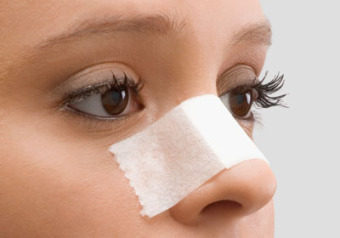
Here's a perfect display of niching: Alexander Rivkin MD at Westside Medical Spa came up with a niche; the non-surgical nose job in which he uses Restylane or Juvederm. Nice. Look at the press he's getting.

Now Dr. Rivkin is offering all sorts of treatments and most of his revenue comes through other services but his 'brand' and positioning starts with the niche that he built. It set him apart and let's him dominate a niche.

Have the confidence to find your niche, define who you are, then declare it again and again and again and again.  If you target your martket smartly, over time you will own that niche.

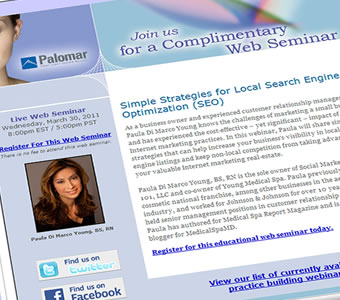
Simple Strategies for Local Search Engine Optimization (SEO)

Paula Di Marco Young is hosting a local SEO webinar for Palomar.

Wednesday, March 30th, 2011
8:00pm EST / 5:00pm PST

As a business owner and experienced customer relationship manager, Paula Di Marco Young knows the challenges of marketing a small business and has experienced the cost-effective – yet significant – impact of sound Internet marketing practices. In this webinar, Paula will share simple SEO strategies that can help increase your business's visibility in local search engine listings and keep non-local competition from taking advantage of your valuable Internet marketing real-estate.

Paula Di Marco Young, BS, RN is the sole owner of Social Marketing Strategy 101, LLC and co-owner of Young Medical Spa. Paula previously owned a cosmetic national franchise, among other businesses in the aesthetics industry, and worked for Johnson & Johnson for over 10 years where she held senior management positions in customer relationship management. Paula has authored for Medical Spa Report Magazine and is an editorial blogger for Medical Spa MD. She has also authored the Medical Spa Training Manuals that are used at top medspas and cosmetic clinics to train their staffs.

Read Paula's Medical Spa MD posts.

Personal Branding For Medical Spa Physicians

By Ashley Wendel

Only if you want to stand out from the crowd, and successfully build your reputation and patient base.

I have the pleasure of going to Chicago in few weeks to attend the Society of Interventional Radiology's annual scientific sessions, and to help facilitate a workshop for physicians on marketing.  While I know that "marketing" is not a new concept to most, the point I'm going to be making about how they, the physician, are the most integral part of the marketing equation, may be.  Shifting their perspective from only looking at what they do, to who they are and how they do things, may be a challenge.  But for docs who (perhaps for the first time) are recognizing the increased competition in the marketplace and the need for marketing to "keep up", it is a message they need to hear.

And why should they care?  Why worry about "brand"?  If you think about your overall goal as a professional, it truly is about growth.  For my IR crowd the bottom line is about leveling the playing field with other docs/specialties that have been marketing themselves longer and have a much higher comfort level with it.  It is about increasing referrals, increasing the number of desireable procedures that the IR docs perform, and establishing a solid patient base for future referrals and procedures.  For anyone, it is about developing a reputation that makes people want to work with you, that allows them to trust you, and gives them an expectation of quality and delivery that meets their unique needs. Creating your brand helps you do this.  And I'll tell you why.

Read More

Health 2.0 San Diego

What can you expect to see at Health 2.0 San Diego?

Companies and creative leaders who are pushing the curve on innovation to tackle three major challenges of our time in health care: prevention, wellness, and the role of food; the user-driven disruption of traditional clinical research; and how smart technology and service design canlower the cost of healthcare. All with the audience mix and engaging format that only a Health 2.0 conference can deliver! 

Register here

San Diego 2011

Following our biggest and highest rated Fall Conference ever, Health 2.0 announces its Spring Fling for 2011. Following trips to Boston and Paris in our two previous Spring Conferences, we’re returning to the scene of our first Spring Fling in 2008 — San Diego.

The American Society of Aesthetic Medical Professionals

We're happy to announce a new partner for Medical Spa MD, the American Society of Aesthetic Medical Professionals.

The American Society of Aesthetic Medical Professionals was founded by plastic surgeon Dr. Marc Scheiner and runs a number of Botox and filler injection training seminars, generally in the North East. Their training courses are attended by physicians, dentists, nurses, physician assistants, and nurse practitioners who are interested in adding Botox and fillers to their practice. You can find their main site here and view their upcoming course dates and registration page.

Their training training courses take place over 2 days. The first day of training is dedicated to Botulinum Toxin injections and the second day to dermal fillers. You may choose to attend one or both days of the course.

Here's some info about the course from the ASAMP site:

The courses assume you have no experience in aesthetic medicine and are designed to educate you in the evaluation and treatment of facial ageing using Botulinum Toxin and dermal fillers. You will be trained to inject Botulinum Toxin and dermal fillers with an experienced plastic surgeon. Participants in the certification courses will inject actual undiluted Botulinum Toxin and Dermal Fillers. You will find that many training programs use diluted Botulinum Toxin or normal saline. We will maximize your learning experience by replicating an actual client encounter using the correct product and live models. This is a hands-on course and you will be required to inject the products using a model that you bring.

After participating in many different training seminars it has become apparent that the most effective way to teach cosmetic injections is to have the participants provide their own models. Previous experience teaching injection methods using volunteer models has been unsatisfactory as often the models only want 1 or 2 areas treated. This leaves the participant without hands-on training in all areas. Furthermore, it is beneficial to the injector to actually see the results of his/her treatments in the weeks following the treatments. With a volunteer model, the participant will likely never see them again. Finding a model to inject Botulinum Toxin and dermal fillers requires you to simply bring a spouse, friend, brother, sister, mother, employee, or any other willing participant.

At the completion of your Botulinum Toxin and Dermal Filler training you will have the tools, as well as the confidence, to begin injecting Botulinum Toxin and Dermal Fillers on the day you return to your practice. In addition, as mentioned above, your course fee includes 12 months of complimentary telephone and/or e-mail support. If at the conclusion of your training, you feel that you are not able to begin injecting Botulinum Toxin or Dermal Fillers, you can repeat the course at no cost**. As you can see, our goal is to not only give you the absolute highest level of training but to provide you with on-going support as you begin to grow your aesthetic practice

There's always been a tremendous interest in training courses on Medspa MD. We hope that the inclusion of ASAMP and Botox Training MD will bring a valued asset to the commuity.