Embezzlement & Employee Theft Can, And Probably Will, Happen To You.

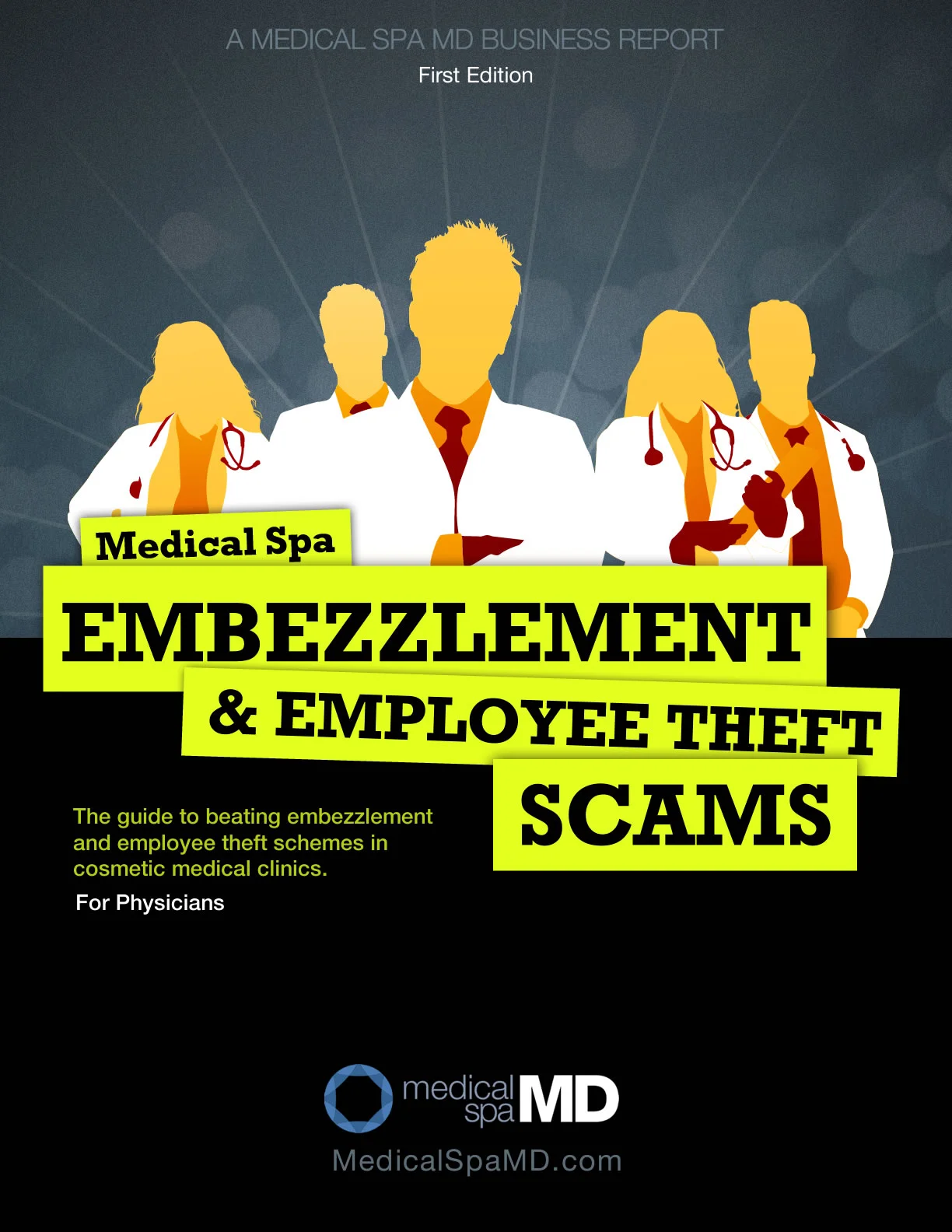
Medical Spa Employee Embezzlement & TheftEmployee embezzlement and thefts are the most common crimes in any cosmetic practice... in fact, it's pervasive.

Believe me it can and it did happen to us. It’s still hard to believe that I saw the evidence and ignored it because I just could not believe what my eyes were seeing. Instead of going with my gut instinct I listened to a mountain full of lies from my Physician Assistant so the first lesson learned is trust what your eyes are seeing and rely less on distracting noise.

When all was said and done, our P.A. had stolen over the course of just 14 months, more than $200,000 in Botox, Fillers and Laser Treatments. 

How was she able to accomplish this?  The theft occurred in three primary ways.

  1. With Botox/Dysport she would mix the proper dilution of 2.5 and then draw out a full syringe of properly diluted Botox and re-inject another syringe of saline. She would then take the syringe of Botox and put into her mini-cooler posing as a lunch box which she brought every day to keep it cold and then treat patients out of her house. The evidence of this was apparent with patients complaining of poor results. She would cover herself with some inventive lies such as; Botox out too long and I did not want to waste it, the refrigerator was not cooling to proper levels, she put the Botox in the freezer and the solution crystalized and weekend the Botox, I may have accidently put in too much saline and I used Dysport and it does not work as well as Botox.  Looking back I can clearly see the evidence but listened to her lies and excuses.
  2. On fillers her number one excuse was that the product “leaked” while injecting and she was forced to use another syringe. Other excuses were the patient had a bad result so to keep them happy she offered a free syringe, a reaction that forced her to remove and re-inject later and I threw in some free syringes because she bought a package of Fractional Laser Treatments.  Most of the time, she was simply pocketing the syringes to again inject patients of our practice at her house.
  3. Watch you consults and close ratios. We have been in a bad economy so this was hard to gage.  She would “feel” out the patient during the consultation and those who she believed would be players she would offer discounts for Fractional Laser, IPL’s, Matrix etc. if they paid her directly in the room in cash. I was tipped off by this from a competitor who called me and told her one of their patients told them about this. After firing my P.A. within weeks we had identified 36 patients who paid cash in the room.  She told those patients she was the co-owner so it was ok to pay in the room… To add insult to injury we had to complete their treatments as well.

Submit your own story about medical clinic embezzlement or theft here

After having gone through this we put in some practices that I wish we had done all along.  We now perform a Botox and filler audit every Friday. Every unit of Botox is logged onto a log sheet by patient and same for fillers. If we are off by more than 5% I will meet with my NP to go over the discrepancy.  On lasers shot counts are logged for every patient. As an example if Mary comes in for a Fractional Laser Treatment and the beginning shot count was 45,000 and ending shot count was 45,400 then the next patient for the same treatment should begin at 45.401. We also now provide to each patient our policy of ONLY paying for services at the front desk during check out.

I was also amazed to find out that every staff member suspected what was going on but was afraid to say anything because they did not want to cause any problems if they were wrong. Lastly review your insurance policy for theft coverage. I was mortified to find that ours only covered $10,000 which left us loses of about $200,000.00. We were able to absorb the losses but many others might have been forced to lay off staff or worse go out of business. As a non-physician owner I trusted far too much that a professional medical practitioner would not steel. I now understand all too well that the white coat which commands respect could also have hidden prison stripes and to use my eyes and cover my ears…

Dr. John S. Silverton, An English Plastic Surgeon In Stockton, CA

Dr. John S. Silverton, An English Plastic Surgeon In Stockton, CA

With his UK medical education and US credentials, Dr. John Silverton brings his artistic sensibilities to his plastic surgery practice in California.

Name: John S. Silverton, MD, FRCS
(England and Edinburgh)
Clinic: Stockton Plastic Surgery
Location: Stockton, CA
Website: silvertonmd.com

That's interesting: Born and educated in the UK but practicing in Stockton, California, Dr. Silverton is a fellow of the Royal College of Surgeons in England and the Royal College of Surgeons in Edinburgh as well as the American Society of Plastic Surgeons.

Read More

Dr. Robert Cohen, Breast Enhancement Specialist In Scottsdale, AZ

Dr. Robert Cohen

As a plastic surgeon in Scottsdale, Dr. Rober Cohen specializes in cosmetic surgery of the breast.

Name:Robert Cohen, MD, FACS
Clinic: Scottsdale Center For Plastic Surgery
Location: Scottsdale, AZ
Websites: robertcohenmd.com, cohenbreastsurgery.com

That's interesting: Dr. Cohen published a textbook chapter on technology and robotics in plastic surgery while at Dartmouth.

Read More

Microderm + Chemical Peel Giveaways As A Marketing Tactic

In our Canyon Lake Med Spa practice, we are always looking for ways to attract new patients, and to give existing patients a “value-added” service. 

We’ve been doing microdermabrasion and chemical peels for many years. April Turner, our medical aesthetic RN, discovered that the 2 procedures done together were mutually complimentary, and could be performed with a minimal amount of time and material cost. We charge $99 for a combination treatment of a microdermabrasion and a medical-grade chemical peel, and do fairly well at this price. But since it is quick and inexpensive to perform, we decided to also make this a “giveaway” at our seminars and marketing events.

This strategy has served us well. We give away this combo treatment to anyone who attends one of our events, or anyone who comes into our surgical or Medical Spa office for a consultation. Some people don’t take advantage of it, but most do. And most of the time they are so happy with the outcome that they follow up the complimentary treatment with regularly scheduled (and paid) future treatments.

We found that this is a great way to attract people to our Med Spa and surgical office events, and it creates an additional revenue source for our business. If you perform these procedures at your facility (and chances are that you do,) you might want to consider this approach for your business.

Marketing Cosmetic Procedures: Thoughts About Where We Drop The Ball & How We Can Improve

To get any attention, you have to be different.

I review a lot of cosmetic surgery websites. I also peruse the local free specialty magazines found in every major city showcasing the local cosmetic surgical practices. There is one element they all seem to have in common – sameness. The colors are different, the logos distinctive, and the navigation is creative. But the content oozes with sameness. And truth be told, my own website is guilty of it as well!

Read More

Proposed Change In PA State Cosmetic Laser Regulations Would Force Laser Clinics To Close

New regulations proposed in PA and would require physicians to be on-site during all cosmetic laser and IPL treatments.

Notice to all physicians, nurses, nurse practitioners, physician assistants, estheticians and laser technicians in PA: I'm asking your help to oppose a new regulations in Pennsylvania requiring changes to who can perform cosmetic laser and IPL treatments.

This law is attempting to be passed through regulatory agencies and implies that estheticians are negligent with the use of lasers and cause harm to patients.  Many of the physicians I spoke with stated they have treated many patients harmed at the hands of other physicians.

The new regulation will stipulate that only physicians, nurses, nurse practitioners and physician assistants will be permitted to operate an aesthetic laser and if the operator is not a physician, the physician must be on-site during the use of the laser and must perform an assessment on the patient prior to treatment.

This would effectively eliminate the use of estheticans and laser techs from performing any laser-based treatment and could force many clinics to drastically change their business models, or close altogether.

Read More

Dr. Michael Kreidstein, Plastic Surgeon in Toronto

Canada Plastic Surgeon Michael Kreidstein, MD, MSc, FRCS(C)

Keeping up with Canadian cosmetic surgery trends with Dr. Michael Kreidstein.

Name: Michael Kreidstein, MD, MSc, FRCS(C)
Location: Toronto, Canada
Website: drkreidstein.com

That's interesting: In 2010 he was appointed by the College of Physicians and Surgeons of Ontario (CPSO) to serve as a Physician and Premises Inspector of private surgical clinics for the Out of Hospital Premises Inspection Program. In 2011 he was appointed by the CPSO to serve as a Plastic Surgeon Peer Assessor. He is committed to excellence in Cosmetic and Reconstructive Plastic Surgery.

Read More

A Team Approach Works Best for Skin Cancer Care

skin medical spa md

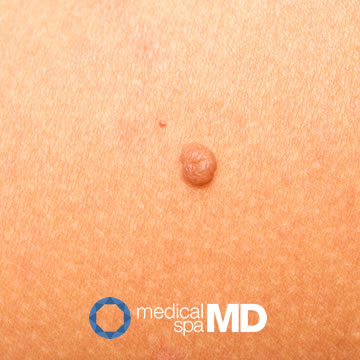
Skin cancer is the most common form of cancer in the United States with one in five Americans developing some form of skin cancer during their lifetime. 

Fair-skinned, blond, or red-haired people with blue or green eyes are most at risk.  In fact, if you are fair skinned and live to age 65, you have a 40%-50% chance of having at least one skin cancer. 

Read More

Dealing With Anonymous Patient Reviews As A Physician

Reputation Management for Doctors

The internet is a double edged sword to the Plastic Surgeon.

Patients from near and far can read about and research our skill and services but at the same time a handful of malicious people can significantly tarnish a great reputation which we have strived to achieve and maintain.

As a surgeon and as a human I have always strived to maintain the highest ethical and moral pathway. Most of us went into medicine to help people. What we do as cosmetic surgeons may not save lives but it does save quality of life and that is evident in our patients' smiles and behavior after successful cosmetic surgery. As doctors we strive to achieve and maintain a pristine reputation but as in anything else in life, it is impossible to please all the people all the time.

The internet has given a voice to everyone but it seems like angry, bitter, malicious people take advantage of this soap box and platform much more often than normal happy folks. You can see this on comments on YouTube or blogs or chat rooms of all kinds - not just medical or plastic surgery related.

But in our field, we depend on our reputation and while you may have thousands of happy patients, a small handful of unhappy ones can affect your reputation. Personally I have seen that the vast majority of my negative online anonymous patient reviews or ratings are from people who I have either never seen in my office or have seen but refused to operate on as patients. I recently had a "1 star negative review" on YELP from a person who has never even come to my office nor met me but decided that she did not want to pay $100 for an hour of my time for a consult and felt obligated to give me a negative rating for not offering free consults! We have all had such occurrences. But how do you deal with it?

My method has always been dealing straight forward with any and all comments.  If it is out there then it begs clarification and a reply from my staff or office managers or even myself.  There has to be accountability.  In the restaurant industry, restaurants can actually review and rate their patrons, not just vice versa! As physicians, we have to respect patient confidentiality and HIPAA but that does not mean we must be silent and let any anonymous person's comments go without a reply or clarification especially when most of us work so hard to do the right thing and practice with skill, ethics and integrity.

Resources for physicians:

How Does A Plastic Surgeon Incorporate Lasers Into A Primarily Surgical Practice?

One of the most common questions that other physicians ask me is “how do I incorporate lasers into my surgical practice?”

I am often called by a plastic surgeon, specializing in cosmetic surgery, who wants to know how he or she can begin to use lasers in their practice. It can seem exciting yet daunting to bring in a new procedure because of the level of knowledge and training required to properly treat patients and produce excellent results. And many times, physicians have limited time for further training once a busy practice has been established. In addition, lasers are expensive and most surgeons are not used to having to purchase expensive equipment beyond the initial investment in supplies to start a surgical practice. That being said, the laser procedures can help surgeons offer a much wider range of treatments that will benefit both the patient who has had surgery and the one who is not yet ready for surgery. I tell physicians and patients that laser procedures can be “insurance for your surgical procedure” in many ways. Laser procedures can help add to the result of surgical tightening by treating dyschromia, discoloration, texture, pore size, vascular lesions, and providing overall better skin health and appearance. One can pull the skin tighter with surgery, but the skin often needs surface treatment with laser procedures. Don’t just focus on achieving tighter skin, focus on overall better looking skin also. This may sound like a sales pitch, but you will hear me often say, “don’t put cheap tires on a Rolls Royce!” Surgical results will greatly benefit from maintenance laser procedures and good medical skincare. Finally, a laser procedure can often help a plastic surgeon treat a patient who does not really need surgery yet, so that the patient does not have to be referred elsewhere.

My advice always starts with telling fellow surgeons that

Read More

Hospital Administrators Are Not Always Honest

Hospital administrators have an agenda that's not always aligned with yours.

I used to do emergency work at a hospital in a large chain. It was hardy profitable and became less so over time. When I moved an hour away I sought to limit my emergency exposure for obvious reasons. The hospital administration cited sections of the Bylaws and Rules and Regulations that mandated that surgical specialists take call. This was specified for Plastic Surgery and Orthopedics.

Later and entirely by accident, I found out that the Orthopedists were being paid to take this emergency call by the same administration that was citing those hospital documents. Essentially they were being paid to take call from 15 minutes away whereas I was required to take call for free from four times the distance. Needless to say I dropped that hospital after briefly entertaining legal action. So soon after my divorce I hardly wanted to enrich another attorney. They are much smarter about getting paid than physicians are. I did inform a contact at the local newspaper who passed on the story stating that the public doesn't really care if a doctor gets screwed over. I found that a bit amusing.

As the story evolved I extended my practice up the street not so far away and something similar almost happened again. This time the administration in my new acute care hospital sought to get into an arrangement with me to take call. They were very quick to stipulate that this arrangement was to be secret. It was to involve some kind of payment from the hospital. The thought left a bad taste in my mouth. Emergency call is a loser. I just stopped taking it.

The moral of this story is that you should not expect hospital administrators to be honorable people. Entering into any kind of business arrangement with them especially a secret one is liable to be unfair, unjust or just plain illegal. You might want to avoid that.

Laser Liposuction & Skin Tightening - Emperor's New Clothes?

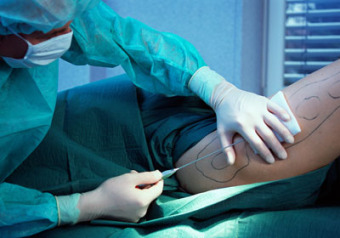
Laser Assisted Liposuction - Medical Spa MDDoes laser assisted liposuction really provide all of the skin tightening benefits that the manufacturers claim?

We are in pursuit of many Holy Grails in plastic surgery, from scarless post-surgical healing, non-invasive liposuction and implant-free breast augmentation to non-invasive skin tightening. With the advent of laser-assisted liposuction (LAL) came the promise from the manufacturers that we have finally achieved a way of combining "minimally invasive" fat removal with skin tightening, sensationally treating two maladies with one procedure.

I been involved with LAL for many years, and it has been the primary revenue driver in my practice for nearly five years running. I began to perform the procedure when the machines became powerful enough to actually generate enough subdermal heat in a timely fashion to potentially create significant collagen remodeling and hopefully result in skin tightening. My case load quickly became large enough that I was asked to be a national speaker for one of the dominant laser companies educating other physicians on the use of LAL. As such, I delved into every published paper even remotely relating to heat-generated skin tightening and laser assisted liposuction. Over the years, I have been able to merge a huge surgical experience with the science behind the procedure and draw some fairly clear and simple conclusions on the issue of skin tightening.

Setting up a patient for potential skin tightening is fully dependent on generating ample subdermal heat to initiate collagen denaturation and subsequent remodelling. Generally, this temperature is felt to be between 40 to 45 degrees celsius.  At around 47 degrees celsius, skin blistering and burns occur.  With proper time, temperature-monitoring devices, and careful technique, adequate temperatures can be achieved. Getting the skin to this temperature range takes time and significantly prolongs the procedure. Additionally, the risk of seroma escalates the longer you spend with the tissues in this temperature range in my experience.

In about 15% of cases, I see clinically visible skin tightening which I don't feel I would have seen using other techniques. This skin tightening is not the equivalent of excision techniques, but typically limited and subtle. This is obviously purely my subjective opinion to be clear, and I cannot say that these same results may not have occured witht the same frequency had I used other liposuction techniques.

The science of LAL and skin tightening is clear that some tightening does occur and is quantifiable. But this does not predictably translate into clinical relevance. I have now performed nearly 1000 LAL's and no longer educate my patients that LAL is a good method of tightening skin. The limited degree of tightening I credit LAL for is not enough to call it a clinically relevant skin tightening procedure. The majority of new LAL consults in my practice present with the impression that LAL is going to tighten up their loose skin while removing fat. The notion is dominant on the internet and even in print ads. I politely educate them that although there may indeed by some skin tightening, this will be subtle at best. In my opinion, the advantages of LAL lie elsewhere, particularly in a somewhat easier recovery.

I continue to hear from colleagues who also use LAL that they believe in the skin tightening.  I don't know if this is a case of "The Emporers New Clothes" or not. I have pushed the envelope in terms of thoroughly heating up the skin to appropriate temperatures and length of time, but only see minimal tightening and an increase number of seromas. I continue to use LAL heavily but no longer tout skin tightening as being an expected end point.

Samuel Lam, MD, FACS: Plastic Surgeon, Artist & Entrepreneur In Dallas, Texas

Double board certified in facial plastic surgery and hair restoration, Dr. Lam keeps himself busy with his Ova skin care line and lecturing worldwide.

Dr. Sam Lam is a triple board-certified facial plastic surgeon who is world renowned for his pioneering work in facial rejuvenation and hair restoration. He is the owner of the 27,000 sq.ft. Willow Bend Wellness Center. He has authored five major medical textbooks, Comprehensive Facial Rejuvenation, Cosmetic Surgery of the Asian Face, Complementary Fat Grafting, Simplified Facial Rejuvenation, and Hair Transplant 360 along with over 150 book chapters and scientific papers. He lectures monthly nationally and internationally with well over 100 lectures to date. He is the 2002 winner of the John Orlando Roe Research Prize for his research on skin rejuvenation.

Name: Dr. Samuel M. Lam
Clinic: Lam Facial Plastic Surgery Center
Location: Dallas, TX
Website: lamfacialplastics.com, hairtx.com, ova-skin.com

That's interesting: After 2 years of research and development, Dr. Lam launched his new skin care line, OVA, that features plant-derived stem cells for skin rejuvenation, that is simple to use with only one morning product and one evening product.

He is an accomplished artist having completed all of the illustrations for three of his medical textbooks along with many drawings for his scientific articles and book chapters. He enjoys painting during his free time and has on display over 150 of his original paintings in the new wellness center. He's also a certified PADI divemaster.

Read More

Dr. Tahl N. Humes: Vitahl Medical Aesthetics In Denver

With two physicians, 30 years of combined aesthetics experience, and inclusion in the top 1% of Botox injectors in the US, Dr. Tahl Humes is rocking it at Vitahl Medical Aesthetics in Denver.


Dr. Tahl N. Humes Vitahl medical Aesthetics Medical Director Denver, Colorado

Name: Tahl N. Humes, MD
Clinic: Vitahl Medical Aesthetics
Location: Denver, CO
Website: vitahl.com

That's interesting: Dr. Tahl Humes is a Laser Trainer and Spokesperson for Cutera Lasers. She is in the top 1% of Botox injectors and the top 5% of Juvederm injectors in the country. 

In addition to serving as Medical Director for VITAHL Medical Aesthetics, Dr. Humes practices Internal Medicine at Saint Joseph Hospital in downtown Denver. 

You're an Internal Medicine Attending at a hospital in Denver. How (and why) did you end up making a move into cosmetic medicine?

Read More

Dr. Stephen Bresnick: Plastic Surgeon in Encino, California

Dr. Stephen Bresnick Encino, California Board Certified Plastic Surgeon

Dr. Bresnick discusses how he balances his teaching career and private practice after 15 years as a plastic surgeon. 

Name: Stephen Bresnick, M.D., D.D.S., M.S.
Clinic: Encino Plastic Surgery
Location: Encino, CA
Website: drbresnick.com

That's interesting: Dr. Bresnick has published nine books in medicine and science and has authored over 20 articles published in medical journals.

Read More

Dr. George Sanders, Encino CA Plastic Surgeon

Dr. George Sanders, Encino CA Plastic Surgeon

Despite of the emergence of noninvasive treatments, Dr. George Sanders keeps himself abreast with the current trends.

Name: George Sanders, M.D.
Location: Encino, CA
Website: drsanders.com

The Sciton Erbium laser was purchased several years ago and remains a stellar performer for full face laser ablative therapy when the patient has 9 days to recover to the point that they can wear makeup and go out and look very good. I do many facelifts and this recovery time frame makes sense in that the remainder of the face is recovering at about the same pace. When I purchased the Sciton, other erbium lasers were available, but the dual head configuration and other factors made it more appealing. It has paid for itself many times over and remains a very reliable piece of equipment that provides a consistently excellent result with minimal complications. 

The Fraxel laser is used by my nurse in those patients who do not need as much of a result as the Sciton produces and who do not have as much time for recovery. These patients have at most one or two days of downtime.

Eventually we will need to replace our Sciton, and it may be that a fractionated CO2 laser may be the answer. I am also looking with interest at the nonsurgical fat sculpting devices as well as the nonsurgical skin tightening devices. Reliability, cost effectiveness, efficacy, and a usefulness that will last years are all things that I look at when deciding upon what to purchase. I am also not interested in a device that requires multiple patient visits to accomplish the desired result because of inherent limitations in office space and personnel time.

Read More