Nick Carr MD, FRCSC, Canadian Plastic Surgeon & Educator

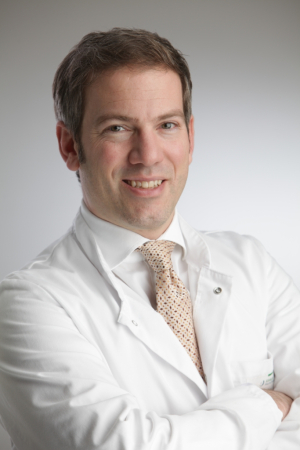
Dr. Nick Carr shares his thoughts on the medical education system in Canada as a plastic surgeon and eductor.

Name: Dr. Nick Carr 
Location: Vancouver, Canada
Website: skinworks.ca

That's interesting: Dr. Nick Carr is a Royal College Examiner in Plastic Surgery.

Read More

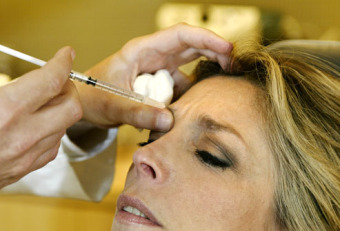
Painless Neurotoxin Injection Method? Join the Discussion!

What injection methods are most useful and reliable for neurotoxin injections: Botox & Dysport.

I have been in clinical private practice going on 14 years now and enjoy a busy and healthy cosmetic surgery practice.  Injectables, both fillers and neurotoxins, remain an integral part of my practice and I suppose that the loyalty my patients show by continuing to return to me as their injection provider is testament that my skills must be competitive with the many other local physicians who offer the same procedures.  I definitely do not price cut to keep the volume or attract new patients, and I believe I price fairly taking into consideration both my training and experience with typical pricing in my area by "mainstream" cosmetic providers.

I continue to strive to offer the least painful experience for my patients and have tried multiple different methods to decrease the degree of injection discomfort for my patients.  From topical anesthetics, icing, slow injection delivery, and currently vibration-distraction techniques, I have yet to find the WOW approach. I do use lidocaine-treated fillers and believe that these have advanced our patients' injection experience to an appreciable degree.

My intent for this entry is to stimulate a healthy community discussion on what methods the readers have found useful and reliable for neurotoxin injections (to keep this discussion focused I am not encouraging discourse on filler injections but perhaps this can be a future topic of discussion), in addition to disregarding any approach that they have found particularly not beneficial.  We all want to make our injections as easy as possible for our patients, so I am hopeful that this topic can generate healthy dialogue!

Dr. Alexander E. Handschin, Plastic Surgeon In Germany

Dr. Alexander E. Handschin

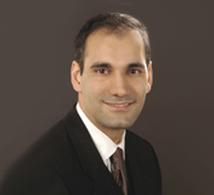
With several specializations in surgery, Dr. Alexander E. Handschin shares his practice style changes in Germany.

Name: Dr. Alexander E. Handschin
Location: Hamburg, Germany
Website: drguth.de

That's interesting: Dr. Handschin belongs to the following professional organizations: the Board of General Surgery in Switzerland and Germany, Board of General Surgery in Switzerland and Germany, and Specialisation Board of Hand Surgery. He is also a fellow of the European Board of Plastic, Reconstructive and Aesthetic Surgery (EBOPRAS).

With the advent of Botox therapy and hyaluronic acid fillers, non-surgical options have certainly increased over the past years. I believe that these tools are adding to the possibilities of a plastic surgeon, since their indications do not necessarily interfere with surgical options.

The use of autologous fat-transplants has certainly seen a significant rise, and I believe that additional knowledge will emerge from this technique. Also, the use of stem cells, such as adipose-derived stem cells poses a great potential for plastic surgeons.

Read More

SIMON Says: “Run Forrest Run!”

Saying ‘No’ to Prospective Cosmetic Medical Patients

Certainly, everyone is entitled and should have access to cosmetic medical and surgical services. However, depending on your particular risk tolerance, there are certain times when you might want to just 'pass' on treating a patient.  Knowing which patients to sidestep is a gray art and is frequently based on hunches and ‘gut’ feelings.  This subtle impression, as described in Malcolm Gladwell’s book 'Blink: The Power of Thinking Without Thinking', is correct more often than not.  However, there are more objective guidelines available to help decide whether or not to dance with a particular patient. Several of these tips have been developed and expounded upon in numerous papers by Dr. Mark Gorney and in the book 'The Patient and the Plastic Surgeon' by Dr. Robert Goldwyn.  Consider running for the hills if:

  • The patient is a SIMON – single,immature, male, overly expectant, and narcissistic.  Even worse if they answer to SIMON-SLAP (SIMON + still lives at parents). 
  • You don’t click with the patient – or just plain dislike them
  • The patient is critical of previous physicians but thinks you hung the moon.
  • The patient is rude to your staff.
  • The patient demands a guarantee.
  • You are asked to do something you can’t deliver.
  • Anyone in a hurry to have surgery – gotta do it now!
  • The surgiholic patient.
  • Patients wanting procedures because they are prodded by friends or family members.
  • The out-of-town patient who has to bolt before you are comfortable with them leaving.
  • The patient who is vague, indecisive and leaves the driving to you.

Unfortunately, patients don’t walk into your office with a label on their shirt saying ‘I’m going to be a real problem’.  Listen to the voices in your head and apply the above principles.  Cosmetic medicine is supposed to be fun – don’t let a rogue patient slip through the cracks and haunt you.  It just isn’t worth it!

Patients with High Expectations (Dreams versus Reality)

patient expectations - reality

It is true that we all have dreams and we all, in some way, want to believe in magic.  But when it comes to cosmetic work and people's appearance, it's best to be realistic. I know we all have patients with unrealistic expectations. These patients are the ones we should be more careful with and we should spend more time educating them.  Patients with high expectations are usually well informed and they know about all the new technologies but they also, many times, are expecting unrealistic results. I have developed a good eye for these patients and what I have learned is that it is best to create low expectations, show them before and after photos that don't show fabulous results and always offer the possibility to go and get a second opinion. If they decide to stay and pursue their treatments, they know what to expect.  Taking before and after photos with these patients is very important or if you have a computerized image system (Visia), it is also helpful. At the end, the patient will be satisfied and feel that they got good results but realistic ones and you will save yourself from a potential headache.   

3 Comments

Beatriz Porras MD

Dr. Porras graduated from Medical School from Norte University in Colombia; subsequently she did a surgical internship and fellowship in Plastic Surgery at Washington University School of Medicine in St Louis MO. She completed her Dermatopathology training at UT Southwestern at Parkland Memorial Hospital in Dallas TX, where she trained with one of the best dermatologist in the world, and former president of the American Academy of Dermatology (Dr. Clay J. Cockerell). Dr. Porras was a professor of Biology at Washington University School of Medicine in St Louis, MO. and currently is the president of Skin Diagnostics Inc., where she serves other physicians by diagnosing skin diseases.

Dr. Porras has extensive research experience, twenty years ago she helped in the research and development of growth factors to promote wound healing, today growth factors are used in several medications and skin products to promote skin regeneration and rejuvenation. She has authored over 30 peer-reviewed papers in leading medical scientific journals and she has contributed several chapters in major dermatology, dermatopathology and plastic surgery textbooks. Dr. Porras is also trained in Laser Medicine and is Laser Certified.

Dr. Porras graduated from Medical School from Norte University in Colombia; subsequently she did a surgical internship and fellowship in Plastic Surgery at Washington University School of Medicine in St Louis MO. She completed her Dermatopathology training at UT Southwestern at Parkland Memorial Hospital in Dallas TX, where she trained with one of the best dermatologist in the world, and former president of the American Academy of Dermatology (Dr. Clay J. Cockerell). Dr. Porras was a professor of Biology at Washington University School of Medicine in St Louis, MO. and currently is the president of Skin Diagnostics Inc., where she serves other physicians by diagnosing skin diseases. Dr. Porras has extensive research experience, twenty years ago she helped in the research and development of growth factors to promote wound healing, today growth factors are used in several medications and skin products to promote skin regeneration and rejuvenation. She has authored over 30 peer-reviewed papers in leading medical scientific journals and she has contributed several chapters in major dermatology, dermatopathology and plastic surgery textbooks. Dr. Porras is also trained in Laser Medicine and is Laser Certified.

Botox & The "Spock" Look

Botox + fillers that make your patients look like Vulcans?

The clinical and cosmetic uses of neurotoxins continue to grow. Botox, perhaps after aesthetician visits, are often the first procedure consumers consider. It is very common for patients to tell me that they have been considering Botox treatments for 3 to 5 years. We frequently see these patients pleased with there Botox treatments and then very interested in fillers, non-invasive body contouring, and often surgical procedures. However, what quickly interrupts this transition to other services is a result from neurotoxins that looks unnatural.

In our practice, we have increased patient retention and satisfaction after their initial Botox treatment by reviewing with them possible outcomes. Patients will often complain about a quizzical or "Spock" look after glabellar and sometimes forehead injections. I am still surprised that patients are not told of this and that there is a simple remedy. As most practioners know, 2-4 units additional neurotoxin at or just above the over arched area will soften the arch of the eyebrow.  A follow-up call/visit or just good instructions to the patient can turn a dissatisfied patient into a lifelong member and proponent of your practice.

The Value Of Board Certification In Cosmetic Medicine?

Board Certified Plastic Surgeon

Is it better and safer to get Botox injected by a family physician who has been injecting patients for 15 years or a newly graduated plastic surgeon who just finished his residency last week?

In Cosmetic Surgery, the term "Board Certified" is the most highly used term for marketing purposes today. Thirty years ago, many doctors were "Board Eligible" or non boarded and their value came from their training and their experience and their expertise, not just a label. Today, doctors are expected to be board certified in something. That something is the topic of heated battles and debates and many of our colleagues are just as confused about it as are our patients and the public and the media. Insurance companies and third party payor and even hospitals require board certification and may use it for determining reimbursement. 

The American Board of Plastic Surgery (ABPS) and The American Board of Facial Plastic Surgery (ABFPRS) have had many decades of heated nasty all out warfare. For the most part, on the surface at least, the war is over but small battles and skirmishes are still waged amongst these two specialties here and there around the country. But cosmetic surgery is no longer being offered purely by Plastic Surgeons or Facial Plastic Surgeons, Oculoplastic surgeons, Oral surgeons, otolaryngologists, & dermatologists are a significant part of the cosmetic surgery providers. More over, family physicians, ER doctors, Radiologists, OBGYNs, and other doctors whose specialty is not traditionally associated with cosmetic surgery are now the fastest growing population of cosmetic surgery providers with Botox and fillers and lasers as their entry to the more involved mini facelifts and blepharoplasties and liposuction. The American Board of Cosmetic Surgery and the American Board of Laser Surgery has given this large heterogonous group of non-cosmetic surgeons an umbrella to gather under and a label to use for marketing and validation.  

The American Board of Plastic Surgery and The American Board of Facial Plastic Surgery have now joined forces in order to "protect the public" and inform the media and public about the lack of proper residency or fellowship training by many of these new non traditional providers.  Protecting the public is a noble endeavour and a great cause but I ask who is going to protect the public from less inept members of the American Board of Plastic Surgery and the American Board of Facial Plastic Surgery?  There is no doubt that the vast majority of poor cosmetic surgery with bad outcomes are being performed by Board Certified doctors, most of which are actually certified by these two esteemed Boards (ABPS and ABFPRS). 

Then what is the true value of "board certification" and how will the public be protected? We must police and control our own profession as a whole before we are controlled by outside forces. In Ontario Canada, a deal between the society of Plastic Surgeons and the Department of health posed a new regulation where no one other than a plastic surgeon could use the term "plastic surgery" in their advertising! So, is it better and safer to get Botox injected by a family physician who has been injecting patients for 15 years or a newly graduated plastic surgeon who just finished his residency last week or even from a nurse who works at a plastic surgeons office? This is a tough question that needs to be answered by us doctors before it gets settled for us by external forces. 

Interview: Dr. Mark Mofid, A Plastic Surgeon In San Diego, California

San Diego Board Certified Plastic Surgeon Dr. Mark MofidDr. Mark Mofid's plastic surgery practice includes the La Jolla, Del Mar, and Chula Vista areas of San Diego.

Name: Mark Mofid, M.D., F.A.C.S.
Location: La Jolla, CA
Website: drmofid.com

Dr. Mark Mofid is a board-certified San Diego and La Jolla area plastic surgeon, certified by both the American Board of Plastic Surgery and the American Board of Facial Plastic and Reconstructive Surgery.

Can you tell us how your clinic's set up?

Our office is centrally located in La Jolla/UTC within San Diego County. We have a full time dermatologist (my wife) and plastic surgeon (me) and a nurse. We have a AAAASF/Medicare accredited surgery center attached to the clinic and also provide laser services. The practice has several thousand patient visits per year and we offer medical and cosmetic dermatologic services as well as cosmetic and reconstructive plastic surgery.

Read More

The Use Of Strategic Vendors

Price isn't the only thing that you should be looking at when choosing a technology or product vendor.

So what is a strategic vendor?  I’ll get to that a bit later…   I’ve been in the business world now over 30 years with the last 8 in the medical aesthetics field.    In those 8 years, I’ve been mystified why so few vendors in this sector understand the importance of staying close to the customer.  How so few  really take the time to understand my business which although is similar to many others is uniquely mine with its own challenges.

Most vendors only come around when they have a new product, service, promotion or are on a ride along exercise with their boss and need some place to go…  Most vendors never care to ask what my goals are and very few know what I’m planning for my business this year and next 5 years.  Most only care about making the sale today and then move on to the next buyer.

Most vendors also carry with them a planned obsolesce strategy for the equipment they sell.

Read More

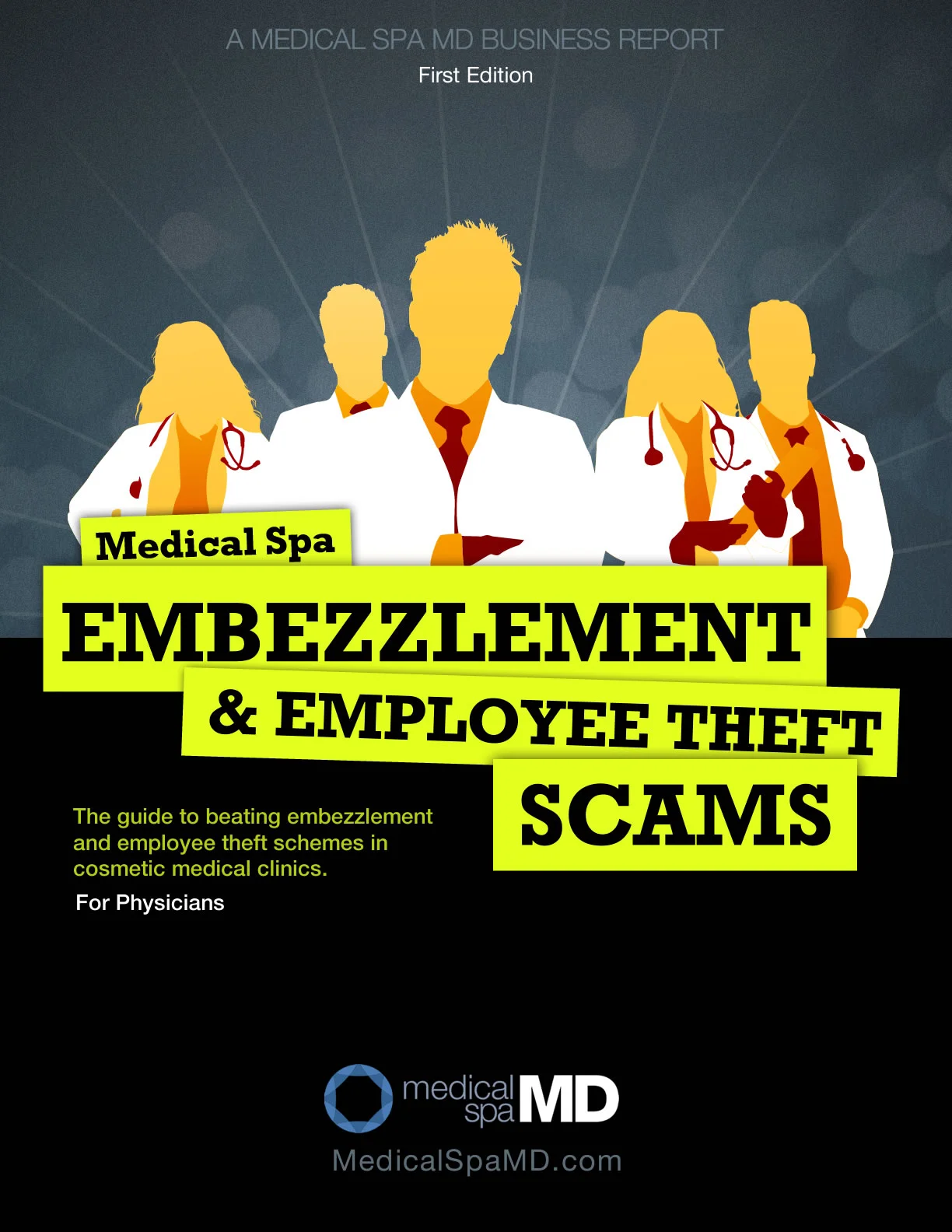
Medical Spa Embezzlement & Employee Theft Scams Report

Download the new, free report for Members: Medical Spa Embezzlement & Employee Theft Scams... Reading it could save your clinic.

It's the guide to beating embezzlement and employee theft schemes in your cosmetic practice or medical spa.

Taking cash payments in the treatment room, stealing Botox and fillers to inject their own patients, ordering fraud, trading extra services for large tips, or stealing your client database to sell or use... In a recent study, more than 82% of medical clinics reported experience with employee theft or embezzlement... that they were aware of. This new 40 page guide to beating embezzlement and employee theft schemes uncovers the hidden tactics behind how these scams work, and how you can find them before they capsize your business.

Embezzlement and employee theft are an unfortunate fact in almost every business, and especially in cosmetic medical practices. If you haven’t ever had to deal with this you’re extremely lucky since it has taken place in every clinic I’ve been personally involved with and the stories that are told by physicians and business owners are legion. If you think it can’t happen in your clinic you’re just whistling past the graveyard. It can. Don’t prepare yourself and it will.

This report is designed to give you a fighting chance to identify how your business is at risk, to understand how these schemes work, and what you can do to minimize your risk and take action when you find a problem.

Here's some of what those who have already read this report are saying:

Great report! It should be required reading for all doctors — even for those of us who've been around!
Marguerite Barnett MD FACS PA, Mandala Medspa
A very eye-opening and sobering report. This is a must read for everyone!
Windie Hayano, The Skin Inc. Dermatology and Laser Center
Opened my eyes! The information in this report is invaluable! I hadn't even thought of some of the scams mentioned in these testimonials!
Lori Robertson FNP, Skin Perfect Medical Rancho
Great! ...after reading others experiences I realize that you just cannot be too careful when it comes to the financial security of your business.
This report will help other centers avoid going through what we had to endure and overcome.
Brian Sidella, Founder, Forever Young Medspa

You’re about to read the many stories that have been collected from clinics and physicians; from how a physician-employee put an extra account on a credit card terminal to deposit payments into his own checking account to how a NP would inject patients with straight saline and steal the Botox to use in her own side business... and a host of others... ordering fraud, trading extra services for large tips, or stealing your client database to sell or use, setting up false bank accounts, switching acocunts on the credit card reader... all of these scams are covered through real life accounts from the physicians and clinic owners who experienced them.

Some of the stories are almost beyond belief in their brazenness and the damage that was caused. In almost every case, the employee was a trusted team member. Do yourself, your family, and your business a favor and read this report. No matter what your experience has been, you're going to learn something important.

Have your own story? Submit it here for the next edition

What To Do About A Teenager's Acne

acne treatmentsMany teens and young adults suffer from different forms and severities of acne. Unfortunately, the “old school” philosophy of treating acne with topical and oral antibiotics and even Accutane is not always the best or even necessary for the child. Kids are too often diagnosed with “acne” and are prescribed some form of antibiotic or Accutane when simply addressing skin health and cleanliness may be all that is necessary to significantly improve their acne.

Here is what we will address in the consult. We will take a full medical and lifestyle history of the child. This goes beyond the medical part of the history by addressing skin health and daily routine. How does the patient clean his/her skin? Does the patient have any undiagnosed allergies or abnormal

Read More

Tanning Industry Calls Warnings A "Sun Scare" Conspiracy By Doctors

If you're a dermatologist or physician who has warned patients about the dangers of tanning, you've been been labled part of "the Sun Scare people" who are "just like Big Tobacco, lying for money and killing people".

The tanning indusrty is changing the debate, moving the discussion from tanning's risks to a "deadly epidemic of vitamin D deficiendy and positioning itself as the more trustworthy source of information on tannings health effects.

Evidently the tanning indusrty is taking a page out of the big tabacco's book and now targeting physicians as part of a conspiracty out to protect their own financial interests, as well as using a few willing doctors to tout their own position.

Fairwarning.or has posted an article that you can read here: Burned By Health Warnings, Defiant Tanning Industry Assails Doctors, 'Sun Scare' Conspiracy

In the video, Levy is explicit about what salon employees are allowed to say at work and what they should say on their own time. He encourages the D-Angels to follow what he calls the “Clark Kent/Superman” model. Inside the salon, employees should be Clark Kents who refrain from making health claims about vitamin D and direct clients to industry websites that make pro-tanning claims that are carefully calibrated to stay inside legal bounds. Beyond salon walls, however, employees can spread their wings, becoming superheroes who expose the lies of sunscreen manufacturers and dermatologists and share the vitamin D gospel. “Outside the salon, you can be a D-Angel,” Levy says in the video. “You can promote a message to your friends and neighbors that the Sun Scare people are just like Big Tobacco, lying for money and killing people.”

Read More

Radiofrequency Assisted Liposuction (RFAL) - A new technique for adipose tissue treatment & 3D-skin tightening

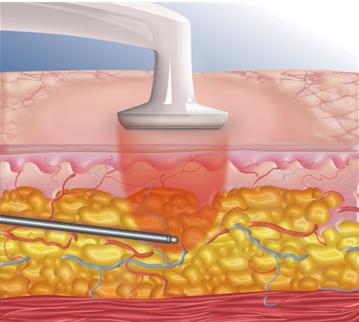
The new technique using radiofrequency assisted liposucion (RFAL) from Invasix is based on bipolar radiofrequency energy which is applied to the subcutaneous adipose tissue and subdermal skin surface.

Preliminary clinical trials, histologic biopsies of the treated tissue and thermal monitoring demonstrate a rapid liquefaction of the adipose cells, coagulation of surcutaneous blood vessels and uniform sustained heating of tissue.

The dramatic rise in liposuction procedures, the aging “baby boomer” population, with decreasing skin tone and advanced laxity are seeking new body contour procedures.

The traditional tumescent, suction-assisted liposuction (SAL) is a mechanical disruption of adipose tissue through the openings in the cannula with induced negative pressure and can be quite traumatic to the patient.

 In seeking to improve the postoperative patient recovery of swelling, bruising, pain and to enhance skin contraction as well as to diminish physician effort, newer generations of energy-assisted liposuction technologies have been developed.

Preliminary studies with the RFAL technique reported faster treatment, improved safety, reduced tissue trauma, liquefaction of adipose tissue, blood vessel coagulation and uniform heating of the skin and subcutaneous tissue as well potential 3D-skin tightening. Due to histologic observation of connective tissue in the treatment area there is a significant change in its structure with coagulation of the deep, dermal collagen. After treating the subcutaneous fibrous and dermal matrix with RFAL the results are impressive in 3D-soft tissue contraction and contours.

Dr. Bratani has no disclosures and interests with Invasix Ltd.

Botox Training MD: Online Botox & Filler Injection Training Course

Getting started with Botox and filler injections through Botox Training MD, a comprehensive online video training course.

Botox Training MD is an online course for clinicians that teaches you everything you need to know to begin offering Botox and filler injections inside your medical practice. It's exactly the same course and content that is taught in Dr. Marc Sheiner's two day course but comes packed with extra information and bonuses. Best of all, better than trying to remember everything you saw and learned during an in-person course, this course is taught via video and delivered online so you can review each module as many times as you want or need to.

Oh, and by the way, you'll save more than $1,400 off of the two day course tuition.

Botox Training Online Video Course

Botox Training MD Membership is for clinicians who…

  • want to add an additional high-profit revenue stream to their practice
  • want access to the highest quality training and learn the secrets of successful experts
  • want to avoid the costly mistakes that all new cosmetic practices make
  • want to know how to start, manage, and grow their new business
  • want to have 24/7/365 access or don't have local access to training
  • are done thinking about going big and are ready to take action!

Here's a welcome message from Marc Scheiner MD, the Botox Training MD online course instructor.

We’re here to help you start learning how you can add Botox and fillers to your practice. There are a lot of tabs, options and videos inside of the coursebut there’s no need to to feel overwhelmed.

Botox Training MD Video Modules: This is where you'll probably want to start. You’ll want to watch these videos in order since they build on each other and we often refer to previous modules. These videos will walk you, step-by-step, through the individual treatments.

  • Module 1: Introduction to Botox & Fillers
  • Module 2: Infra-orbital & Mental Nerve Blocks
  • Module 3: Lip Augmentation, Nasolabial Folds & Peri-Orbital Rejuvenation
  • Module 4: Glabellar Frown Lines
  • Module 5: Periorbital Rhytids (Crows Feet)
  • Module 6: Forehead & Frown Lines
  • Module 7: Liquid Face Lift (Cheek & Jaw Augmentation)
  • Module 8: Marionette Lines & Fillers
  • Module 9: Axillary Hyperhydrosis
  • Module 10: Advanced Botox Techniques (Lower Face, Platysmal Bands, Depressor Anguli Oris & Browlift)
  • Module 11: Advanced Dermal Filler Techniques

Here are two very short excerpts from Botox Training MD's online video training modules from module 5 on using Botox for periorbital rhytids (crows feet) and another excerpt from module 11 on advanced filler techniques.

Module 5: Periorbital Rhytids (Crows Feet)

Illustrated PDF Treatment Guides detailing exactly how each treatment is performed,  how it can be modified for best results, and how to avoid complications.

Resource Guides show you where to find the best deals on products and services to grow your practice without breaking the bank, from managing your legal structure to adding marketing resources.

Consent & Follow-up Forms: Use the same forms that I use for my own patients! Informed consent, follow-up, treatment records and more. Best of all, they’re delivered as Word documents so you’ll be able to modify them with your own logo, address and any other information you may want.

Discover the secrets that only the real insiders know. Learn from physician experts that have been performing Botox and dermal fillers for years. These experts take you inside and share their secrets with you. What works. What doesn’t. What to look for and what to avoid. You’ll have insider information that you can’t get anywhere else on marketing, consultations, staff training, up-selling, pricing and every other aspect of cosmetic medicine.

Bonus Courses, Guides, Special Offers and Resources.

Cosmetic services are unlike traditional medical services and demand an understanding of new techniques as well as getting a handle on marketing and advertising. Our free bonuses will teach you how to sell without being ‘salesy’ or turning clients off, how successful physicians are marketing these treatments, and you'll be able to access some special offers that will save you money on products and services that you'll actually use.

NOTICE: This course is offered exclusively to physicians and clinicians who are licensed to perform these treatments in their geographic location.

Read More

The New Larger 5 ML Latisse, Is It Worth It?

Is offering Allergan's new 5 mL Latisse size worth the extra expense for your patients?

Allergan launched on August 1, 2012, a larger 5 mL bottle of Latisse in the USA. The original sized bottle is 3 mL.  

Latisse (bimatoprost ophthalmic solution) is a FDA approved drug to treat inadequate and aging eyelashes. Approved in December 2008, over 3 million kits have been sold with approximately 500,000 users. It is estimated that 1 Latisse kit is sold every 30 seconds.

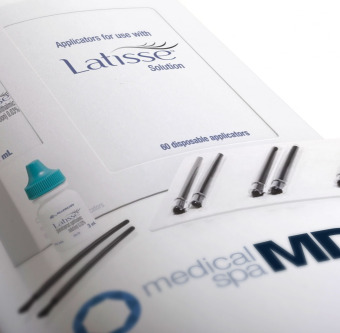
The new 5 mL Latisse comes with 140 brushes for 10 weeks of manufacturer suggested usage, as opposed to the 3 mL version which comes with 60 brushes for about 4 weeks of manufacturer suggested usage. At this point, there is a choice to puchase 5ml or 3ml bottles of Latisse. The suggested retail for physicians to sell at their offices for a 5ml bottle of Latisse is $179 versus $120 for a 3ml bottle. But, it's not just the price and volume of Latisse that has changed.

Read More

Add Allergan's Brilliant Distinctions Program To Your Website's Social Media Buttons

What is the Allergan Brilliant Distinctions Program?

Brilliant Distinctions (BD) is a frequent user program by Allergan for their products of Botox, Juvederm, Latisse and their skin care line. This program gives the patients coupons and rebates. Many practices in the US who inject Botox have the opportunity to join this program. Your Botox/Allergan representative would have more information. In my location, Brilliant Distinctions is well utilized.

New Patients look for Brilliant Distinctions

I have also found that when experienced Botox and Juvederm patients move to my area, they sometimes come armed with Brilliant Distinction discounts which they would like to use. They have called my office asking whether we take Brilliant Distinctions  These patients usually come from different states, and the transition process is painless. We just need their name, zip code, and birthdate. With that information, the patients can use their points and earn new ones at our practice. With any patients who have somehow created multiple accounts, a quick call to the toll free hotline provided by Brilliant Distinctions usually solves the problem.

Creation of the Brilliant Distinctions Button 

I thought it would be useful to create a button that goes along with some of our social media buttons. I presented the idea to Allergan, and they actually helped me create some of their logos that matched the size of frequently used social media "buttons." By buttons, I mean those icon or logos that represent Facebook, Twitter, YouTube, etc. I have had links from my website before to Brilliant Distinctions, but they were big clunky pictures, and I've never matched it up on the page with the Facebook or Twitter logos. I asked Allergan about the idea and they sent me basic BD logos to work with. I spent some time trying to make these logos match, and I've shown them to Allergan.  Allergan has a section on their website for physicians which has logos to use on their websites, but when I contacted them, they didn't have ones of this design. I thought I'd share these logos with you so you can put them on your websites yourself or have your trusty webmaster do it if you like the idea.

Please feel free to copy the Brilliant Distinctions Buttons (ie. Right click/save-as). 

Allergan Brilliant Distinctions Program

Allergan Brilliant Distinctions ProgramAllergan Brilliant Distinctions Program


I've seen many beautiful websites out there with beautiful social media buttons. Now you can also add a matching BD logo to the collection.

I made a website displaying the logos that Allergan and I tweaked to match most common social media buttons which are already used on many plastic surgery, dermatology, and aesthetic websites.